

The sports betting industry faces a critical decision in 2025: allocating campaign budgets between Digital Out-of-Home (DOOH) advertising and traditional stadium perimeter placements. Both formats offer distinct advantages for reaching high-intent audiences, but understanding their respective ROI profiles determines optimal #Strategy deployment for #Sports marketing campaigns.
Recent industry analysis reveals that sports betting operators are experiencing unprecedented growth in advertising spend, making budget allocation decisions increasingly consequential for long-term market positioning. The choice between DOOH and stadium perimeter advertising represents more than a tactical consideration: it fundamentally shapes brand reach, audience engagement, and measurable campaign outcomes.
Digital Out-of-Home Advertising: Precision and Flexibility
Core Performance Metrics
DOOH campaigns demonstrate exceptional efficiency in sports betting verticals, with industry data indicating CPMs as low as $5.40 when deployed strategically across major metropolitan markets. A comprehensive $6.5 million DOOH investment can generate over 1 billion impressions, achieving average reach of 84% and frequency of 9.5 across targeted demographics.
The format's strength lies in programmatic capabilities that enable real-time content optimization. Sports betting operators can dynamically adjust messaging based on game developments, odds fluctuations, and promotional triggers: capabilities that traditional stadium advertising cannot match.
Audience Engagement and Response
Research data shows 54% of adults in cities exceeding 1 million population notice OOH advertisements for sports betting platforms. More significantly, 62% of exposed audiences engage meaningfully with the content, demonstrating behavior ranging from word-of-mouth sharing to direct website visits.
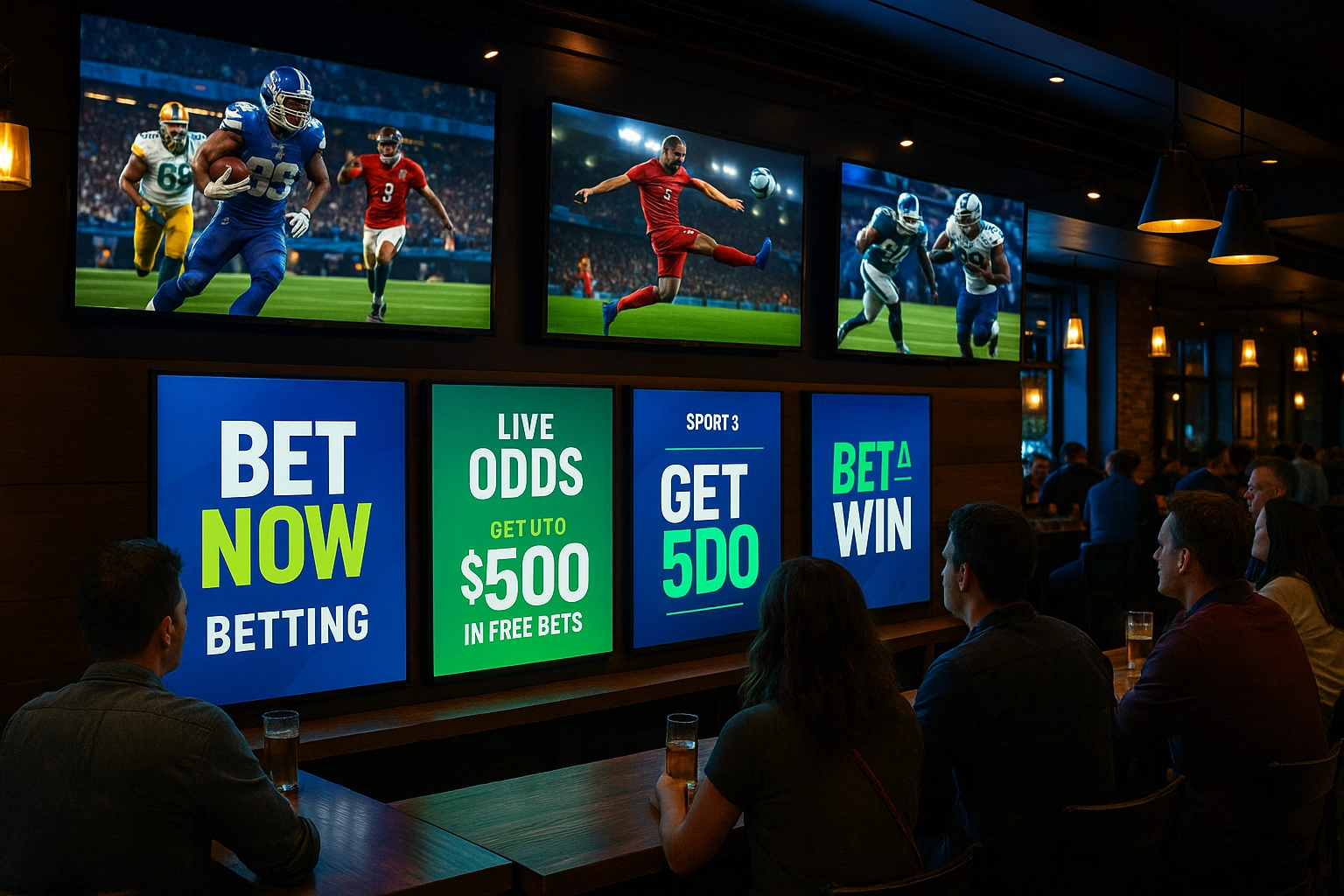
This engagement profile indicates DOOH's effectiveness in driving both awareness and action within the sports betting customer acquisition funnel. The format's strategic placement in sports bars, entertainment districts, and transit hubs captures audiences in contextually relevant environments where betting consideration naturally occurs.
Targeting and Attribution Capabilities
DOOH platforms offer sophisticated audience targeting through location-based data integration and device ID tracking. Campaigns can layer demographic, behavioral, and contextual targeting parameters to reach specific audience segments during optimal engagement windows.
Attribution measurement capabilities enable precise ROI calculation through exposed device tracking, website visit correlation, and conversion attribution models. This data transparency allows for continuous campaign optimization and budget reallocation based on performance metrics rather than estimated reach figures.
Stadium Perimeter Advertising: Context and Emotional Engagement
Exclusive Access to Peak Moments
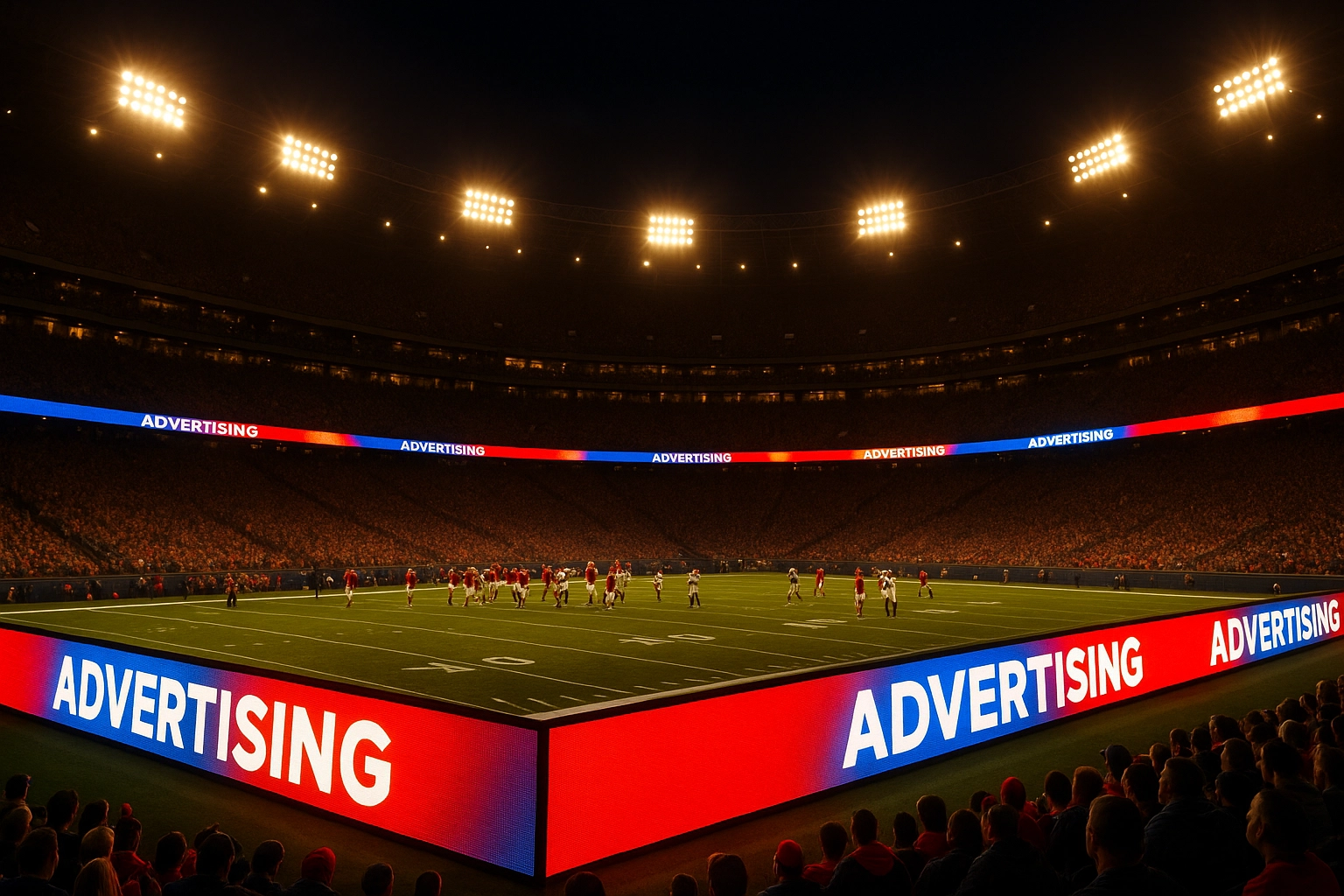
Stadium perimeter placements provide unparalleled access to audiences during peak emotional engagement periods. Live sporting events generate heightened attention states that translate to improved brand recall and consideration metrics compared to passive advertising exposure.
The dual-audience benefit: reaching both in-venue attendees and broadcast viewers simultaneously: amplifies impression value beyond traditional measurement models. Premium sporting events can deliver broadcast audiences exceeding 10 million viewers while engaging thousands of in-stadium participants.
Brand Association and Credibility
Stadium advertising creates implicit brand endorsements through association with premium sporting properties. This credibility transfer proves particularly valuable for sports betting operators seeking to establish legitimacy and trust within competitive markets.
Long-term partnerships with major sporting venues and leagues provide consistent brand exposure across multiple events, building cumulative awareness that extends beyond individual campaign periods.
Limitations and Considerations
Stadium perimeter advertising requires advance booking and long-term commitments that limit campaign flexibility. Content cannot adapt to real-time developments, and premium placement costs increase significantly for marquee events and prime visibility positions.
Measurement capabilities rely primarily on broadcast ratings and estimated in-venue exposure, providing less granular attribution data compared to digital advertising formats.
Comparative ROI Analysis
| Performance Factor | DOOH | Stadium Perimeter |
|---|---|---|
| Cost Efficiency | $5.40 CPM achievable | $15-50+ CPM for premium events |
| Targeting Precision | Device-level targeting available | Broad demographic alignment |
| Campaign Flexibility | Real-time content updates | Static creative requirements |
| Attribution Accuracy | Device tracking and conversion data | Estimated reach and brand lift |
| Deployment Speed | 24-48 hours possible | 30-90 days advance booking |
| Creative Optimization | A/B testing and dynamic content | Limited creative variation |
Quantified Performance Comparisons
DOOH campaigns consistently demonstrate superior cost efficiency metrics, with documented case studies showing 3-5x lower acquisition costs compared to stadium-based placements. The programmatic nature of DOOH enables budget optimization based on real-time performance data rather than predetermined allocation models.
Stadium advertising excels in brand lift metrics, particularly for awareness and consideration indicators. Premium sporting event placements can generate 15-25% increases in aided brand awareness within target demographics, though these gains require larger budget commitments to achieve significant scale.
Strategic Budget Allocation Framework
Market Entry Strategy
New market entry scenarios favor DOOH deployment due to lower minimum investment requirements and faster campaign deployment capabilities. Operators can establish market presence within weeks rather than months while maintaining budget flexibility for optimization based on initial performance data.

DOOH's geographic targeting capabilities enable precise market expansion testing, allowing operators to evaluate market viability before committing to premium stadium partnerships.
Brand Building vs. Conversion Optimization
Brand Awareness Objectives: DOOH delivers superior reach efficiency for broad awareness campaigns, achieving 84% reach across target markets with optimized frequency distribution.
Conversion-Focused Campaigns: Stadium perimeter advertising justifies premium costs when targeting specific sports audiences during high-engagement moments, particularly for operators with established brand recognition seeking to drive immediate action.
Seasonal and Event-Driven Considerations
Regular Season Strategy: DOOH provides consistent brand presence across multiple touchpoints, building cumulative awareness throughout extended sports seasons.
Major Event Amplification: Stadium perimeter placements during championship games, playoffs, and marquee matchups deliver concentrated impact that can justify premium pricing for established operators with sufficient budget allocation.
Implementation Recommendations for 2025
Hybrid Campaign Architecture
Optimal ROI achievement requires strategic integration of both formats within unified campaign frameworks. Recommended allocation structures distribute 70% of OOH budget toward DOOH for consistent reach and customer acquisition, with 30% allocated to premium stadium placements during high-impact sporting events.
This approach balances cost efficiency with strategic brand building while maintaining campaign flexibility for real-time optimization based on performance data.
Technology Integration and Measurement
Successful campaigns implement unified attribution models that track audience exposure across both DOOH and stadium perimeter touchpoints. Cross-platform measurement enables accurate ROI calculation and informed budget reallocation decisions based on comprehensive performance analysis.
Advanced attribution platforms can correlate stadium advertising exposure with subsequent DOOH engagement, creating closed-loop measurement systems that optimize overall campaign effectiveness rather than individual channel performance.
Partnership Strategy and Vendor Selection
DOOH success requires partnerships with programmatic platforms offering sports betting vertical expertise and compliance capabilities. Stadium partnerships demand long-term relationship building with venue operators and league properties to secure premium placement opportunities.
Dan Kost, CEO of OOH Sports, emphasizes the importance of integrated #AdvertisingAndMarketing approaches that leverage both formats strategically rather than viewing them as competing alternatives. The company's experience with programmatic DOOH campaigns demonstrates the effectiveness of data-driven optimization in achieving superior campaign outcomes.
The decision between DOOH and stadium perimeter advertising ultimately depends on specific campaign objectives, target market characteristics, and budget allocation flexibility. DOOH generally provides more predictable ROI metrics and campaign control, while stadium advertising offers unique brand building opportunities during peak audience engagement periods.
For strategic guidance on optimizing your sports betting advertising approach, contact OOH Sports at +1 (970) 703-0102 to discuss customized campaign development and implementation strategies.
What's your experience with sports betting advertising campaigns? Share your insights on #DigitalMarketing effectiveness and #Innovation in sports advertising on LinkedIn, Facebook, Instagram, and X.
#Motivation #Branding #Strategy #Marketing #AdvertisingAndMarketing #digitalmarketing #Innovation #Sports