
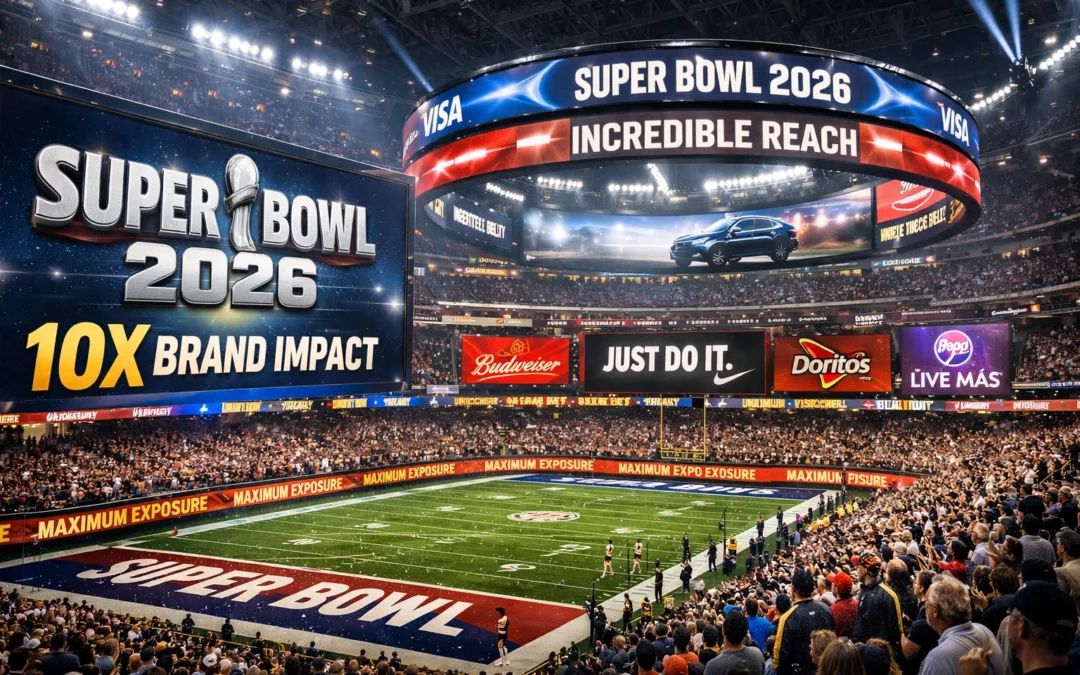
Super Bowl 2026 is approaching, and advertisers face a familiar question: spend $8 million on a 30-second TV spot that airs once, or invest that same budget in a strategy that captures audiences throughout the entire event window?
After four decades of leadership in sports advertising, the data is clear. Single-placement strategies deliver fragmented attention. Multi-format out-of-home campaigns that span from airport arrivals to stadium floors create sustained brand presence that multiplies impact by 10X or more.
The Problem with Single-Placement Thinking
Television advertisers paying approximately $8 million for 30 seconds during Super Bowl LX face significant challenges beyond cost. Viewers split attention between multiple screens, placing bets, scrolling social media, and texting during commercial breaks. The brand message competes for seconds of fractured attention in an environment designed for distraction.
Traditional billboard campaigns fare better but still limit reach to a single touchpoint along the fan journey. A driver passing one billboard on the highway to the stadium receives one impression. That same advertiser could capture that driver at the airport, in their hotel lobby, on transit shelters walking to restaurants, and on digital screens inside the venue.

The floor-to-billboard strategy eliminates this limitation entirely. Rather than competing for attention at isolated moments, brands become omnipresent throughout the complete Super Bowl experience.
How Venue-Wide Coverage Compounds Brand Recall
The strategy begins with audience movement analysis. Where do premium ticket holders congregate? Which transportation routes experience peak traffic on game day? What locations capture both attendees and locals throughout the multi-week event window?
Strategic placements then layer across this mapped journey:
- Airport domination captures arriving fans before they reach hotels
- Hotel lobby floor graphics create impossible-to-ignore brand moments during check-in
- Transit shelter networks reach pedestrians exploring the host city
- Digital billboards near the stadium deliver dynamic messaging that shifts throughout the day
- Street-level kiosks provide detailed information at decision-making moments
- Convention center placements engage corporate hospitality audiences
This coordinated approach ensures repeated exposures across multiple days and contexts. A fan encounters the brand six to eight times before entering the stadium, each placement reinforcing the previous one. The cumulative effect on brand recall substantially exceeds isolated advertising moments.
See the Strategy in Action
https://www.youtube.com/watch?v=l6J-0zileKE
The above showcase demonstrates how integrated out-of-home placements work together to create environmental dominance. Notice how formats complement each other rather than competing for the same attention.

Cost Efficiency Through Extended Timeline Visibility
A comprehensive Super Bowl advertising campaign including national broadcast media and production typically ranges from $12.5 million to $23 million or more. That investment captures audiences for 30 seconds during a single commercial break.
By contrast, a four-week billboard placement spanning from championship matchup confirmation through post-game delivers sustained visibility without the attention fragmentation challenges that plague broadcast advertising. Digital out-of-home placements can shift messaging throughout the day: breakfast offerings at 8 AM, game-time specials at noon, post-game venues by evening. The same physical space delivers multiple strategic messages across different audience segments.
Regional market alternatives provide additional cost advantages. Major markets offer 30-second spots at $300,000 to $600,000 versus $8 million for national broadcast. Layered OOH strategies in these markets capture not just game-day attendees but also hundreds of thousands of locals passing those locations daily throughout the Super Bowl period.
The efficiency calculation is straightforward. One $8 million TV spot delivers 30 seconds of fragmented attention. That same $8 million invested in coordinated OOH placements delivers thousands of impressions per day across multiple weeks, each exposure occurring in physical environments where audiences cannot scroll past or skip the message.
Integration Amplifies Digital Channel Performance
The most effective campaigns extend impact beyond physical placements by functioning as anchors for multi-channel strategies. QR codes on transit ads drive immediate mobile engagement. Branded hashtags on digital billboards encourage social sharing. Location-based mobile campaigns retarget audiences who pass specific OOH placements.

One execution example: a digital billboard near the stadium features a live social media feed of fan photos using the branded hashtag. This simultaneously pairs with an Instagram campaign encouraging fans to post selfies with OOH placements for contest entry. The strategy transforms out-of-home advertising from one-way broadcasting into participatory brand experiences.
Influencer-driven content and user-generated content strategies have demonstrated up to 70% cost-per-landing-page-click efficiency on Meta platforms. Multi-channel integration substantially enhances the value of OOH investments by converting passive impressions into active engagement and measurable digital actions.
Measurement Beyond Impressions
Traditional OOH measurement focused on traffic counts and estimated impressions. Modern floor-to-billboard strategies employ device ID exposure tracking, foot traffic attribution, and brand lift studies to quantify impact with precision comparable to digital advertising.
Measurement partners track mobile devices that pass OOH placements, enabling retargeting campaigns and conversion attribution. Brands can identify which placements drove the highest engagement, which formats generated the most foot traffic to specific locations, and how OOH exposure influenced downstream digital behavior.
Brand lift studies quantify awareness increases, message recall improvements, and purchase consideration shifts among exposed audiences versus control groups. The data demonstrates that layered OOH strategies do not simply increase impressions, they drive measurable changes in brand perception and consumer behavior.
Strategic Implementation for Super Bowl 2026
Brands planning Super Bowl 2026 campaigns should begin with comprehensive audience journey mapping. Identify every physical touchpoint where target audiences will congregate during the multi-week event window. Layer placements across these touchpoints to create sustained presence rather than isolated moments.
Prioritize formats that align with strategic objectives:
- Digital billboards for dynamic messaging that adapts to time of day and audience context
- Floor graphics in high-traffic areas for unavoidable brand moments
- Transit networks to reach mobile audiences exploring the host city
- Street-level placements for detailed information and calls to action
Integrate physical placements with digital channels through QR codes, branded hashtags, and location-based mobile retargeting. Measure performance through device ID exposure tracking and brand lift studies to quantify impact and optimize placements in real time.
The floor-to-billboard strategy for Super Bowl 2026 represents 40 years of evolution in sports advertising. Single placements deliver single impressions. Venue-wide coverage delivers sustained brand presence that compounds throughout the fan journey, creating impact that exceeds isolated advertising moments by an order of magnitude.
Brands investing in coordinated multi-format strategies capture audiences when attention is highest and fragmentation is lowest, in physical environments where the message cannot be skipped, scrolled past, or ignored. That advantage translates directly to measurable increases in awareness, recall, and preference that persist long after the final whistle.