
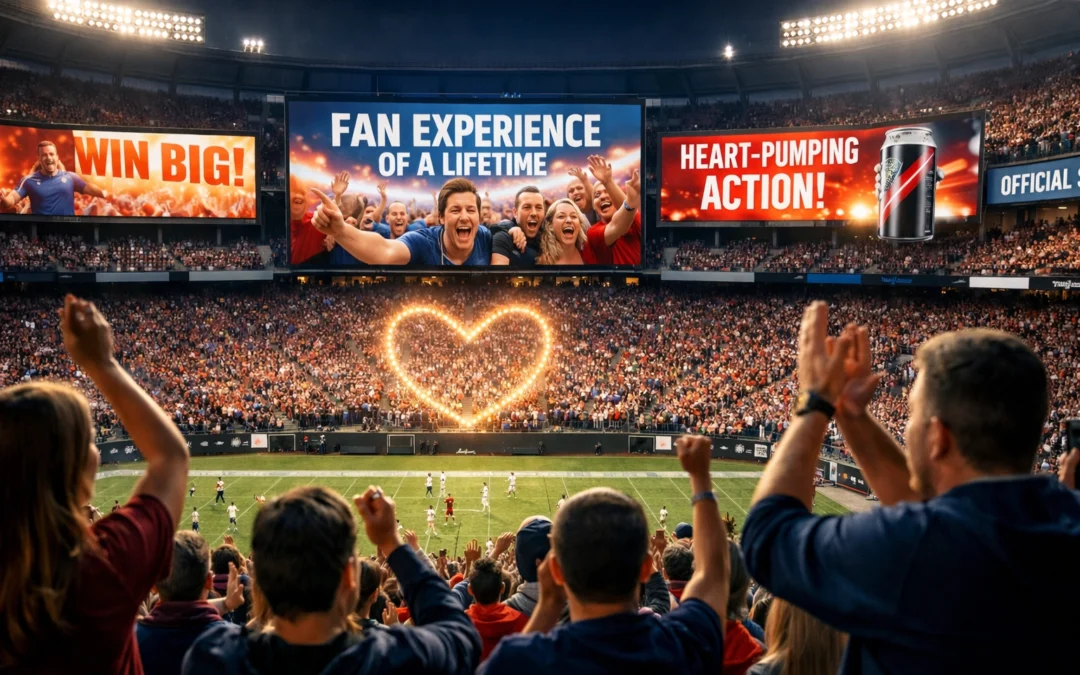
Social media metrics tell one story. Stadium advertisers know another. While brands obsess over impressions, shares, and engagement rates, a different type of marketing operates in real-time, creating moments that live in memory long after the final whistle. The secret lies not in reach or frequency, but in something social platforms fundamentally cannot replicate: shared, sensory experience.
The Real-Time Experience Advantage
Stadium advertising operates in a dimension that digital channels struggle to match. When thousands of fans experience the same moment simultaneously, brands tap into collective emotion that transforms passive viewing into active participation. This is not about individual reactions captured after the fact. This is about synchronized moments where every person participates together, creating immediate unity.

Coordinated light shows deliver full-scale participation with high emotional impact. Consider the approach used by the Golden State Warriors, where sound-reactive technology transforms crowd noise into visual feedback across the arena. Fans receive instant confirmation of their participation. They become part of the show rather than observers of it. The brand message embedded in these moments carries emotional weight that no social media post can manufacture.
This creates a fundamental shift in how audiences process advertising. Social media requires users to actively choose engagement. Stadium environments pull audiences into immersive brand experiences through collective participation. The difference is measurable in retention, recall, and long-term brand affinity.
Sensory Engagement That Data Cannot Capture
Sound operates as a critical loyalty driver that exists outside traditional metrics. While social platforms track what fans choose to broadcast, stadium environments measure what fans actually feel. PSV Eindhoven discovered this through acoustic mapping technology, using sound cameras to capture emotional truth that never appears in posts or comments.
Acoustic energy conveys authenticity. Chants, cheers, and crowd roar represent unfiltered emotional response. When brands align with these moments through perimeter advertising, LED displays, or in-stadium activations, they associate with genuine feeling rather than curated content. This sensory layer adds depth that digital engagement lacks.
The visual component extends beyond simple display advertising. Stadium perimeter boards operate at eye level during the most emotionally charged moments of play. Unlike scrolling feeds where attention is fragmented, these displays capture focused attention during peak engagement. Fans cannot swipe away. They cannot scroll past. The message integrates into the live experience, creating natural brand recall without interruption.

Temperature, sound volume, crowd movement, even the smell of stadium concessions contribute to memory formation. Brands that activate in these environments benefit from multi-sensory encoding that strengthens neural pathways. Social media operates primarily through visual and occasional audio channels. Stadium advertising engages the full sensory spectrum, creating stronger, longer-lasting brand associations.
Physical Proximity Transforms Spectators Into Participants
Access creates investment. When Formula 1 introduced Pit Lane Walk experiences, thousands of fans gained proximity to teams and machinery previously reserved for insiders. The resulting content, clips, and photos represented surface-level value. The deeper impact came from emotional transformation. Fans walked away feeling they had been inside the sport rather than merely spectating.
This principle applies directly to stadium perimeter advertising and branded activations. Interactive fan zones, pre-game branded spaces, and theme nights convert mundane waiting periods into high-traffic engagement opportunities. Every fan becomes part of the activation, not through forced participation but through environmental immersion.
Physical presence in branded spaces creates implicit endorsement. When fans photograph themselves in front of sponsor logos, share images from branded lounges, or participate in interactive displays, they self-identify with the brand. This is fundamentally different from paid influencer content or social media advertising. The endorsement is organic, rooted in real experience rather than transactional promotion.

Stadium advertising also benefits from contextual relevance that social platforms struggle to achieve at scale. A beverage brand displayed during a hot afternoon match carries immediate utility. A financial services company positioned during playoff intensity associates with high-stakes decision making. Timing and context merge in ways that programmatic targeting attempts to replicate but cannot fully capture.
Environmental Design and The Power of Idle Time
Breaks in action represent untapped engagement opportunities. Where social media fights for attention during distracted scrolling, stadium advertisers own focused eyeballs during natural pauses. Lighting sequences during timeouts become energy builders. Sponsored replays on massive screens create branded moments that fans record organically. These are not interruptions. They are enhancements to the experience.
Environmental design transforms every surface into potential engagement. From entrance tunnels featuring sponsor graphics to branded seating sections and digital ribbons, the stadium becomes a three-dimensional brand canvas. Fans move through these spaces over hours, not seconds. Repeated exposure occurs naturally, without the banner blindness that plagues digital advertising.
Theme nights exemplify this strategy. When teams host specialty events, brands integrate into the narrative rather than interrupting it. A financial literacy night sponsored by a banking partner, a sustainability theme supported by an eco-focused brand, these activations align brand values with shared experiences. The association feels earned rather than purchased.
The pre-game period alone offers extended engagement windows. Fans arrive early, explore, socialize, and consume content. Brands that activate during this time capture attention when audiences are relaxed and receptive. Digital channels compete for micro-moments of attention. Stadium advertising owns extended dwell time with captive, emotionally primed audiences.
Strategic Implications for Marketing Leaders
For creative directors and CMOs evaluating channel mix, stadium perimeter advertising offers distinct advantages that complement digital strategies. The medium delivers guaranteed viewership during peak emotional states. Brand recall rates in stadium environments consistently outperform digital benchmarks because memory formation ties to experiential context.

The measurement challenge that once limited out-of-home advertising has evolved. Modern stadium advertising incorporates device ID tracking, geofencing, and post-exposure behavioral analysis. Brands can now measure foot traffic lifts, online search increases, and purchase attribution tied directly to stadium exposures. The gap between traditional and digital measurement continues to narrow.
Budget allocation becomes strategic rather than tactical. Stadium advertising requires longer commitment periods than digital campaigns, but this creates consistency that builds brand equity. While social media thrives on rapid iteration and short-term optimization, stadium presence compounds over seasons. Fans develop familiarity that translates to preference and loyalty.
The integration opportunity matters most for sophisticated marketers. Stadium advertising does not replace social media. It enhances it. Fans photographing branded moments create user-generated content. Stadium activations generate social buzz. The physical experience seeds digital conversation. Smart brands use stadium presence as the hub of integrated campaigns, with social amplification as the spoke.
The Emotional Equity Difference
Ultimately, stadium advertisers understand a truth that data-driven marketers sometimes miss. Not everything that matters can be measured in real-time. Emotional equity builds through repeated, positive associations in meaningful contexts. Stadiums provide these contexts naturally. The tension of close games, the joy of victory, the camaraderie of shared fandom, these emotional states create ideal conditions for brand building.
Social media captures reactions. Stadium advertising creates them. Social platforms document moments. Stadium environments generate them. The difference is foundational. Brands that recognize this distinction gain access to engagement that operates on a different level entirely.
For marketing leaders seeking breakthrough brand building, the question is not whether stadium advertising outperforms social media. The question is how to integrate both effectively, using the unique strengths of each channel to create cohesive brand experiences. The advertisers who have figured this out are not louder than their competitors. They are simply present in the moments that matter most, building emotional connections that last far beyond the final score.