
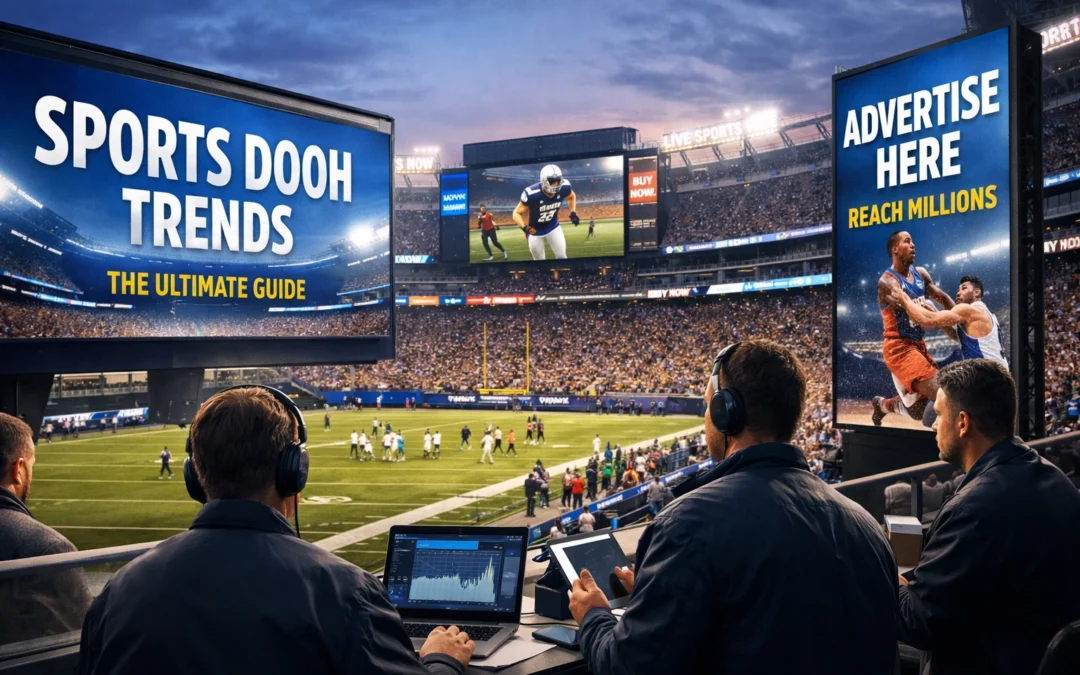

The digital out-of-home advertising landscape is evolving at breakneck speed, and nowhere is this transformation more evident than in sports advertising. Media buyers who want to maximize campaign performance need to understand the shifts happening right now in programmatic DOOH and how these trends directly impact results.
This guide breaks down the most critical trends shaping sports DOOH advertising and provides actionable insights for media buyers looking to stay competitive.
Real-Time Creative Optimization Changes Everything
Static creative is officially outdated. Dynamic Creative Optimization (DCO) has transformed sports advertising from fixed messaging into responsive storytelling that adapts to live moments.

The technology enables advertisements to automatically update based on multiple triggers:
- Live game moments and score changes
- Weather conditions affecting gameplay or viewer experience
- Social media sentiment and trending topics
- Foot traffic patterns around venues
- Time of day and event phases
When a game goes into overtime, creative can automatically shift to capture extended audience engagement. During halftime, messaging pivots from product-focused content to entertainment-oriented themes. If an underdog team pulls ahead unexpectedly, campaigns can acknowledge the moment within minutes.
This level of responsiveness creates relevance that static creative simply cannot match. Audiences notice when advertising reflects the live context they are experiencing, and that attention translates directly to improved campaign performance.
Precision Targeting Replaces Broad Audience Buying
The days of selecting screens based solely on location are ending. Addressable advertising powered by location intelligence and behavioral data allows media buyers to reach audiences based on actual movement patterns and demonstrated interests.
Geofencing technology identifies high-intent zones where concentrated fan activity occurs:
- Airport corridors capturing traveling fans
- Stadium perimeters during event windows
- Fan zones and entertainment districts
- Transit hubs connecting venues to city centers
- High-traffic retail areas along fan routes
Rather than buying impressions on screens near a stadium and hoping the right people see them, media buyers can now activate inventory when specific audience segments are present. Device data reveals household-level targeting opportunities and enables cross-device measurement connecting DOOH exposure to downstream actions.
This precision reduces wasted impressions and increases return on ad spend by ensuring messages reach audiences when they are most receptive.
Multi-Moment Activation Windows Maximize Reach and Efficiency
Successful sports campaigns require planning across three distinct phases, each offering unique advantages.
Before Events: Premium inventory around major sporting events commands higher rates as competition intensifies. Media buyers can lock in guaranteed placements ahead of time while leveraging programmatic DOOH for flexibility closer to event dates. Pre-game periods capture audiences in planning and anticipation mode, making them receptive to brand messaging.
During Events: Concentration around stadiums, fan zones, and entertainment districts reaches audiences at peak engagement. Context-aware creative capitalizes on the live atmosphere and emotional intensity surrounding games. This window delivers the highest attention levels but also faces the most competition for inventory.

After Events: Post-game periods represent a substantial opportunity often overlooked by advertisers. Commuter corridors, transit hubs, and entertainment districts maintain high traffic as audiences disperse. Refreshing messaging to guide audiences toward next actions, whether visiting a retail location or engaging with digital content, extends campaign impact beyond the final whistle.
Expanding activation windows beyond game day reduces per-impression costs by 40-60% while increasing total reach by 35%. The strategic distribution of budget across all three phases optimizes both efficiency and effectiveness.
Synchronized Multi-Format Campaigns Amplify Impact
Treating each DOOH placement as an isolated touchpoint leaves significant performance on the table. The most effective campaigns orchestrate coordination across multiple formats to create narrative progression.
A synchronized approach might include:
- Digital billboards along major highways establishing initial brand presence
- Transit advertising reinforcing messaging during commutes
- Airport displays capturing traveling fans
- Street-level installations providing final touchpoints before venue entry
- Stadium perimeter screens delivering peak-context messaging
When audiences encounter consistent visual language and evolving storytelling across multiple environments during their journey, brand recall increases exponentially. Each placement builds on previous exposures rather than starting from zero.
This coordination extends beyond physical format to timing, creative sequencing, and message evolution. The result is a cohesive experience that guides audiences through awareness, consideration, and action.
Context Outperforms Visual Dominance
Short-format, context-driven messaging consistently outperforms traditional static visuals in sports environments. Audiences moving through transit corridors, entertainment districts, and venue perimeters are in motion, both physically and mentally. They are not stopping to study detailed creative.

Passive interaction has become the standard expectation. Advertisements that serve the immediate context rather than interrupt it achieve higher engagement rates. This means:
- Bold, simple visuals that register instantly
- Messaging that acknowledges the current moment or environment
- Calls-to-action that align with immediate opportunity
- Integration elements like QR codes or mobile prompts that enhance rather than distract
The shift from attention-demanding creative to context-serving messaging reflects broader changes in how audiences consume information in high-activity environments.
Cross-Channel Measurement Proves Real-World Impact
Impression counts no longer satisfy performance expectations. Media buyers must implement measurement infrastructure that connects DOOH exposure to meaningful outcomes.
Integration of mobile location data reveals how venue-adjacent placements impact actual behavior. Did quick-service restaurants see increased foot traffic after evening matches? Did retail locations along fan routes capture additional visitors? Which placement combinations drove the highest conversion rates?
Cross-channel measurement connects exposure across devices and environments to consumer actions:
- Foot traffic attribution comparing exposed versus unexposed audiences
- Cross-device tracking revealing downstream digital engagement
- Sales lift analysis tying campaign periods to revenue changes
- Brand lift studies quantifying awareness and perception shifts
This visibility enables proactive optimization during campaigns rather than post-event analysis. Media buyers can identify underperforming inventory, adjust creative based on real response data, and shift budget toward highest-performing placements in real time.
Category-Specific Performance Patterns Inform Strategy
Sports and Recreation brands consistently over-index in sports advertising benchmarks, which is logical given audience alignment. However, Automotive campaigns also demonstrate exceptional performance in sports contexts.
Sports-adjacent campaigns with cultural relevance and high visibility thresholds accelerate performance sharply. City-scale moments amplified through digital installations create outsized impact compared to standard placements.
Understanding category-specific performance patterns allows media buyers to set realistic benchmarks and identify opportunities where their clients can outperform category averages. A beverage brand might reference successful case studies like White Claw's programmatic DOOH campaign that drove a 74% lift in purchase consideration, demonstrating what is achievable with proper execution.
Streaming Integration Expands the Playing Field
Streaming-first sports consumption requires addressable strategies across connected TV and streaming platforms alongside traditional DOOH. Attention now fragments across multiple screens and devices simultaneously.
Audiences watch games on mobile devices while commuting, stream on tablets in public spaces, and engage with highlight clips on social platforms. This fragmentation makes omnichannel coordination essential rather than supplementary.
DOOH campaigns must consider how messaging complements streaming experiences. Timing activations around streaming schedules, creating visual consistency across physical and digital screens, and developing measurement frameworks that capture cross-platform exposure become critical components of comprehensive strategies.
The Winning Formula for Media Buyers
Success in sports DOOH requires combining multiple elements into a cohesive approach:
Early Planning: Secure premium inventory before competition intensifies while maintaining programmatic flexibility for optimization.
Dynamic Creative Capabilities: Implement DCO technology that enables real-time responsiveness to live moments and context changes.
Audience-Led Targeting: Leverage behavioral data and location intelligence to activate inventory when specific audiences are present.
Multi-Moment Activation: Distribute budget strategically across pre-game, during-game, and post-game windows to maximize reach and efficiency.
Synchronized Formats: Coordinate messaging across multiple DOOH formats to create narrative progression and reinforce brand presence.
Performance Infrastructure: Deploy measurement systems that connect exposure to real-world outcomes and enable continuous optimization.
The sports DOOH landscape rewards media buyers who move beyond traditional buying approaches and embrace data-driven, dynamic strategies. Those who adapt quickly will capture disproportionate value as the market continues evolving.
Media buyers ready to explore how these trends apply to specific campaigns can learn more about OOH Sports and access additional resources for implementing advanced sports advertising strategies.