
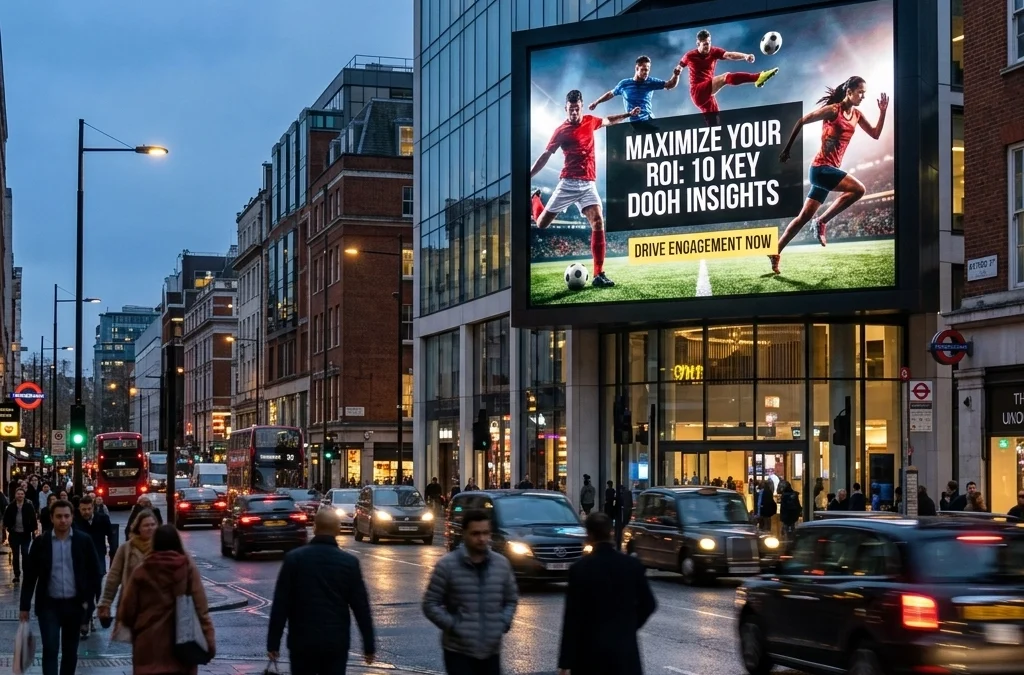
Maximizing return on investment (ROI) is a constant pursuit for marketing professionals and brand managers. In the rapidly evolving landscape of Digital Out-of-Home (DOOH) advertising, the strategies that worked a few years ago are being replaced by data-driven, programmatic, and contextually aware campaigns. As the market for DOOH sports advertising continues to expand, staying ahead of industry trends is essential for anyone looking to capture a meaningful share of consumer attention.
The following insights provide a roadmap for navigating the complexities of the DOOH sector, focusing on how technology and strategic placement can drive better results for your brand.
1. Focus on Mid-Funnel Actions for Measurable Growth
For a long time, out-of-home advertising was viewed primarily as a top-of-funnel awareness tool. While its ability to build brand recognition is undisputed, the industry is shifting toward driving mid-funnel customer journeys. Modern DOOH campaigns are increasingly designed to trigger specific actions, such as opening an app, visiting a website, or navigating to a retail pop-up.
By targeting these mid-funnel behaviors, advertisers can see a more direct correlation between their spend and consumer intent. Instead of just hoping someone remembers a logo, campaigns now encourage immediate engagement. This targeted approach ensures that every impression has the potential to move the needle on measurable business goals.
2. Leverage Real-Time Analytics for Unprecedented Transparency
Transparency has historically been a challenge in outdoor advertising. However, the tide is turning. Recent reports indicate that approximately 75% of advertisers now believe that improved measurability has significantly enhanced their perception of DOOH. This shift is driven by the integration of mobile location data, sensor technology, and artificial intelligence.
These tools allow platforms to estimate audience exposure with high levels of accuracy. Brands no longer have to rely on vague traffic counts. Instead, they can access detailed reports on how many people were in the vicinity of a screen and what their demographic profiles likely were. This level of data-driven insight transforms DOOH from a speculative investment into a accountable media channel.
 )
)
3. Achieve Better Accuracy with Retail and Footfall Analytics
When it comes to retail-focused campaigns, geofenced insights linked to footfall data provide a significant advantage. Studies suggest that these methods offer two to three times the accuracy of traditional outdoor measurement for tracking store visits. By creating a digital perimeter around a screen and a retail location, brands can observe how exposure to an ad leads to a physical visit.
This precision is invaluable for budget allocation. If data shows that certain screens in a specific district are driving more foot traffic to a local storefront, marketers can shift their resources to those high-performing assets in real-time. This feedback loop is a core component of modern marketing strategy.
4. Harness the Power of Programmatic Real-Time Bidding
The rise of programmatic DOOH has revolutionized how inventory is purchased. Rather than signing long-term contracts for specific static locations, advertisers can now use real-time bidding to buy inventory based on live conditions. This includes factors like audience movement, weather patterns, time of day, and even current traffic congestion.
Programmatic platforms allow for high levels of efficiency. For example, a sports drink brand might increase its bid for screens near stadiums only when the temperature rises above 80 degrees or when a high-profile game is about to end. This ensures the message is seen exactly when it is most relevant to the consumer. For a deeper dive into how this compares to traditional methods, explore the comparison between programmatic DOOH and stadium ads.
 )
)
5. Implement Cross-Channel Attribution Models
DOOH does not exist in a vacuum. Its true power is unlocked when it is integrated into an omnichannel campaign. Advertisers are now tracking online and offline actions simultaneously, using footfall attribution alongside website uplift measurement and QR code engagement.
A notable example involved a retail chain that tracked commuters across five major cities. By coordinating their DOOH messaging with mobile retargeting, they achieved a 22% increase in foot traffic and a 29% increase in QR code engagement within just 48 hours. This synergy between digital and physical touchpoints is what drives modern ROI. Successful campaigns, like those seen with White Claw, demonstrate how a lift in purchase consideration is often tied to these multi-layered attribution models.
6. Optimize Campaigns Mid-Flight to Reduce Wasted Spend
One of the greatest benefits of digital infrastructure is agility. Unlike traditional paper billboards that require physical labor to change, DOOH allows for mid-flight optimization. If a creative execution is not resonating, it can be swapped out instantly. If a particular region is overperforming, exposure can be increased there while being dialed back in lower-performing areas.
This flexibility allows brands to react to real-world conditions as they happen. Whether it is a sudden change in the weather or a breaking news event, the ability to pivot ensures that the advertising spend is always working as hard as possible. Agility is no longer a luxury, it is a requirement for maintaining a high ROI.
7. Prioritize Contextual Content Relevance for Higher Impact
Context is king in the world of out-of-home advertising. Research has shown that contextually triggered content can increase brain response by up to 32% compared to generic advertisements. Consumers are much more likely to engage with a message that feels relevant to their current environment and state of mind.
This means matching the message to the moment. In a sports setting, using Sportrons to deliver highlights or live scores alongside a brand message creates a seamless experience for the fan. When the advertisement feels like a value-add to the environment rather than an interruption, the impact on brand recall and sentiment is significantly higher.
 )
)
8. Leverage AI for Audience Segmentation and Bidding
Artificial Intelligence is no longer just a buzzword, it is a functional tool for optimizing DOOH spend. AI-powered platforms can segment audiences in real-time, adjusting bids and creative delivery based on the specific profiles of people passing a screen. This level of personalization allows brands to reach the right people without the need for invasive personal data collection.
By using specialized platforms, such as those highlighted in the StackAdapt DSP spotlight, marketers can automate the complex process of audience targeting. This allows for a more efficient use of the budget, as the AI can identify patterns and opportunities that a human operator might miss.
9. Identify and Target High-ROI Industries
While DOOH can benefit almost any brand, certain sectors see particularly strong results. Industries such as real estate, FMCG (fast-moving consumer goods), e-commerce, and fintech are leading the way. These sectors rely on rapid recall and timely prompts to drive consumer behavior.
For example, FMCG brands often use DOOH to provide a final "nudge" to consumers who are already on their way to a grocery store. This proximity to the point of purchase is a powerful driver of ROI. Similarly, fintech and e-commerce brands use the high visibility of DOOH to build the trust and credibility necessary for consumers to engage with their digital platforms.
10. Adopt a Holistic Systems Approach to ROI
Finally, it is crucial to recognize that ROI in the DOOH space is determined by an entire ecosystem, not just the hardware of the screen. High resolution and brightness are important, but they do not guarantee performance. A successful campaign is built on a foundation of quality location data, audience measurement, share of voice, and attribution discipline.
A systems approach means looking at how the content strategy aligns with the physical environment and the technological capabilities of the platform. By focusing on the realistic chance an audience has to see and interact with a message, brands can move beyond vanity metrics and focus on the data that actually impacts the bottom line.
 )
)
Moving Forward with Data and Strategy
The landscape of DOOH is becoming more sophisticated every day. By focusing on mid-funnel actions, leveraging real-time analytics, and embracing programmatic flexibility, brands can achieve levels of ROI that were previously impossible in the out-of-home category. Whether you are looking to drive store visits or increase brand preference, the key is to let data and context guide your decisions.
For those ready to explore how these insights can be applied to their specific goals, OOH Sports provides the expertise and technology to bridge the gap between traditional advertising and the digital future.

To learn more about how to optimize your next campaign, visit the OOH Sports contact page to start a conversation with the team. Together, the focus can remain on delivering impactful messages that resonate with fans and drive real business results.