
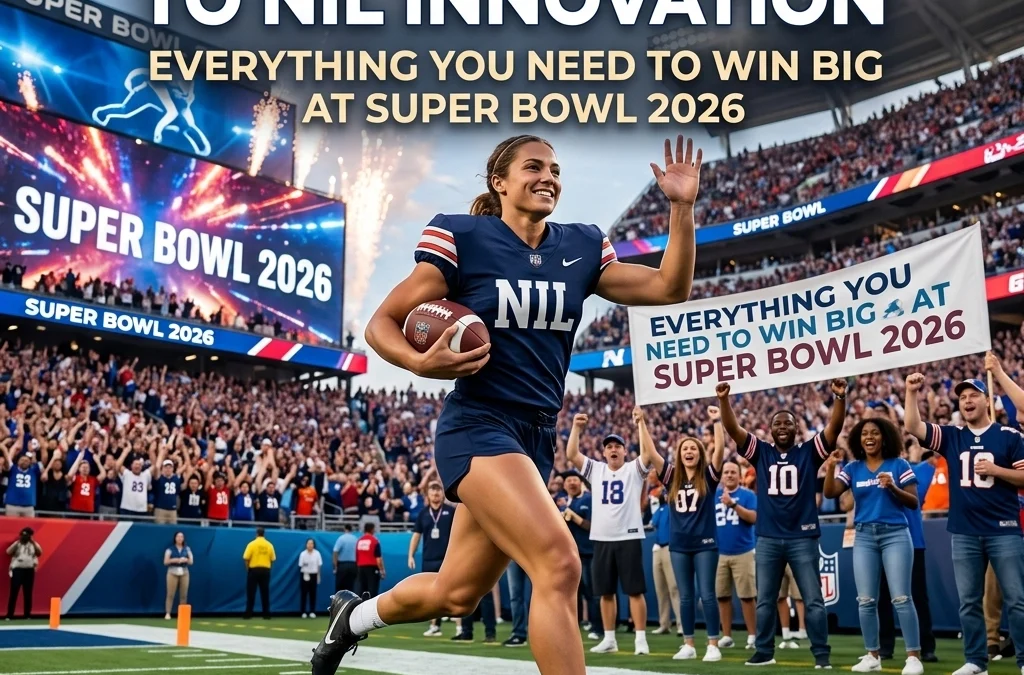
The landscape of championship advertising has fundamentally shifted. For decades, the standard for success was a single, high-priced television spot during the big game. In 2026, that model is no longer the only path to dominance. While a 30-second commercial can cost upwards of $7 million, forward-thinking media buyers are pivoting toward Name, Image, and Likeness (NIL) innovations to capture attention where it actually lives: on the second screen.
Winning at the Super Bowl now requires more than a single megaphone. It requires a symphony of voices. This guide explores how connecting with over 20,000 authentic student-athlete voices creates a distributed, always-on campaign that outlasts any traditional broadcast window.
The Power of 20,000 Authentic Voices
The core of NIL innovation lies in the scale of human connection. In the past, athlete endorsements were reserved for the top 1% of professional stars. Today, the opportunity has expanded to include tens of thousands of student-athletes who hold significant influence within their local communities and digital niches.
OOH Sports facilitates this connection by tapping into a platform of over 20,000 student-athletes. This is not just a list of names. It is a network of creators who offer:
- Hyper-Local Relevance: A college star in a key market carries more trust than a national celebrity.
- Niche Engagement: Student-athletes often see higher engagement rates because their followers are peers and dedicated local fans.
- Cost Efficiency: Instead of betting the entire budget on one pro athlete, brands can diversify across hundreds of voices to ensure consistent reach.
By leveraging a vast network, media buyers can ensure their brand message is present in every corner of the social ecosystem before, during, and after the kickoff.
Strategy: The Multi-Tiered NIL Roster
A successful Super Bowl campaign does not rely on a single athlete. It uses a tiered approach to build layers of influence. This strategy ensures that the brand message is both broad and deep.
Tier 1: The Marquee Names
These are the national icons and top-tier pro athletes. Their role is to provide massive reach and instant credibility. They anchor the campaign and provide the "hero" content that sets the tone for the brand story.
Tier 2: The Regional Standouts
This is where the 20,000 student-athlete voices become critical. By selecting stars from major college programs, especially those in regions with high viewership or specific market importance, brands can dominate regional conversations.
Tier 3: The Micro-Influencers
High school and local college athletes act as the "ground game." Their content feels like a recommendation from a friend rather than a corporate ad. This tier is essential for driving high-intent actions and community trust.

The 72-Hour Blitz: Execution Timeline
Timing is everything during the Super Bowl window. A distributed NIL campaign should be viewed as a 72-hour high-intensity event.
Phase 1: Pre-Game Narrative (24 Hours Before)
The goal is to build "narrative equity." Athletes share pre-game predictions, "day in the life" content, and watch-party preparations. This ensures that by the time the game starts, the audience already associates the brand with the excitement of the event.
Phase 2: Live-Game Real-Time Activation
During the game, attention is split. While the TV is on, fans are scrolling. Real-time reaction kits allow athletes to post immediate thoughts on big plays or halftime moments. This keeps the brand relevant during every momentum shift.
Phase 3: Post-Game Conversion (24 Hours After)
The emotional high of the game is the perfect time for conversion. Whether it is celebrating a win or reflecting on a tough loss, athletes use this window to share limited-time offers and call-to-action links.
For a visual breakdown of how these elements come together, view the following video:
https://www.youtube.com/watch?v=l6J-0zileKE
Integrating NIL with Out-of-Home (OOH) Advertising
Innovation in 2026 is not limited to social media. The most effective campaigns bridge the gap between digital content and the physical world. This is where OOH Sports provides a unique advantage. By combining NIL voices with programmatic digital out-of-home (DOOH) advertising, brands can create a surround-sound effect.
Imagine a fan seeing an athlete's post on their phone and then seeing that same athlete featured on a digital billboard at a transit hub or outside a stadium. This cross-channel approach reinforces the message and increases brand recall significantly. According to recent trends in marketing, integrated campaigns that use both social and physical media see a higher lift in purchase consideration.
For example, previous campaigns using programmatic DOOH have shown impressive results:
- White Claw saw a 74% lift in purchase consideration by using targeted digital displays.
- AB InBev's Mike’s Hard Iced Tea achieved a 119% lift in brand image through strategic placements.

Technology and Workflow: Scaling the Impossible
Managing 20,000 different athletes manually is impossible. The innovation that makes this scale achievable is the NIL platform technology. To win at the Super Bowl, media buyers must utilize platforms that offer:
- Automated Discovery: Filtering athletes by sport, geography, and audience demographics.
- Streamlined Contracting: Standardized agreements that ensure legal and NCAA compliance across thousands of individuals.
- Content Moderation: Tools to review and approve posts quickly to maintain brand safety during a fast-moving live event.
- Real-Time Analytics: Dashboards that track impressions, engagement, and conversions as they happen.
Using specialized technology allows a small team of media buyers to manage a massive network with the same precision as a single TV buy.
Measurement and ROI: Proving the Win
The ultimate goal of any Super Bowl strategy is a measurable return on investment. Unlike traditional commercials, where impact is often estimated, NIL campaigns provide granular data. Media buyers should focus on three key areas:
- Upper Funnel: Reach, impressions, and share of voice compared to competitors.
- Mid-Funnel: Engagement rates, including shares and comments, which indicate how well the audience is resonating with the athlete's voice.
- Lower Funnel: Clicks, app installs, and sales tracked through unique athlete promo codes or links.
Data from case studies shows that multi-channel sports marketing often delivers a better ROI than traditional stadium ads alone. This is particularly true when looking at how programmatic DOOH vs. traditional ads perform in high-traffic environments.

Conclusion: The New Playbook for 2026
The Super Bowl remains the pinnacle of the advertising calendar, but the way brands win has changed. Success in 2026 is defined by authenticity, scale, and real-time agility. By tapping into the voices of 20,000 student-athletes and integrating them into a broader OOH Sports strategy, media buyers can move beyond the 30-second spot and create a lasting connection with fans.
The tools are available, the network is ready, and the blueprint is clear. To win big, brands must stop looking at the Super Bowl as a single moment and start seeing it as a massive, distributed conversation.
For more information on how to start building your NIL strategy, visit our contact page or explore our blog for more insights on the future of sports advertising.