
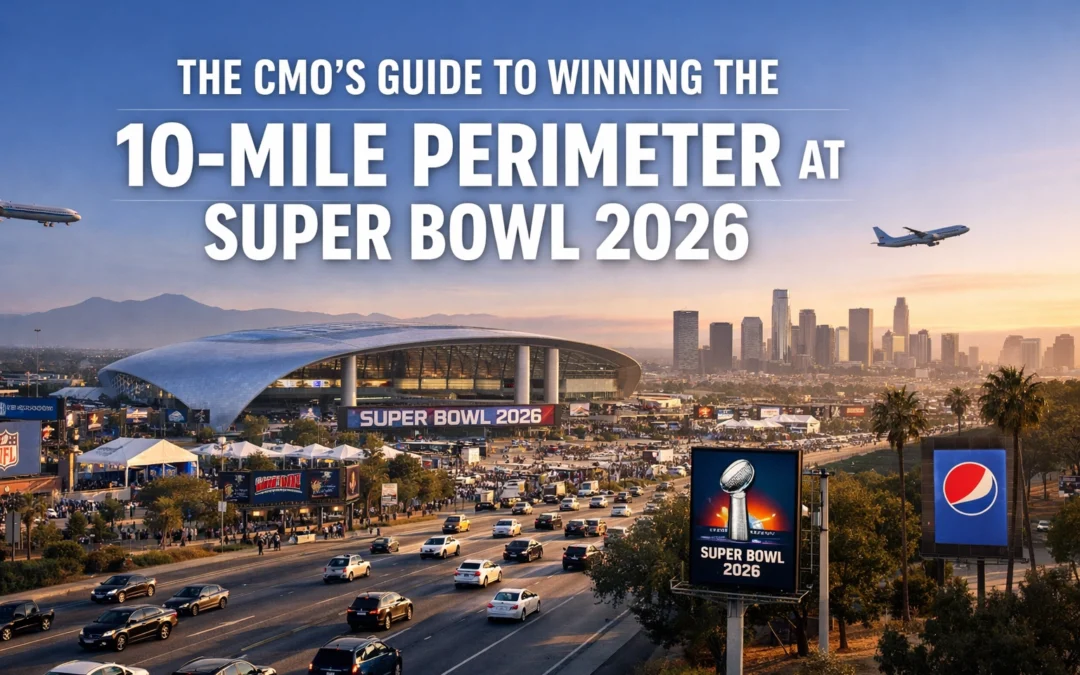
The Super Bowl is not just a football game. It is a cultural takeover. As we hit the middle of March 2026, every CMO in the country is already looking at the data from the last big game and planning how to dominate the next one. While the television commercials get the headlines, the real battle for brand loyalty happens on the ground.
Winning the Super Bowl requires more than a thirty-second spot. It requires a strategy that owns the 10-mile perimeter surrounding the venue. At OOH Sports, we have spent the last 40 years perfecting the art of venue-wide coverage. From the moment a fan steps off a plane to the second they walk over a branded floor graphic in the stadium, we make sure your brand is the only one they see.
The Power of the 10-Mile Perimeter
When a city hosts the Super Bowl, it transforms. For a full week, the 10-mile radius around the stadium becomes the most valuable real estate in the world of advertising. This is where the fans live, eat, and celebrate. If you only advertise during the broadcast, you are missing the hundreds of thousands of people who are physically present, spending money, and creating social media content.
The 10-mile perimeter strategy is about ubiquity. It is about making your brand feel like an official part of the experience, even if you are not an official league sponsor. We have seen this work time and time again. For instance, look at how Nike successfully positioned itself during the NYC Marathon without being an official sponsor. The same logic applies to the Super Bowl. By owning the Out-of-Home (OOH) space in the immediate vicinity, you own the conversation.
40 Years of Advertising Leadership
Experience matters when the stakes are this high. OOH Sports, led by CEO Dan Kost, has been at the forefront of this industry for four decades. We have watched advertising evolve from simple static billboards to the high-tech, programmatic digital displays we use today.
Our team understands the logistics of a major sporting event. We know which street corners get the most foot traffic and which billboards are visible from the highway traffic jams. We also know how to navigate the complex regulations that cities often put in place during the Super Bowl. When you work with a team that has 40 years of history, you are not just buying ad space. You are buying a playbook for success.

From the Floors to the Billboards: Total Venue Coverage
To truly win the 10-mile perimeter, you have to think in three dimensions. Modern OOH advertising is about more than just looking up at a screen. It is about occupying the space the consumer inhabits. Our approach to venue-wide coverage is exhaustive.
We start at the ground level. Floor graphics are an incredibly effective way to catch attention in crowded concourses and transit hubs. People naturally look down while they walk, especially when they are navigating a new city. From there, we move to eye-level activations, such as digital kiosks and transit shelters. Finally, we scale up to the massive digital billboards and stadium wraps that define the city skyline.

This "floor to billboard" approach ensures that there is no "dead air" in your campaign. Whether a fan is checking their phone at a bus stop or cheering in the stands, your brand is present. This level of saturation creates a psychological effect known as the mere-exposure effect. The more people see your brand in a high-energy, positive environment, the more they trust and prefer it.
The Role of Programmatic DOOH in 2026
In 2026, static ads are only half the story. The real growth is in programmatic Digital Out-of-Home (pDOOH). This technology allows brands to buy ad space in real-time based on specific triggers like weather, time of day, or even the current score of a game.
For CMOs, this means extreme efficiency. You can ramp up your messaging in the hours leading up to kickoff and pivot your creative instantly based on who is winning. We have seen incredible results with this technology. For example, White Claw saw a 74 percent lift in purchase consideration by using targeted digital campaigns. Similarly, AB InBev’s Mike’s Hard Iced Tea experienced a 119 percent lift in brand image through pDOOH.
The flexibility of digital screens also allows for better storytelling. You are not stuck with one image for the whole month. You can run a countdown, share live social media feeds, or display localized directions to the nearest retail location where your product is sold.
Why Every CMO Needs a Super Bowl Newsletter Strategy
Communication is key when managing a campaign of this scale. We recommend that CMOs maintain a dedicated Super Bowl newsletter to keep all stakeholders aligned. This is not just for internal use. A newsletter can be a powerful tool to share updates with partners, distributors, and even top-tier customers.
In your newsletter, you should highlight the specific assets you have secured within the 10-mile perimeter. Show them the map. Show them the "Sportrons" and the high-impact displays that will be carrying the brand message. If you want to see what top-tier sports advertising looks like in action, check out this overview:
https://www.youtube.com/watch?v=l6J-0zileKE
Maximizing ROI with Data-Driven Decisions
The biggest question for any CMO is always about the return on investment. Historically, OOH was seen as a "brand awareness" play that was hard to measure. That is no longer the case. With modern attribution tools, we can track how many people saw an ad and then visited a store or made a purchase on their mobile device.
We often compare programmatic DOOH against traditional stadium ads to show where the best value lies. While being inside the stadium is great, the cost-per-impression is often much lower in the surrounding 10-mile perimeter, while the frequency of exposure is much higher.

Consider the case of Sea-Doo. Their first digital OOH campaign increased purchase consideration by 144 percent. That is a massive shift that directly impacts the bottom line. By using the right mix of billboard types and digital screens, you can achieve similar results even in the crowded environment of the Super Bowl.
Strategic Steps for the 2026 Perimeter Play
If you are a CMO looking to win the 10-mile perimeter, here is your short-term playbook:
- Secure High-Impact Locations Early: The best billboards and transit hubs are usually booked a year in advance. If you haven't started looking at the 2026 map yet, now is the time.
- Integrate Programmatic: Do not rely solely on static vinyl. Use platforms like StackAdapt to manage your digital spend and ensure you are reaching fans at the right time.
- Think Beyond the Stadium: Look at the hotels where the fans stay, the bars where they celebrate, and the airports where they arrive.
- Use Creative That Pops: In a sea of advertising, your creative needs to be simple, bold, and high-contrast. Avoid clutter.
- Track and Adjust: Use mobile retargeting to follow up with fans who were exposed to your OOH ads.

The Future of Sports Advertising
As we look toward the end of the decade, the industry is only growing. Estimates suggest that DOOH sports advertising will hit 50 billion dollars by 2030. This growth is driven by the fact that sports remain the last bastion of live, "must-see" content.
The Super Bowl is the pinnacle of this trend. For a brand to remain relevant, it must be where the people are. It must be part of the physical world. OOH Sports has spent 40 years helping brands do exactly that. We don't just put up ads. We create landmarks.
If you are ready to start planning your 10-mile perimeter strategy for Super Bowl 2026, the time to act is now. You can learn more about our marketing strategies or check out our latest case studies to see how we help brands win big on the world's largest stage.
Winning the Super Bowl isn't just for the players on the field. It's for the brands that own the city. Let's make sure that brand is yours.