
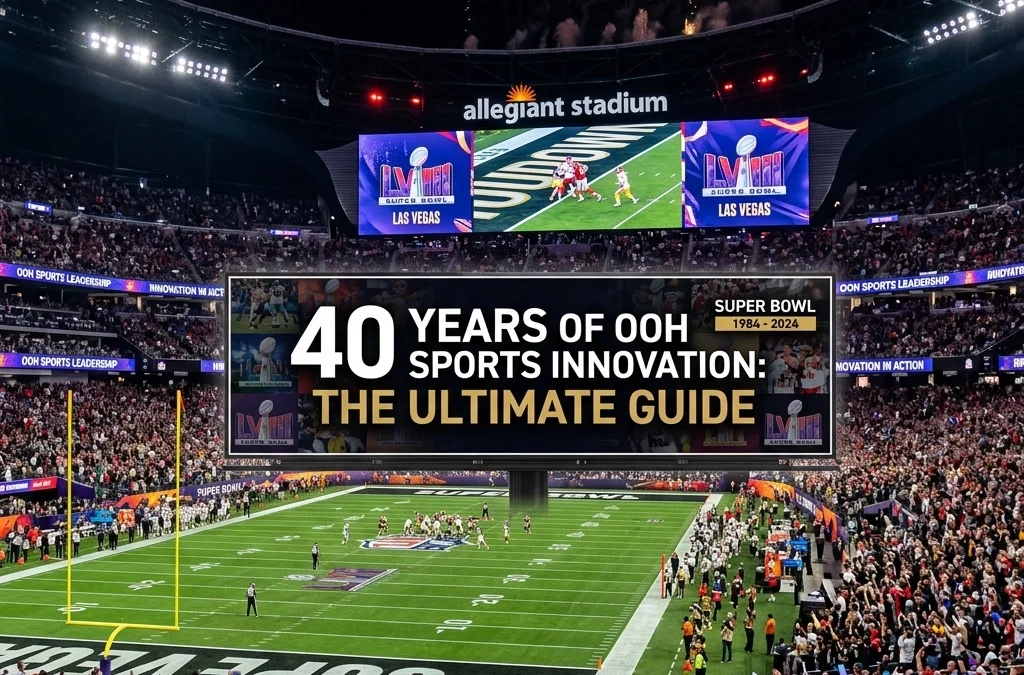
The conclusion of Super Bowl LX in February 2026 marked a historic milestone for the advertising industry. It was not just another championship game. It represented the culmination of four decades of evolution in sports marketing and out-of-home (OOH) media. Under the leadership of Dan Kost, OOH Sports demonstrated how a legacy of experience can be paired with cutting-edge technology to dominate the most crowded advertising environment in the world.
For 40 years, the approach to reaching fans has shifted from simple static posters to fully integrated digital ecosystems. The 2026 Super Bowl served as the ultimate testing ground for this venue-wide coverage strategy. From the very floors fans walked on to the massive digital billboards that lit up the skyline, the presence of OOH Sports was impossible to miss.
The Legacy of 40 Years in Sports Advertising
Experience in the sports marketing world is measured by the ability to adapt. When the journey began 40 years ago, advertising was largely a one-way conversation. Brands bought television spots or placed static boards along highways and hoped for the best. There was little way to track real-time engagement or pivot a strategy mid-game.
OOH Sports spent four decades changing that dynamic. By building a network that now includes over 780 venues, the company transitioned from being a participant in the industry to a primary leader of innovation. This long-term perspective allowed for a deep understanding of fan behavior, which is essential for any successful Super Bowl campaign. The history of the company, which can be explored on the about page, shows a consistent trend of moving ahead of the market.
https://www.youtube.com/watch?v=l6J-0zileKE
A Venue-Wide Strategy: From Floors to Billboards
The Super Bowl 2026 campaign was built on the concept of total immersion. It is no longer enough to have a single ad during the broadcast. To truly capture the attention of a modern audience, a brand must exist in the physical space where the fans live, breathe, and celebrate.
High-Impact Floor Graphics
One of the most innovative aspects of the Super Bowl LX activation was the use of venue floors. Often an overlooked asset, the ground beneath a fan's feet represents prime real estate. OOH Sports utilized high-durability, vibrant floor graphics throughout Levi’s Stadium and surrounding fan zones. These graphics served two purposes. First, they provided directional assistance and branding. Second, they acted as "anchor points" for social media moments. When fans looked down to check their phones or take a photo, the brand was already there.
Digital Billboards and Sportrons
While floors provided the ground-level engagement, the digital billboards provided the scale. The company’s Sportrons technology played a critical role in the 2026 strategy. These digital displays allow for real-time content updates, meaning ads could change based on the score, the quarter, or even the weather. This programmatic flexibility is what separates modern OOH from the traditional methods of the past.

Integrating NIL Athletes and Social Media
The 2026 campaign also leaned heavily into the power of Name, Image, and Likeness (NIL) partnerships. With a network of over 20,000 athletes, OOH Sports bridged the gap between physical advertising and digital social circles.
During the Super Bowl week, these athletes were not just faces on a screen. They were active participants in the OOH ecosystem. A fan might see a digital billboard featuring a popular athlete near the stadium, and seconds later, see that same athlete posting behind-the-scenes content on TikTok or Instagram. This creates a loop of brand reinforcement that is difficult to ignore. This multi-platform approach is a core part of the marketing services offered by the firm, ensuring that the physical ad is just the beginning of the journey.

Objectives and Strategic Execution
The primary objective for any brand during the Super Bowl is to stand out without being intrusive. The strategy for 2026 focused on three main pillars:
- Saturation: Ensuring that the brand was visible at every touchpoint of the fan journey, from the airport to the hotel, and finally into the stadium.
- Contextual Relevance: Delivering ads that made sense for the moment. For example, beverage ads were prioritized during high-energy tailgating hours, while travel and luxury ads took over during the post-game departures.
- Measurability: Using data to prove that the investment was worth it.
By using programmatic digital out-of-home (DOOH) platforms, the campaign was able to target specific demographics with surgical precision. This is a significant shift from the "spray and pray" methods of 40 years ago. Today, every impression is accounted for, and every screen is optimized for maximum ROI.
Technology Partners and Data-Driven Results
The success of the Super Bowl 2026 innovation guide is backed by hard data. In recent years, programmatic DOOH has shown a remarkable ability to drive purchase consideration. For instance, past campaigns have seen a 74% lift in purchase consideration for major brands. Others have reported a 119% lift in positive brand image.
For Super Bowl LX, the measurement went even deeper. By using device IDs and geofencing around the venue-wide OOH placements, the team could track how many fans saw a billboard or floor graphic and later visited a website or made a purchase. This level of attribution is the "holy grail" of sports marketing. It turns an outdoor ad into a measurable performance tool.

The Future of Sports Marketing
As the industry looks beyond 2026, the lessons learned from 40 years of leadership remain clear. Technology will continue to change, but the need for authentic, venue-wide engagement will not. The move toward $50 billion in DOOH sports advertising by 2030, as detailed in our industry forecast, suggests that we are only at the beginning of this growth curve.
The Super Bowl is more than just a game. It is a showcase for what is possible when veteran precision meets modern innovation. OOH Sports has proven that by controlling the environment, from the floors to the sky-high billboards, a brand can dominate the conversation and achieve unparalleled results.

Summary of the 2026 Innovation Model
To recap the strategies used in this year's Super Bowl leadership guide:
- Longevity: Utilizing 40 years of industry knowledge to anticipate fan movements.
- Physical Dominance: Using floor graphics and stadium-wide placements to ensure constant visibility.
- Digital Flexibility: Leveraging Sportrons and programmatic DOOH for real-time messaging.
- Athlete Synergy: Connecting 20,000+ NIL athletes to physical ad locations.
- ROI Focus: Moving beyond impressions to focus on actual purchase lift and brand sentiment.
For companies looking to replicate this level of success in future sporting events, the blueprint is ready. It requires a combination of high-impact visuals, technological savvy, and a deep understanding of the sports fan’s journey. Those interested in seeing more detailed breakdowns of past successes can review our case studies or contact the team to begin planning for the next big game.
The Super Bowl LX newsletter serves as a reminder that in the world of sports advertising, the best way to predict the future is to lead it. With four decades in the books, the focus now turns to what the next 40 years will bring. One thing is certain. OOH Sports will be there, on the floors, on the screens, and in the minds of fans everywhere.