
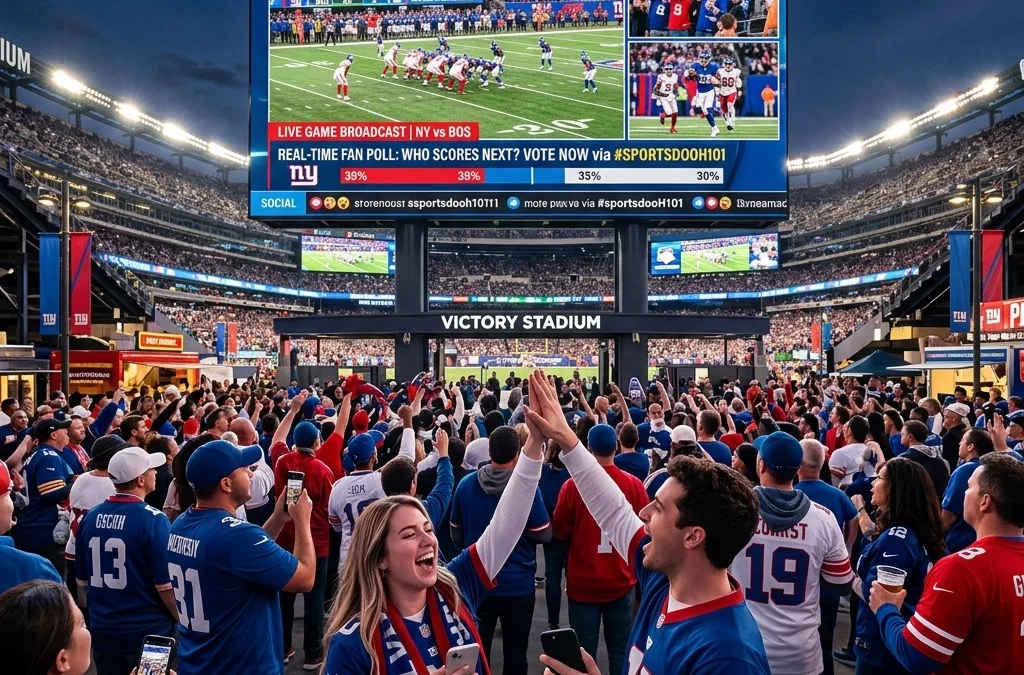
Digital out-of-home (DOOH) has evolved into the connective tissue of modern sports marketing. While the action on the field or court captures the immediate attention of those inside the arena, the vast majority of fans experience the excitement elsewhere. In fact, research indicates that fans spend 99 percent of their lives outside the stadium. They are commuting, visiting sports bars, shopping at grocery stores, traveling through airports, or exercising at the gym.
Sports DOOH provides a specialized channel to reach these fans in their daily environments while maintaining the ability to respond to live sports moments as they happen. This guide serves as a foundational resource for media buyers and marketers aiming to utilize the medium for real-time fan engagement and measurable brand impact.
Defining the Sports DOOH Landscape
Sports DOOH encompasses any digital out-of-home inventory used to reach sports enthusiasts. Unlike traditional static billboards, these digital screens are capable of displaying video, motion graphics, and dynamic content. The inventory typically falls into several key categories:
- Venue Perimeters: Screens located immediately outside stadiums and arenas.
- Watch Spaces: Digital displays in sports bars, pubs, and restaurants where fans gather to view games.
- Transit Routes: Inventory in airports, subways, and rail hubs, as well as roadside billboards along high-traffic corridors.
- Lifestyle Environments: Screens in gyms, office buildings, malls, and grocery stores where fans maintain their daily routines.
The primary distinction of sports DOOH lies in its relationship with time and context. Because sporting events are time-bound, they create predictable peaks of collective attention. When combined with real-time data signals like live scores or betting odds, DOOH transforms from a static message into a responsive narrative.

The Core Building Blocks of Engagement
To master real-time engagement, an understanding of the four pillars of modern DOOH is required: inventory, data, technology, and measurement.
1. Diverse Inventory and Formats
Every format serves a specific role in a marketing campaign. Large-format roadside billboards are designed for high reach and building broad anticipation before a game. Conversely, proximity formats, such as screens in retail environments or sports bars, are better suited for driving immediate participation or conversion. By selecting the right mix, a brand can maintain presence throughout the entire fan journey.
2. Audience-Led Targeting
The industry has shifted from location-led buying to audience-led strategy. Rather than simply buying a board because it is near a stadium, marketers now use behavioral and contextual data to reach fans where they actually spend time. This includes routine-based targeting, which maps the daily movements of fans, and venue-level precision, which allows for the selection of specific types of businesses, such as fitness centers or convenience stores, within a set radius of a sports venue.

3. The Tech Stack: DCO and Programmatic DOOH
Technology is the engine behind real-time engagement. Dynamic Creative Optimization (DCO) allows for the automatic updating of creative assets based on live triggers. This means an ad can change its messaging the moment a goal is scored or the weather changes.
Programmatic DOOH (pDOOH) further enhances this by allowing impressions to be purchased in real-time. Instead of committing to a long-term static contract, marketers can set parameters to turn screens on or off based on specific conditions. For example, a campaign might only activate when a local team is playing or when a certain occupancy level is reached in partnered sports bars. For a deeper look at how this compares to older methods, one might explore programmatic DOOH vs traditional stadium ads.
4. Advanced Measurement Frameworks
Success in sports DOOH is no longer measured solely by estimated impressions. Modern frameworks connect exposure to tangible outcomes, including website visits, app installs, and footfall lift. By using control versus exposed groups, brands can determine the incremental impact of their DOOH spend on consumer behavior.
Real-Time Triggers and Use Cases
The effectiveness of sports DOOH relies on aligning the message with the moment. Several trigger categories are commonly used to achieve this:
Game Moments
Score-based triggers are among the most effective. A brand can display celebratory creative the instant a team scores, targeting fans in nearby bars or transit hubs. Similarly, if a game is particularly close in the final minutes, messaging can shift to high-energy content to capture the heightened emotional state of the audience.
Environmental Conditions
Weather triggers provide a high degree of relevance. If rain begins near a stadium, an apparel brand might display ads for waterproof gear, or a rideshare service might emphasize the comfort of a dry ride home. During extreme heat, beverage brands can trigger creative promoting cold drinks at nearby convenience stores.
Live Utility and Social Sentiment
Betting partners often use DOOH to stream live odds or "boosts" directly to bar screens, providing immediate utility to fans. Additionally, brands can monitor social media chatter. If a specific player moment goes viral, DOOH screens can be updated within minutes to acknowledge the cultural beat, making the brand appear more attuned to the fan community.

Orchestrating the Fan Journey
A successful sports DOOH strategy requires a multi-moment activation window. This is generally divided into three phases: pre-game, during the game, and post-game.
Phase 1: Pre-Game (Anticipation)
The objective here is awareness and priming. Tactics often include countdown creatives, such as "2 Days to Kickoff," displayed on transit screens and urban panels. This is the time to reach shoppers at grocery stores or commuters on their way home, ensuring the upcoming event is top-of-mind.
Phase 2: Game-Time (Participation)
During the event, the focus shifts to participation. This is where DCO tied to game feeds becomes vital. Real-time offers, such as "Team Scores, You Get a Discount," can drive traffic to local businesses or encourage app engagement. The targeting should be heavy around fan zones, sports bars, and last-mile transit stops.
Phase 3: Post-Game (Loyalty)
The final phase focuses on reinforcement and retention. If the team wins, celebratory creative can be used to drive merchandise sales or loyalty program sign-ups. If the team loses, the messaging might pivot to community and long-term support. The day after a game is an ideal time for digital recaps and calls-to-action for streaming replays. This comprehensive approach is part of why the industry is seeing such rapid growth, as noted in the DOOH sports advertising projections.
Creative Best Practices for DOOH
Because DOOH screens are often viewed by people on the move, the creative must be optimized for speed and clarity.
- Instant Comprehension: There should be one main message and one visual focal point. Large fonts and high contrast are essential, as most viewers will only offer one to three seconds of attention.
- Modular Systems: Creative should be built as a template with dynamic fields. This allows variables like scores, opponents, and temperatures to be swapped without the need to rebuild the entire ad.
- Omnichannel Alignment: The visuals and tone used in DOOH should match what the fan sees on social media or TV. This consistency reinforces brand recall.
- Clear Calls to Action: When an action is required, use simple methods like QR codes. These should lead to mobile-optimized landing pages that load quickly.

Targeting Strategy: Beyond the Stadium
A sophisticated strategy maps the fan's entire life through three layers of targeting:
- The Macro Layer: High-reach boards on highways and at major airports to reach the broad fan base and traveling supporters.
- The Meso Layer: Grocery stores, gyms, and malls to prime fans during their daily routines in the days leading up to an event.
- The Micro Layer: Sports bars, near-venue streets, and pubs to nudge behavior at the peak of intent, such as ordering another round or placing a bet.
By layering these approaches, a brand can ensure it is present at every touchpoint of the fan experience.
Measuring Success and Optimizing Performance
To truly master sports DOOH, every campaign must be treated as a learning cycle. Marketers should define their KPIs by phase. For instance, pre-game success might be measured by search lift or website visits, while game-time success is measured by venue footfall or in-game sales.
Data from programmatic campaigns can be used to optimize in real-time. If analytics show that sports bars are outperforming stadium perimeters for a specific goal, the budget can be shifted mid-campaign to maximize ROI. For examples of how major brands have successfully implemented these strategies, the OOH Sports case study section provides detailed breakdowns of campaign performance and results.
Sports DOOH is no longer a static medium of the past. It is a dynamic, data-driven tool that allows brands to join the live narrative of sports. By focusing on real-time triggers, audience routines, and modular creative, marketers can engage fans in a way that is both meaningful and measurable. As the technology continues to advance, those who master these 101 fundamentals will be best positioned to capture the attention of the modern sports fan.