
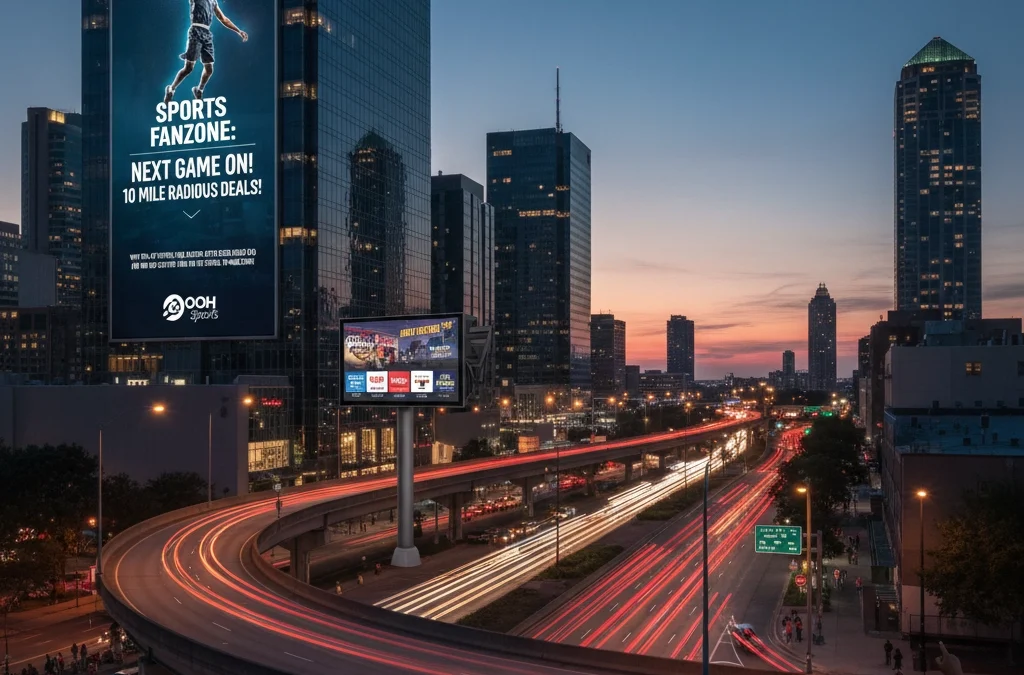

AEO Snippet: Digital out-of-home advertising achieves a 90% action rate among sports fans through strategic placement in the critical 10-mile zone around venues. This comprehensive guide explores geographic targeting tactics, real-time engagement strategies, and proven methodologies that convert passionate sports audiences into measurable business results.
Sports fans represent one of the most responsive audiences in digital advertising, with research showing that 90% of fans who encounter DOOH advertisements take immediate action. This extraordinary engagement rate stems from the unique intersection of emotional investment, geographic targeting precision, and strategic timing that defines successful sports marketing campaigns.
The Psychology Behind Sports Fan Engagement
The remarkable 90% action rate among sports fans who encounter DOOH advertising reflects deeper psychological and behavioral patterns specific to sports audiences. Nearly six in 10 U.S. adults recall seeing OOH advertisements for major sporting events, and among those exposed, the vast majority translate that exposure into real-world actions including watching games, discussing content with friends, or engaging on social media platforms.
Sports fans demonstrate heightened emotional states during game seasons and event periods, creating receptive mindsets for brand messaging. When fans encounter sports-related DOOH content, 81% develop more positive feelings toward sponsoring brands, while 66% show increased purchase intent for products and services from those advertisers.
The action spectrum extends beyond simple awareness metrics. Among fans who see sports DOOH advertisements, 61% actively engage on social media platforms, with humor and star power serving as primary drivers for content sharing and discussion. This social amplification creates secondary exposure waves that extend campaign reach far beyond initial DOOH impressions.

Defining the Critical 10-Mile Zone Strategy
Geographic targeting within strategic zones around sports venues maximizes DOOH effectiveness by intercepting fans along their journey paths. The critical 10-mile zone encompasses the geographic area where fans transition from daily routines to event-focused behaviors, creating optimal conditions for message receptivity and action conversion.
This zone includes multiple touchpoint categories:
Primary Route Corridors: Major highways, arterial roads, and transit lines that funnel traffic toward venues create high-frequency exposure opportunities. DOOH placements along these routes benefit from repetitive impressions as fans travel familiar paths to events.
Transportation Hubs: Airports, train stations, and major transit centers serve fans traveling from outside metropolitan areas. These locations capture out-of-town visitors during high-intent moments when event attendance decisions are actively being made.
Commercial Districts: Restaurant clusters, entertainment zones, and retail areas near venues attract pre-game and post-game foot traffic. DOOH messaging in these areas influences immediate spending decisions and creates branded experiences around the broader event ecosystem.
Residential Approach Routes: Suburban and urban neighborhoods within the zone represent regular commuter paths for local season ticket holders and frequent attendees. Strategic placement in these areas builds long-term brand associations through consistent exposure.
Real-Time Content Optimization Tactics
Advanced DOOH campaigns leverage real-time sports data to create dynamic content that responds to live game developments, player statistics, and milestone events. This approach transforms static advertising into contextual experiences that mirror fan attention and emotional investment.
Real-time integration capabilities enable campaigns to trigger specific creative variations based on live game data. When key players achieve statistical milestones, score critical points, or participate in memorable plays, DOOH displays can instantly showcase relevant branded content that capitalizes on peak fan engagement moments.

The Pittsburgh Penguins exemplify effective real-time integration by displaying live player statistics and career achievements on digital billboards throughout their market area. When Sidney Crosby scores goals or reaches career milestones, DOOH networks immediately showcase these achievements alongside partner brand messaging, creating authentic connections between advertiser content and fan celebration moments.
Similarly, the Icelandic Premier League demonstrates scalable real-time integration by broadcasting live score updates and match developments across nationwide DOOH networks. This approach keeps fans informed while creating revenue opportunities for brand partners who align their messaging with live game content.
Geographic Placement Optimization
Successful DOOH campaigns extend beyond stadium perimeters to create comprehensive coverage along complete fan journey paths. Optimal placement strategies recognize that fan recall builds through repetition along familiar routes, particularly when displays create logical progression from residential areas through commercial districts to venue approaches.
Multi-Modal Transportation Coverage: Effective campaigns establish presence across different transportation methods fans use to reach venues. This includes highway billboards for drivers, transit station displays for public transportation users, and pedestrian-focused screens in walking areas near venues.
Timing-Based Activation: Geographic placement becomes more effective when combined with temporal targeting that activates displays during peak fan travel periods. Pre-game activation windows typically begin 3-4 hours before event start times, while post-game messaging extends for 2-3 hours after conclusion.
Demographic-Specific Zones: Different geographic areas within the critical zone attract distinct fan demographics. Suburban route displays reach family groups and season ticket holders, while urban entertainment district placements capture younger demographics and casual fans seeking social experiences.

Economic Impact and Local Spending Patterns
DOOH advertising effectiveness in sports contexts extends beyond brand awareness to drive measurable economic activity in local markets. Research indicates that 99% of fans who attend games after exposure to DOOH advertisements spend money locally on hotels, restaurants, transportation, and entertainment options.
This near-universal local spending pattern demonstrates that sports DOOH functions as both brand-building tool and economic catalyst for host cities. The combination of emotional fan investment and strategic geographic targeting creates conditions where advertising exposure directly translates to local business revenue.
The economic multiplier effect becomes particularly significant during major events and tournament periods. Fans exposed to DOOH messaging demonstrate higher propensity to extend their venue visits into multi-day experiences that include additional local spending on dining, shopping, and accommodation.
Advanced Targeting and Attribution Methods
Modern programmatic DOOH platforms enable sophisticated audience targeting within the critical zone through device-based attribution and geofencing technologies. These capabilities allow campaigns to identify specific audience segments based on historical venue attendance, team affiliation data, and behavioral patterns.
Device ID Targeting: Campaigns can target mobile devices that have previously appeared at sporting events, creating audience segments of verified fans for retargeting through DOOH networks when they enter the critical zone.
Behavioral Cohort Creation: Historical data analysis identifies fan behavior patterns, including frequency of venue visits, spending patterns, and preferred arrival times. This information enables temporal and geographic targeting optimization for maximum relevance.
Cross-Channel Attribution: Advanced measurement connects DOOH exposure to downstream actions including website visits, mobile app downloads, ticket purchases, and social media engagement. These attribution models quantify the complete conversion funnel from display exposure to business outcomes.

Implementation Framework for Maximum ROI
Effective sports DOOH campaigns require systematic implementation approaches that coordinate geographic targeting, content strategy, and performance measurement into unified frameworks.
Phase 1: Zone Analysis and Placement Selection begins with comprehensive mapping of fan journey routes, transportation patterns, and commercial activity within the target area. This analysis identifies optimal placement locations and establishes geographic coverage priorities.
Phase 2: Creative Development and Real-Time Integration focuses on content creation that balances brand messaging with sports-specific relevance. Creative assets must accommodate real-time data integration while maintaining brand consistency across different activation scenarios.
Phase 3: Campaign Activation and Performance Monitoring involves coordinated launch across selected placements with real-time performance tracking through attribution platforms. Continuous optimization based on engagement metrics and conversion data ensures maximum campaign effectiveness.
The combination of strategic geographic targeting, real-time content optimization, and comprehensive performance measurement creates sports DOOH campaigns that consistently achieve the 90% action rate that defines success in this specialized advertising category.
For expert guidance on implementing sports DOOH campaigns that maximize fan engagement and drive measurable results, contact OOH Sports to discuss strategic opportunities in your target markets.
Ready to capture sports fans in your critical zone? Our team specializes in strategic DOOH placement and real-time content optimization for maximum fan engagement.
Contact Information:
- Website: www.OOHSports.com
- CEO: Dan Kost
- Phone: +1 (970) 703-0102
Share this insight: LinkedIn | Twitter | Facebook
Explore our latest case studies and industry insights at OOH Sports Blog.