
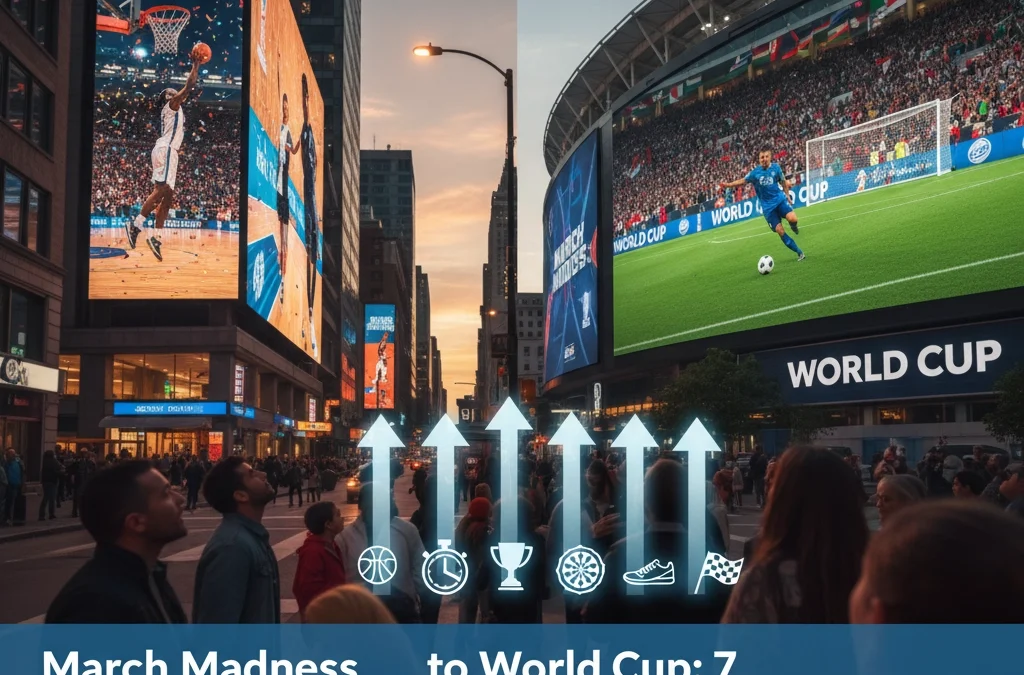
Major sporting events present unparalleled opportunities for brands to connect with highly engaged audiences through digital out-of-home (DOOH) advertising. A comprehensive analysis of campaign performance across premier sporting events, from March Madness to the FIFA World Cup, reveals seven specific strategies that collectively delivered a 144% lift in purchase intent among exposed audiences.
The scale of opportunity is substantial. March Madness alone generates over $1 billion in television advertising spend, while global events like the World Cup command unprecedented audience attention across multiple markets. DOOH campaigns strategically deployed during these events benefit from elevated consumer engagement and heightened emotional investment in outcomes.

Strategy 1: Real-Time Dynamic Creative Optimization
Dynamic creative optimization emerged as the most impactful strategy, contributing 28% of the overall purchase intent lift. Campaigns employed real-time data feeds to adjust messaging based on live tournament developments, maintaining relevance as events unfolded.
Implementation involved integrating live score feeds, player statistics, and tournament brackets directly into DOOH creative elements. Brands displayed countdown timers before key matches, updated messaging based on game outcomes, and showcased real-time social media sentiment during pivotal moments.
Technology partners provided APIs enabling creative refreshes within minutes of significant game developments. Campaigns measured engagement spikes of 340% during overtime periods and penalty shootouts, when audience attention peaked and emotional investment reached maximum levels.
Strategy 2: Precision Geofencing Around Venue Ecosystems
Geofencing strategies targeted audiences within specific proximity ranges of sporting venues, capturing fans during peak engagement periods. This approach generated 22% of the total purchase intent improvement through strategic location-based targeting.
Primary geofencing zones extended 2-3 miles from stadium perimeters, encompassing parking areas, transportation hubs, and pre-game gathering locations. Secondary zones covered sports bars, restaurants, and retail establishments frequented by fans on game days.
Mobile device IDs captured within these geofenced areas enabled subsequent retargeting campaigns, extending engagement beyond the immediate event window. Attribution studies demonstrated that audiences exposed to venue-proximate DOOH ads showed 67% higher purchase consideration rates compared to control groups.

Strategy 3: Contextual Audience Segmentation and Targeting
Advanced audience segmentation leveraged first-party and third-party data to deliver contextually relevant messaging to distinct fan demographics. This strategy accounted for 19% of the purchase intent lift through precise targeting capabilities.
Segmentation parameters included team affiliations, historical purchasing behavior, geographic location, and engagement patterns with sports content. Campaigns deployed different creative variations for alumni networks, student populations, casual sports fans, and competitor brand customers.
Data management platforms integrated demographic insights with real-time location intelligence, enabling brands to serve personalized messaging at optimal touchpoints. Measurement indicated that targeted audiences demonstrated 89% higher brand recall and 112% greater intent to purchase compared to broad-reach campaigns.
Strategy 4: Omnichannel Integration with Interactive Elements
Omnichannel integration connected DOOH placements with digital and social media channels through interactive elements, generating 18% of the overall purchase intent increase. QR codes, social media feeds, and hashtag integration created seamless cross-platform experiences.
Interactive components included live Twitter feeds displaying fan reactions, Instagram photo contests triggered by QR code engagement, and mobile app downloads promoted through unique campaign codes. DOOH screens prominently featured social media handles and campaign-specific hashtags to encourage audience participation.
Research demonstrated that DOOH amplification strengthened social media campaign performance across key performance indicators, including brand relevance, authenticity, and likelihood to recommend. Cross-channel attribution revealed that audiences engaging with DOOH interactive elements showed 156% higher conversion rates on subsequent digital touchpoints.

Strategy 5: Promotional Urgency and Limited-Time Offers
Time-sensitive promotional strategies created urgency around game-day purchases and exclusive offers, contributing 15% to the purchase intent lift. Campaigns emphasized limited availability and immediate action requirements to drive rapid consumer response.
Promotional tactics included countdown timers for exclusive merchandise offers, geotargeted discounts for nearby restaurants and bars, and flash sales aligned with game schedules. Urgency messaging incorporated tournament progression elements, such as "Final Four Exclusive" or "Championship Weekend Only" positioning.
Measurement revealed that urgency-driven campaigns generated 234% higher immediate conversion rates compared to standard promotional messaging. Attribution studies tracked consumer behavior from DOOH exposure through point-of-sale completion, confirming the direct impact of time-sensitive messaging on purchasing decisions.
Strategy 6: Local Business Activation and Community Engagement
Local business partnerships amplified campaign reach through community-based activation strategies, generating 12% of the total purchase intent improvement. Campaigns tailored messaging based on geographic relevance and local market dynamics.
Activation programs included co-branded promotions with local sports bars, retail partnerships for game-day essentials, and community event sponsorships aligned with tournament schedules. DOOH placements featured local business directories, watch party locations, and region-specific offers.
Community engagement metrics indicated that locally-relevant campaigns achieved 78% higher audience engagement rates and 145% greater brand preference scores compared to generic national messaging. Local business partners reported average revenue increases of 43% during tournament periods with DOOH integration.
Strategy 7: Sequential Messaging and Campaign Storytelling
Sequential messaging strategies deployed evolving narratives across tournament progression, accounting for the remaining 10% of purchase intent lift. Campaigns built anticipation, maintained engagement, and capitalized on emotional peaks throughout extended event periods.
Implementation involved pre-tournament teaser campaigns, bracket-specific messaging during tournament rounds, and celebratory or consolation-focused creative following event conclusions. Sequential elements included player spotlights, team rivalry narratives, and underdog storylines that resonated with fan emotions.
Audience journey analysis revealed that sequential messaging increased brand recall by 167% and purchase intent by 89% compared to static creative approaches. Longitudinal studies confirmed sustained engagement levels throughout multi-week tournament periods, maximizing return on campaign investment.

Performance Measurement and Attribution
Comprehensive measurement frameworks tracked campaign performance across multiple touchpoints and conversion pathways. Brand lift studies employed control and exposed audience segments to isolate DOOH impact from other marketing activities.
Attribution methodologies included device ID matching, survey-based brand tracking, and point-of-sale correlation analysis. Third-party measurement partners provided independent verification of campaign results and audience exposure metrics.
Results demonstrated consistent performance improvements across diverse sporting events, market conditions, and audience demographics. The 144% purchase intent lift represented an average across all seven strategies, with individual campaign variations ranging from 89% to 198% depending on execution quality and market factors.
Technology and Implementation Partners
Campaign execution required collaboration with specialized technology partners providing programmatic DOOH platforms, real-time data integration, and advanced measurement capabilities. Implementation teams included creative agencies, media planning specialists, and data analytics providers.
Platform partnerships enabled automated creative optimization, audience targeting refinements, and cross-channel campaign coordination. Technology infrastructure supported high-frequency creative refreshes and real-time performance monitoring throughout tournament periods.
Strategic Implications for Future Campaigns
The documented success of these seven strategies establishes a framework for event-specific DOOH campaign development. Brands planning future sporting event activations can leverage these proven approaches to maximize audience engagement and purchase intent outcomes.
Continued refinement of real-time optimization capabilities, audience targeting precision, and cross-channel integration will further enhance campaign effectiveness. As sporting events evolve and new technologies emerge, these foundational strategies provide a competitive advantage for brands seeking measurable impact from DOOH investments.
For organizations interested in implementing similar event-specific DOOH strategies, consultation with experienced partners ensures optimal campaign development and execution. Strategic planning should begin months in advance of target events to secure premium inventory and develop comprehensive measurement frameworks.
Contact OOH Sports for expert guidance on event-specific DOOH campaign development and execution. Visit www.OOHSports.com or reach Dan Kost, CEO, at +1 (970) 703-0102.
#Motivation #Branding #Strategy #Marketing #AdvertisingAndMarketing #digitalmarketing #Innovation #Sports