
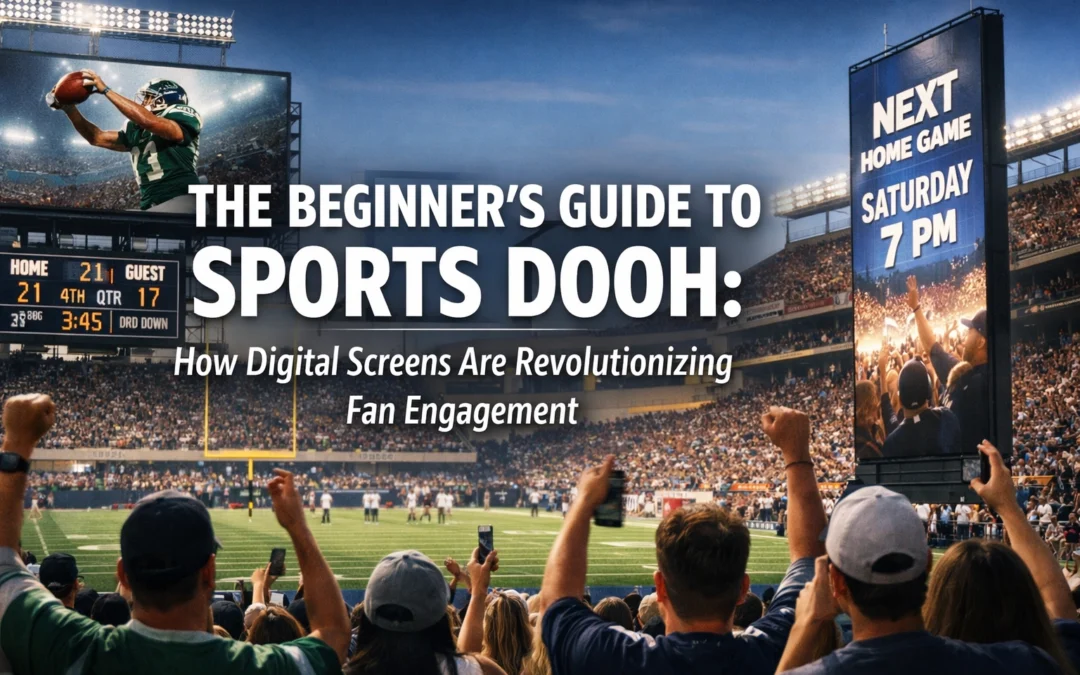
Digital out-of-home advertising has evolved from static billboards into a dynamic, data-driven channel that allows brands to connect with audiences at scale. For media buyers and brand managers entering the sports marketing space, understanding Digital Out-of-Home (DOOH) represents a strategic advantage in reaching engaged, captive audiences at the moments when they are most receptive.
Sports DOOH combines the high-visibility impact of traditional outdoor advertising with the precision targeting and real-time flexibility of digital media. This guide breaks down the fundamentals of sports DOOH, how it operates within sporting environments, and why it has become an essential component of modern sports marketing strategies.
Understanding Digital Out-of-Home Advertising
DOOH refers to advertising content delivered on digital screens positioned in shared public environments. Unlike traditional out-of-home media, which requires physical production and installation for each creative update, DOOH supports remote content updates, scheduled messaging, and dynamic creative that responds to external triggers.

The technology underpinning DOOH enables several capabilities that static outdoor advertising cannot match. Content can be modified in minutes rather than days, campaigns can be scheduled to run at specific times or under specific conditions, and multiple advertisers can share the same inventory through programmatic buying platforms.
In sports contexts, DOOH encompasses digital displays at stadiums and arenas, screens in sports bars and entertainment districts, digital billboards along routes to venues, and networks of screens in fitness centers and sports retail locations. Each placement offers distinct audience characteristics and engagement opportunities.
The Sports DOOH Advantage
Sports environments create unique conditions for advertising effectiveness. Audiences attending live sporting events arrive in a heightened emotional state, with increased receptivity to brand messages that align with their experience. The captive nature of venue-based advertising, combined with the social atmosphere of sporting events, produces measurable lift in brand awareness and purchase consideration.
The temporal concentration of audiences represents another distinct advantage. Major sporting events create predictable surges in traffic to specific geographic areas, allowing brands to deploy concentrated messaging during windows of maximum relevance. This is particularly valuable for product categories with immediate conversion opportunities, such as beverage brands, quick-service restaurants, and ride-sharing services.
DOOH in sports settings also benefits from the association effect. Brands that advertise within premium sporting environments inherit some of the prestige and excitement associated with the events themselves. This halo effect extends beyond the immediate audience to create broader brand positioning benefits.
Dynamic Content and Real-Time Adaptation
The capacity for real-time content updates distinguishes DOOH from legacy outdoor advertising formats. In sports marketing, this flexibility enables several high-impact use cases.
Live score integration allows creative content to reference current game conditions, creating relevance and demonstrating brand responsiveness. Weather-triggered creative ensures that messaging aligns with current conditions, a particularly valuable capability for beverage, apparel, and transportation advertisers. Time-of-day scheduling enables different messages to reach audiences during pre-game, in-game, and post-game periods.

Programmatic DOOH platforms have extended these capabilities further by enabling automated buying based on multiple data signals. Inventory can be purchased based on audience composition predictions, competitive activity, or achievement of specific campaign objectives. This automation increases efficiency while maintaining strategic control over placement and timing decisions.
Measurement and Attribution in Sports DOOH
Historically, outdoor advertising measurement relied primarily on circulation estimates and general visibility calculations. Modern DOOH introduces multiple attribution methodologies that provide concrete evidence of campaign impact.
Device ID exposure tracking identifies mobile devices that have been exposed to DOOH advertising, creating audiences for retargeting and enabling before-and-after comparison of behavior. Location-based attribution measures foot traffic to retail locations or venues among exposed audiences versus control groups. Brand lift studies administered through mobile surveys quantify changes in awareness, consideration, and purchase intent attributable to DOOH exposure.
These measurement approaches transform DOOH from an awareness-only medium into a channel with demonstrable business outcomes. Media buyers can justify investments based on concrete performance data rather than estimated impressions alone.
Integration with Omnichannel Strategies
Sports DOOH operates most effectively as part of an integrated marketing approach. The channel's strength in generating awareness and shaping perception combines productively with digital channels that drive immediate response and conversion.
A typical integration pattern includes DOOH exposure driving initial brand awareness, followed by mobile and social retargeting to exposed audiences, and concluding with conversion tracking to measure the full-funnel impact. This approach leverages DOOH's scale and visibility while capturing the precision and accountability of digital channels.

The physical presence of DOOH also enables creative strategies that bridge offline and online experiences. QR codes, custom URLs, and social media callouts on DOOH creative can drive immediate digital engagement, creating measurable interaction and ongoing relationship opportunities with audiences first reached through outdoor advertising.
Strategic Placement Considerations
Effective sports DOOH deployment requires understanding the relationship between venue locations, audience movement patterns, and campaign objectives.
Venue-proximate placements reaching audiences within the immediate area surrounding sporting venues capture fans during arrival and departure periods. These placements benefit from the concentration and known demographics of event attendees. Route-based placements along major thoroughfares connecting residential areas to venues extend reach to broader audiences traveling to games.
In-venue placements, including concourse displays and integrated sponsorship positions, reach captive audiences during extended dwell times. These positions command premium pricing but deliver guaranteed exposure to highly engaged audiences. Sports bar and entertainment district placements capture fans watching games remotely, particularly valuable for reaching audiences during away games or high-profile matchups.
Technology Platforms and Buying Methods
The sports DOOH ecosystem includes multiple technology platforms that facilitate campaign planning, buying, and measurement. Programmatic platforms aggregate inventory from multiple operators, enabling centralized buying and automated optimization. Venue-specific networks operated by teams and leagues offer exclusive access to premium inventory with direct sales relationships.
Mobile location platforms provide the data infrastructure for audience targeting and attribution. These platforms collect anonymous location signals from mobile devices, enabling audience creation based on behavioral patterns and verified exposure measurement. Demand-side platforms designed for DOOH integrate these capabilities into unified interfaces that support cross-channel campaign management.

Media buyers entering the sports DOOH space benefit from understanding these platform relationships. Working directly with venue networks provides access to exclusive inventory but may limit flexibility. Programmatic platforms offer efficiency and scale but may not include all premium positions. A hybrid approach that combines both methods typically delivers optimal results.
Getting Started with Sports DOOH
For brands and agencies launching initial sports DOOH campaigns, several practical steps establish a foundation for success.
Begin with clear objective definition. Determine whether the campaign prioritizes reach and awareness, specific audience targeting, or measurable business outcomes. This decision shapes inventory selection, creative strategy, and measurement approach.
Conduct thorough audience analysis to understand the composition and behavior of attendees at target venues. Demographics, psychographics, and consumption patterns inform creative development and offer selection. Consider seasonal patterns and event schedules to identify optimal timing for campaign flights.
Develop creative specifically designed for outdoor viewing conditions. Account for viewing distances, exposure duration, and environmental factors when designing layouts and selecting messaging hierarchy. Test creative in conditions that simulate actual placement environments.
Establish measurement frameworks before campaign launch. Define success metrics, implement tracking mechanisms, and ensure that baseline data exists for comparison purposes. Consider working with third-party measurement providers to establish credibility for reported outcomes.
The Future of Sports DOOH
Ongoing technological development continues to expand the capabilities of sports DOOH. Advances in computer vision enable audience measurement based on actual viewer attention rather than circulation estimates. Improved connectivity supports higher-resolution content and more sophisticated interactive experiences.
The integration of DOOH with emerging media formats, including augmented reality and connected vehicle platforms, will create new opportunities for immersive brand experiences. As sports organizations invest in venue technology infrastructure, the opportunities for premium branded content placements will expand.
For media buyers and brand managers, sports DOOH represents a channel that combines the scale and impact of traditional outdoor advertising with the targeting precision and accountability of digital media. Understanding the fundamentals of how sports DOOH operates, how it integrates with broader marketing strategies, and how performance can be measured establishes the foundation for effective campaign development in this evolving channel.