
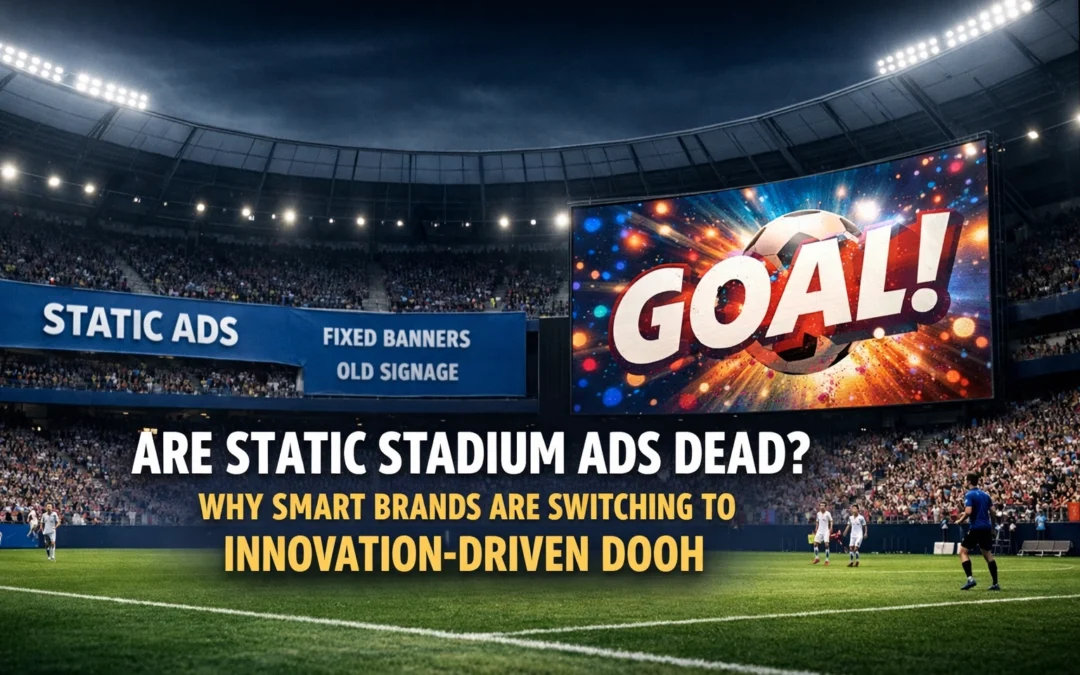
The question on every sports marketing professional's mind: are static stadium advertisements losing their relevance? The short answer is no, they are not entirely dead. However, the landscape is shifting dramatically as digital out-of-home (DOOH) advertising claims an increasing share of stadium marketing budgets. Brands seeking measurable engagement and real-time responsiveness are finding that innovation-driven DOOH offers capabilities that static banners simply cannot match.
The DOOH Advantage: Real-Time Engagement and Precision
The transition from static to digital is driven by fan expectations and technological capabilities rather than a wholesale rejection of traditional formats. Modern audiences expect dynamic, contextually relevant content, and DOOH delivers exactly that.

Dynamic Creative Optimization Changes the Game
Dynamic Creative Optimization (DCO) represents a fundamental shift in how stadium advertising operates. Unlike static banners that display the same message regardless of circumstances, DOOH enables advertisers to adapt messaging instantly based on real-time events. Brands can react to scoring plays, weather changes, or increased foot traffic around venues within moments.
This capability transforms advertising from a passive display into an active conversation with fans. When a team scores, brands can celebrate alongside supporters. When weather conditions shift, messaging can pivot to reflect the current environment. The result is advertising that feels timely and relevant rather than predetermined and generic.
Programmatic DOOH Introduces Strategic Flexibility
Programmatic digital OOH (pDOOH) adds another dimension of flexibility that static placements cannot provide. Traditional stadium sponsorships require brands to commit to fixed placements months in advance, often without precise knowledge of game outcomes, attendance patterns, or competitive contexts.
pDOOH allows brands to activate advertisements closer to game time or during specific moments when target audiences are most receptive. This approach reduces wasted impressions and concentrates budget on high-value opportunities. Combined with geofencing technology and device data, pDOOH reaches audiences based on actual movement patterns and behavior rather than static location assumptions.
Key benefits of programmatic DOOH include:
- Activation flexibility closer to event timing
- Targeting based on real audience movement and behavior
- Budget optimization through precise impression delivery
- Reduced commitment to long-term fixed placements
- Dynamic pricing that reflects actual demand

Interactivity Drives Measurable Engagement
Perhaps the most significant distinction between DOOH and static alternatives lies in interactivity. QR codes, mobile prompts, and live polls transform stadium advertising from passive impressions into active engagement opportunities. Fans can participate in real-time voting, access exclusive content, or receive promotional offers directly through their mobile devices.
This interactivity serves a dual purpose. First, it creates memorable brand experiences that extend beyond simple awareness. Second, it enables first-party data collection, providing brands with actionable insights about fan preferences, behaviors, and purchase intent. In an era where data privacy regulations limit third-party tracking, this first-party data becomes increasingly valuable for ongoing marketing efforts.
Static Ads Retain Strategic Value
Despite the compelling advantages of DOOH, static stadium advertisements continue to deliver measurable value in specific contexts. Understanding where static formats excel helps media buyers and brand managers allocate budgets more effectively.
Cost-Effectiveness for Long-Term Presence
Static signage requires no ongoing creative production, no technical infrastructure beyond installation, and no continuous campaign management. For brands seeking consistent presence without recurring investment, static placements in high-traffic areas such as fan zones and venue entrances provide reliable exposure.
The economics are straightforward. A single static banner investment delivers impressions throughout an entire season without additional costs. For brands with limited budgets or those prioritizing foundational brand awareness over dynamic engagement, this cost structure remains attractive.
Brand Reinforcement Through Consistency
Static advertisements excel at long-term brand reinforcement. When the same message appears in the same location consistently over time, it builds familiarity and mental availability. Fans begin to associate the brand with the venue experience itself, creating a form of brand equity that transcends individual game moments.
This consistency matters particularly for categories where purchase decisions involve extended consideration periods. Automotive brands, financial services, and major consumer goods often benefit more from steady presence than from momentary engagement spikes.

The Hybrid Strategy: Combining Static and Digital for Maximum Impact
The most sophisticated approach to stadium advertising does not treat static and digital formats as mutually exclusive options. Instead, leading brands deploy hybrid strategies that leverage the strengths of each format simultaneously.
Foundational Presence Meets Real-Time Activation
A hybrid strategy positions static advertisements as foundational brand presence while utilizing DOOH for real-time engagement and conversion. Static placements in key locations ensure consistent visibility, while digital screens adapt messaging based on game dynamics, audience composition, and external factors.
This approach provides several advantages:
- Static formats establish baseline brand awareness and familiarity
- Digital formats capitalize on high-engagement moments with relevant messaging
- Budget allocation balances cost-effectiveness with innovation
- Brand presence remains consistent while messaging stays flexible
- Measurement combines reach metrics with engagement data
Strategic Placement Considerations
Successful hybrid strategies require thoughtful placement decisions. Static advertisements perform best in locations where fans spend extended time, such as concourses, entrance areas, and gathering spaces. These environments allow for repeated exposure over longer periods.
Digital placements deliver maximum value in high-energy environments where attention is focused and engagement potential is elevated. In-stadium video boards, concourse digital screens, and exterior displays positioned for pre-game and post-game traffic capture attention during peak emotional moments.
Measurement and Attribution
The debate between static and DOOH ultimately centers on measurement capabilities. DOOH advertising provides granular data about impressions, engagement rates, and downstream behaviors. Brands can track how many unique devices were exposed to specific creative, measure attention metrics through computer vision technology, and attribute subsequent actions to specific advertisement exposures.
Static advertisements, by contrast, rely on estimated impressions based on attendance figures and placement visibility. While these estimates provide directional insight, they lack the precision and verifiability that modern marketing organizations demand.

Brand Lift and Business Outcomes
Both formats can drive brand lift when deployed strategically. Brand lift studies measure changes in awareness, consideration, preference, and purchase intent among exposed audiences compared to control groups. DOOH campaigns consistently demonstrate measurable brand lift, with documented increases ranging from double digits to triple digits depending on category, creative quality, and competitive context.
Static advertisements contribute to brand lift through sustained exposure over time, though isolating their specific impact requires more sophisticated measurement methodologies. The combination of both formats often produces the strongest overall brand lift, as consistent presence amplifies the impact of dynamic engagement moments.
Making the Strategic Choice
Media buyers and brand managers evaluating stadium advertising investments should consider several factors when allocating budget between static and digital formats:
Budget availability determines baseline feasibility. Organizations with limited resources may prioritize cost-effective static placements, while those with larger budgets can explore comprehensive DOOH strategies.
Campaign objectives guide format selection. Awareness-focused campaigns may lean toward static consistency, while consideration and conversion objectives benefit from DOOH's engagement capabilities.
Measurement requirements influence the format mix. Organizations requiring detailed attribution and performance metrics will favor DOOH's data-rich environment.
Category dynamics affect format effectiveness. Fast-moving consumer goods benefit from timely activation, while considered purchases may prioritize sustained presence.
Competitive context shapes strategic choices. In categories where competitors deploy sophisticated DOOH campaigns, static-only approaches risk appearing outdated.
The Future of Stadium Advertising
Static stadium advertisements are not dead, but their role is evolving. They serve as foundational elements in comprehensive marketing strategies rather than standalone solutions. The brands achieving the strongest results recognize that innovation-driven DOOH offers capabilities that align with modern measurement expectations, audience behaviors, and marketing objectives.
The transition to DOOH represents an opportunity rather than a threat. Media buyers and brand managers who understand both formats and deploy them strategically position their organizations for maximum impact in the dynamic stadium advertising environment. The question is no longer whether to embrace DOOH, but how to integrate it most effectively within a balanced, results-driven approach to sports marketing.