
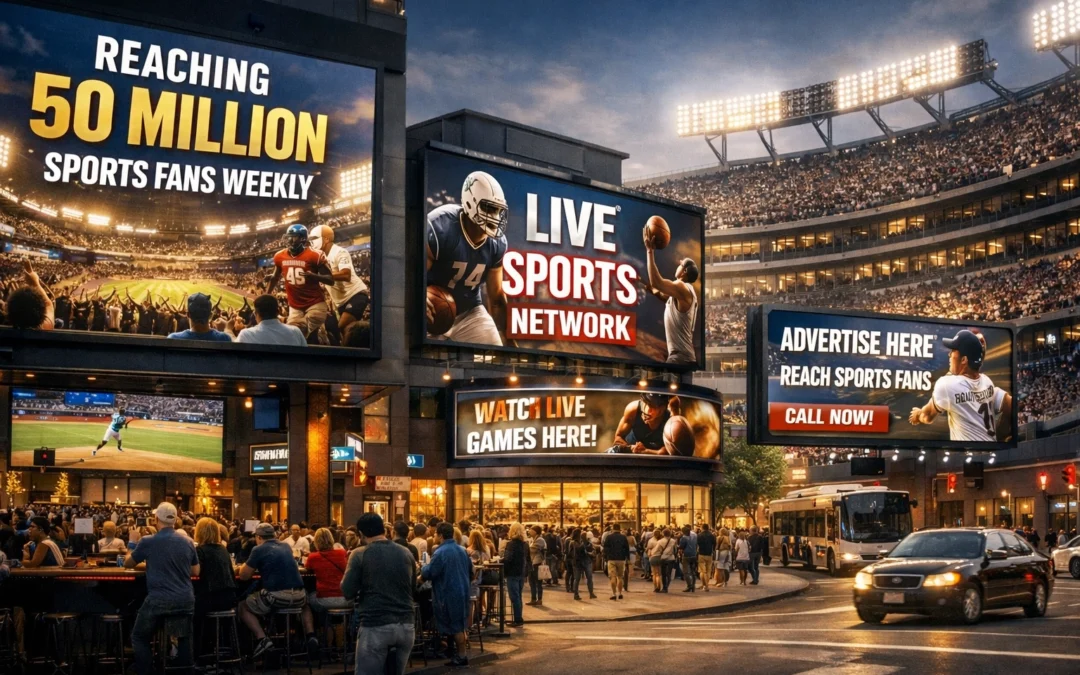
OOH Sports Network has achieved a significant milestone in sports marketing reach, now connecting with 50 million sports fans on a weekly basis through its expanding digital out-of-home advertising infrastructure. This benchmark represents a shift in how brands access engaged sports audiences outside traditional stadium sponsorships and broadcast advertising.
The network's growth stems from strategic distribution across more than 25,000 digital screens positioned in high-traffic sports viewing environments. This scale provides media buyers with programmatic access to captive audiences during peak engagement moments, when fans are actively watching games and making real-time purchasing decisions.
Network Infrastructure and Distribution Strategy
The foundation of the 50 million weekly reach lies in the network's physical footprint. OOH Sports has established screen placements across multiple venue categories where sports consumption occurs naturally:
- Sports bars and restaurants with live game broadcasts
- Entertainment venues with sports programming
- High-traffic retail locations near sports facilities
- Fitness centers and recreational facilities
- Quick-service restaurants frequented by sports demographics

This distribution strategy prioritizes environments where dwell time is extended and audience attention is already focused on sports content. Unlike traditional billboards or transit advertising, these screen placements benefit from viewers who are stationary, engaged, and often in social settings that amplify brand messaging through conversation and shared experience.
The programmatic nature of the network allows for dynamic content delivery across all 25,000+ screens simultaneously, with the ability to adjust creative, messaging, and targeting parameters in real time based on game schedules, scores, and audience composition.
Audience Composition and Engagement Metrics
The 50 million weekly reach represents a primarily male-skewed audience with strong representation in the 21-54 age demographic. This audience profile aligns closely with key consumer segments for categories including alcoholic beverages, automotive, financial services, sports betting, quick-service restaurants, and consumer electronics.
Research on out-of-home advertising effectiveness in sports contexts reveals that nearly six in ten adults recall recently seeing OOH ads promoting sporting events. Of those who recall the advertising, 90 percent took real-world action such as watching the advertised game, discussing it with friends and family, or engaging with related content on social media platforms.
The engagement rate extends to purchasing behavior. When fans attend sporting events after exposure to OOH advertising, 99 percent spend money locally on hospitality, dining, transportation, or related services. This creates a measurable economic impact that extends beyond direct brand lift metrics.
Programmatic Access and Campaign Flexibility

Media buyers access the OOH Sports Network through major demand-side platforms, enabling integration with broader omnichannel campaigns. This programmatic approach removes traditional barriers associated with out-of-home advertising, including long lead times, inflexible contracts, and limited measurement capabilities.
Campaign parameters can be adjusted based on:
- Specific sports leagues, teams, or game schedules
- Geographic targeting at venue, market, or national levels
- Daypart optimization aligned with game times
- Audience demographics and behavioral characteristics
- Real-time performance data and attribution signals
The programmatic infrastructure also supports dynamic creative optimization, allowing brands to adjust messaging based on game outcomes, scores, or relevant real-time events. This capability has proven particularly valuable for sports betting operators, quick-service restaurants offering game-day promotions, and beverage brands seeking to capitalize on specific moments within sporting events.
Replicating the Reach: Strategic Approaches for Advertisers
Brands seeking to leverage the 50 million weekly reach of the OOH Sports Network can deploy several strategic approaches based on campaign objectives and budget parameters.
High-Impact National Campaigns
For brands with national distribution and significant media budgets, full network buys provide simultaneous presence across all 25,000+ screens. This approach delivers maximum reach and frequency during peak sports viewing periods. National campaigns work particularly well for product launches, seasonal promotions, and brand awareness initiatives targeting sports enthusiasts.
Market-Specific Targeting
Brands with regional distribution or market-specific objectives can concentrate spend in designated metropolitan areas or venue clusters. This approach allows for higher frequency within target markets while maintaining budget efficiency. Market-specific targeting also enables localized creative messaging and promotion of market-specific retail locations or events.
League and Team Alignment

Advertisers can align campaigns with specific sports leagues, teams, or game schedules to reach passionate fan bases during moments of peak attention. This strategy proves effective for brands seeking association with particular sports properties without the cost commitment of official sponsorship rights. The targeting can be refined to specific game types, rivalries, or playoff scenarios that generate heightened viewership and engagement.
Audience-Based Buying
Beyond venue and geography, the network supports audience-based buying using first-party and third-party data segments. Brands can target based on demographic profiles, behavioral characteristics, purchase history, and contextual signals. This approach optimizes reach efficiency by focusing impressions on consumers most likely to respond to the advertising message.
Measurement and Attribution Capabilities
The digital infrastructure supporting the 50 million weekly reach includes comprehensive measurement capabilities that address traditional limitations of out-of-home advertising. Advertisers gain access to multiple layers of performance data:
Impression Verification
Screen-level impression counts based on venue traffic patterns, dwell time analysis, and audience composition estimates. This provides baseline reach and frequency metrics comparable to other digital advertising channels.
Brand Lift Studies
Pre-campaign and post-campaign survey methodologies measure shifts in brand awareness, message recall, purchase consideration, and brand preference among exposed audiences compared to control groups. These studies quantify the impact of OOH Sports Network campaigns on brand perception metrics.
Foot Traffic Attribution
Mobile device ID matching connects screen exposures to subsequent store visits, enabling measurement of offline conversion impact. This capability proves particularly valuable for retail advertisers, quick-service restaurants, and automotive brands with physical dealership networks.
Digital Retargeting Audiences
Device IDs exposed to OOH Sports Network campaigns can be packaged into retargeting audiences for follow-up messaging across mobile, display, video, and social media channels. This extends the campaign impact beyond the physical screen environment and enables multi-touch attribution analysis.
Campaign Activation Process

Accessing the 50 million weekly reach through the OOH Sports Network follows a streamlined activation process designed for media buyers familiar with programmatic buying workflows:
Campaign planning begins with objective definition and audience identification. Media buyers work with OOH Sports or through their demand-side platform to establish targeting parameters, budget allocation, and creative specifications.
Creative assets are submitted in standard digital formats, with the network supporting both static and video content. The programmatic infrastructure handles creative trafficking and distribution across the screen network without requiring manual placement coordination.
Campaign launch occurs through the demand-side platform interface, with real-time bidding determining ad placement across available inventory. The system optimizes delivery based on targeting parameters and performance signals throughout the campaign flight.
Performance monitoring happens in near real-time through platform dashboards displaying impression delivery, geographic distribution, and preliminary engagement signals. Post-campaign reports provide comprehensive analysis including brand lift study results and attribution data when applicable.
Industry Context and Market Position
The 50 million weekly reach milestone positions OOH Sports Network as a significant player in the digital out-of-home sports advertising landscape. This scale enables competition with traditional stadium perimeter advertising and broadcast sponsorships while offering advantages in targeting precision, campaign flexibility, and measurement capabilities.
The programmatic access model democratizes sports audience reach for brands that may lack budget for official league sponsorships or broadcast advertising. Mid-market brands, regional advertisers, and direct-to-consumer companies gain access to premium sports audiences through flexible budget commitments and performance-based buying.
The network's growth trajectory reflects broader shifts in out-of-home advertising toward digital infrastructure, programmatic buying, and sophisticated measurement. As sports viewership fragments across streaming platforms and venue-based consumption grows, the OOH Sports Network provides brands with a consistent access point to engaged fans regardless of broadcast distribution.
Strategic Value for Media Buyers
For media buyers evaluating out-of-home investments in sports marketing, the 50 million weekly reach represents an opportunity to achieve scale without the commitments associated with traditional sports sponsorships. The programmatic access model enables testing, optimization, and performance-based budget allocation across campaign flights.
The audience composition aligns with high-value consumer segments across multiple product categories. The engagement environment, with fans actively watching sports in social settings, creates favorable conditions for message reception and brand recall. The measurement capabilities address historical concerns about out-of-home attribution and performance verification.
Brands can leverage the network as a standalone channel or integrate it within broader omnichannel campaigns that span digital video, social media, search, and display advertising. The ability to build retargeting audiences from OOH exposures enables sequential messaging strategies that reinforce brand messages across multiple touchpoints.
The 50 million weekly reach achieved by OOH Sports Network demonstrates the viability of venue-based digital out-of-home advertising as a scalable channel for sports marketing. For media buyers seeking to connect with sports audiences during moments of peak engagement, the network provides programmatic access, measurement capabilities, and campaign flexibility that align with modern performance marketing requirements.