
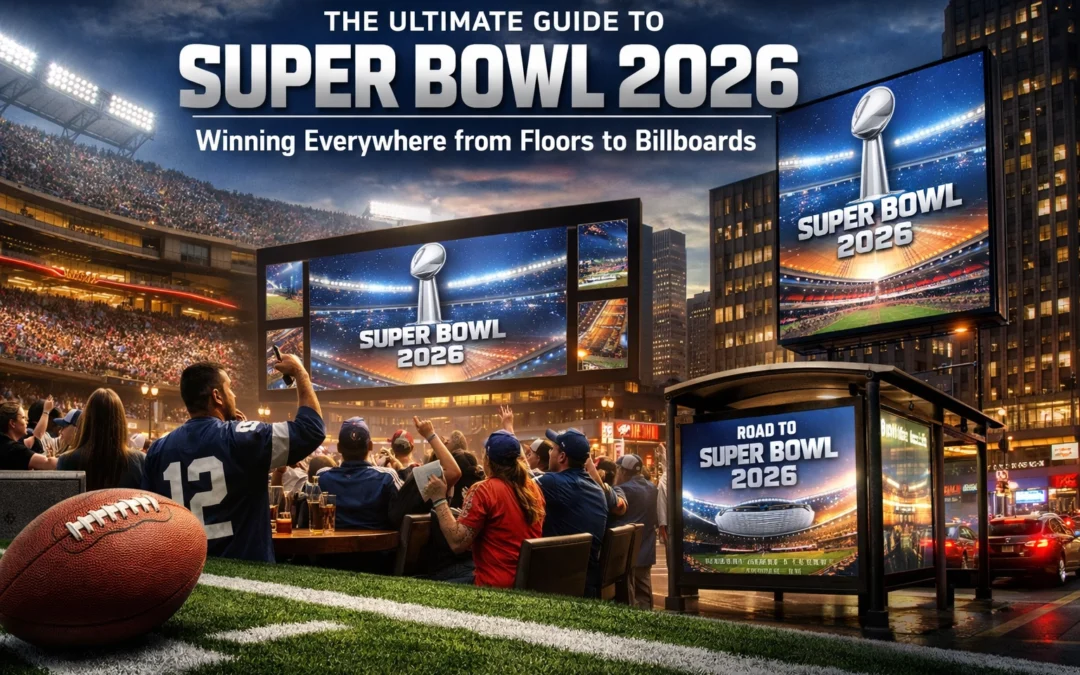
Super Bowl LX took place on February 8, 2026, at Levi’s Stadium in Santa Clara, California. The event saw the Seattle Seahawks secure a 29-13 victory over the New England Patriots. While the action on the field captured global attention, the advertising landscape surrounding the game represented a pinnacle of four decades of industry evolution. For OOH Sports, this event served as a masterclass in venue-wide coverage, moving beyond traditional spots to a strategy that spanned from floor graphics to massive digital billboards.
Strategy: Four Decades of Advertising Leadership
The success of Super Bowl 2026 was not an overnight achievement. It was the result of 40 years of advertising leadership and a steady transition from static signage to high-tech digital out-of-home (DOOH) solutions. Over these four decades, the industry moved from simple perimeter boards to a fully integrated digital ecosystem.
OOH Sports has focused on creating a seamless experience for fans. This means that a brand message is not just a single touchpoint but a continuous journey. When a fan enters the stadium, they are greeted by floor graphics. As they move through the concourses, they see high-definition digital screens. In the seating bowl, stadium perimeter ads capture attention during key plays. This comprehensive approach ensures that brand messaging is inescapable yet remains a natural part of the game-day environment.

Objective & Strategy: Total Venue Dominance
The primary objective for advertisers during Super Bowl LX was to achieve "Total Venue Dominance." This strategy involves utilizing every available surface to reinforce a brand's presence. In the lead-up to the event, the OOH Sports network expanded to 25,000 digital screens across America, providing an unprecedented reach for sports advertisers.
The strategy for Super Bowl 2026 focused on three key areas:
- Entrance and Concourse Engagement: Utilizing floor graphics and eye-level digital displays to catch fans as they enter and move through the stadium.
- In-Game Visibility: Dominating the stadium perimeter boards which, as research shows, capture hearts and wallets better than social media.
- Surrounding Area Saturation: Using large-scale digital billboards in the San Francisco Bay Area to target fans traveling to and from Levi's Stadium.
This holistic approach ensures that a brand is not just seen once, but is reinforced throughout the entire Super Bowl experience.
Technology Partners: The Role of Programmatic DOOH
One of the most significant shifts in the last decade has been the adoption of programmatic technology. For Super Bowl 2026, the use of sophisticated Demand Side Platforms (DSPs) was critical. A major spotlight on StackAdapt DSP highlights how these tools drive programmatic DOOH adoption in omnichannel campaigns.

By using programmatic DOOH, advertisers could adjust their creative in real-time based on game events, weather, or crowd sentiment. This level of flexibility was once impossible with traditional billboards. The integration of AI-powered targeting allowed brands to deliver specific messages to specific sections of the stadium or surrounding transit hubs, maximizing the efficiency of every ad dollar spent.
https://www.youtube.com/watch?v=l6J-0zileKE
Execution: From Floors to Billboards
The execution of the Super Bowl 2026 campaign required meticulous planning and logistics. The "floors to billboards" concept was realized through a variety of media formats:
- Digital Floor Graphics: Strategically placed at entrance gates and concession lines, these high-durability screens provided interactive brand moments.
- Perimeter LED Boards: Encircling the field, these boards provided the high-impact visibility necessary for television broadcasts and in-person spectators.
- Large Format Billboards: Located along Highway 101 and near San Jose International Airport, these served as the first and last touchpoints for visiting fans.
- Transit Hubs: Digital screens in Caltrain stations and ride-share pickup zones ensured brand continuity outside the stadium gates.
The precision of this execution allowed brands to tell a story that evolved as the fan progressed through their day. For example, a beverage brand might show a "refreshment" message on concourse screens before the game and a "celebratory" message on exterior billboards following the final whistle.

Results: Quantifiable Impact and Brand Lift
The data from Super Bowl LX confirms the effectiveness of this venue-wide strategy. When comparing integrated DOOH campaigns to traditional stadium sponsorships, the programmatic approach consistently delivers a higher return on investment.
Historical data from previous campaigns provides a clear picture of what is possible:
- White Claw saw a 74 percent lift in purchase consideration using similar programmatic strategies.
- AB InBev’s Mike’s Hard Iced Tea experienced a 119 percent lift in positive brand image.
- Sea-Doo reported a 144 percent increase in purchase consideration during their first digital OOH push.
For Super Bowl 2026, brands that utilized the full "floors to billboards" spectrum reported significantly higher brand recall compared to those who only focused on a single medium. The ability to reach fans in a low-clutter environment like a stadium floor or a transit screen proved to be a major differentiator.
Logistics and Targeting: Why Stadium Perimeter Matters
Many marketers question if traditional stadium ads are still relevant in the age of mobile devices. However, the 2026 event proved that stadium perimeter targeting fixes many of the mistakes found in standard digital campaigns.
Unlike social media, which is often ignored or blocked by users, stadium OOH is part of the spectacle. It is a shared experience. During Super Bowl LX, the perimeter ads were synchronized with the stadium lighting and audio systems to create an immersive environment. This level of logistical coordination ensured that ads were not just seen, but felt by the audience.

The Future: 2030 and Beyond
As the industry looks past the success of 2026, the growth trajectory for digital sports advertising remains steep. Experts predict that DOOH sports advertising will hit 50 billion dollars by 2030. This growth will be driven by further advancements in AI and real-time data integration.
The strategies refined during Super Bowl LX, such as real-time betting updates and programmatic audience triggers, are becoming the new standard. Programmatic DOOH sports campaigns are expected to reach 58 billion dollars as brands move away from static buys toward more dynamic, data-driven placements.
The "Ultimate Guide to Super Bowl 2026" is essentially a roadmap for the future of the industry. By combining 40 years of leadership with cutting-edge technology, OOH Sports has demonstrated that the most effective way to win in the advertising world is to be everywhere the fan is, from the floors they walk on to the billboards they see on the way home.
Summary of Tactics for Maximum ROI
To replicate the success seen at Levi's Stadium, advertisers should focus on the following tactics:
- Start Early: Integrate OOH into the omnichannel mix from the beginning of the planning phase.
- Use Data-Driven Targeting: Leverage DSPs like StackAdapt to ensure ads reach the right demographic at the right time.
- Think Beyond the Billboard: Utilize non-traditional surfaces like floors and stadium perimeters for higher engagement.
- Measure Everything: Use brand lift studies and exposure data to quantify the impact of the campaign.
The 2026 Super Bowl was a milestone for the advertising industry, proving that with the right strategy and technology, out-of-home advertising remains the most powerful tool in a marketer's arsenal for major sporting events. For more information on navigating this evolving landscape, visiting the OOH Sports website provides access to further case studies and strategic insights.