
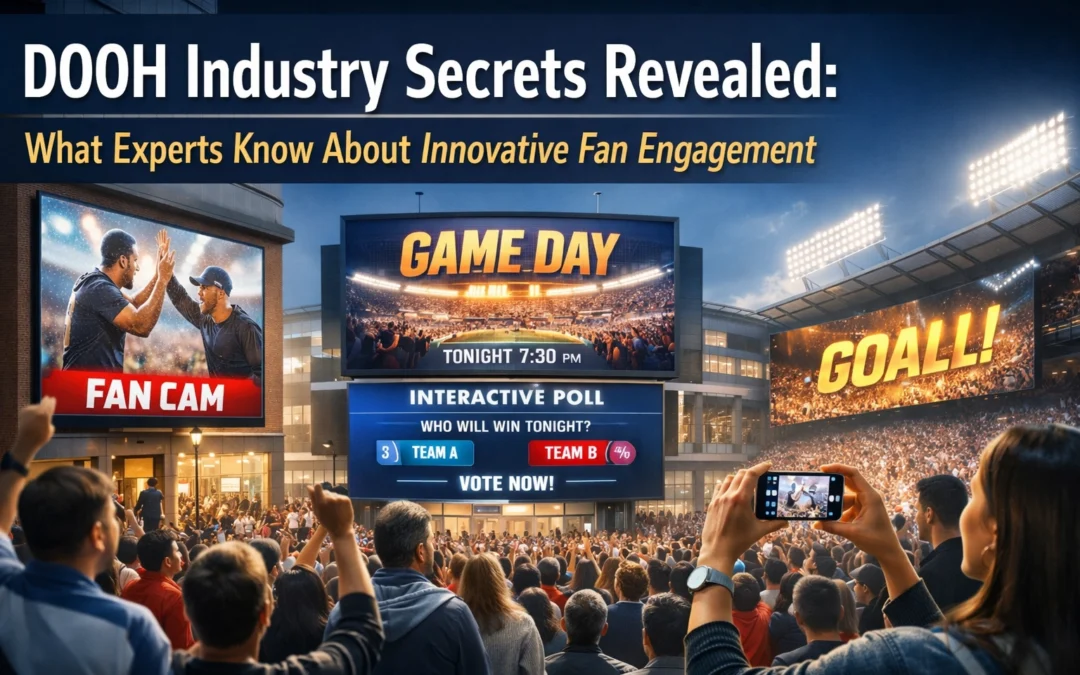
The landscape of sports advertising is undergoing a significant transformation. While traditional television spots and social media campaigns continue to play a role, Digital Out-of-Home (DOOH) advertising has emerged as a powerhouse for driving deep, meaningful fan engagement. Industry experts now recognize that the most effective strategies go far beyond simply placing a logo on a screen. Success in the modern era requires a sophisticated blend of real-time data, strategic placement, and omnichannel integration.
This shift is driven by the realization that fan attention is not a finite resource tied strictly to the duration of a game. Instead, it is a continuous journey that begins long before the first whistle and extends well after the final score. By leveraging the unique capabilities of DOOH, advertisers are finding ways to insert themselves into this journey in ways that feel organic, helpful, and high-impact.
The Strategy of Real-Time Dynamic Content
One of the most guarded secrets in the DOOH industry is the power of dynamic content. Programmatic technology now allows advertisers to change creative assets in real-time based on external data triggers. For sports fans, this means ads are no longer static messages but live information hubs.
Experts prioritize contextual relevance by utilizing live game scores, athlete statistics, and countdown clocks to game starts. This level of integration ensures that the advertisement is seen as part of the sports experience rather than an interruption. For instance, a digital billboard near a stadium can display the current score during the third quarter, paired with a celebratory message from a sponsor when the home team scores.
The technical execution involves connecting the DOOH media player to a live data feed. This allows the creative to update automatically without manual intervention. The result is a campaign that remains perpetually fresh and relevant to the immediate environment of the viewer. When fans see information that matters to them in the moment, brand recall and affinity increase significantly.

Omnichannel Activation Across the Fan Journey
A common misconception in sports marketing is that the stadium is the only place to reach a captive audience. In reality, experts understand that 99 percent of fan attention exists outside the arena. Strategic activation involves mapping out the entire fan journey, from the morning commute to the post-game celebration.
The journey often begins hours before an event. Digital displays in transit hubs, such as subways and bus stations, can build anticipation through highlight reels or "matchday" teasers. As fans move toward the venue, screens at gas stations or convenience stores can offer promotions on tailgating essentials.
By the time the fan reaches the stadium vicinity, the DOOH messaging shifts to welcome messages and directional assistance. Even after the game, the strategy continues. Screens in nearby entertainment districts or restaurants can capitalize on the emotional state of the crowd, offering celebratory deals after a win. This multi-touchpoint approach ensures that the brand remains a constant companion throughout the day. For more insights on how these touchpoints compare to other channels, exploring why stadium ads capture attention better than social media provides a clear perspective on physical presence: https://oohsports.com/2026/02/13/fan-engagement-matters-why-stadium-perimeter-ads-capture-hearts-and-wallets-better-than-social-media.
Bridging Physical and Digital Spaces
The most innovative campaigns currently running are those that successfully bridge the gap between the physical world and the digital device in the fan's pocket. Experts use DOOH as a "top of funnel" awareness tool that seamlessly leads to a "bottom of funnel" digital conversion.
A key tactic in this area is the use of dynamic QR codes and mobile integration. By scanning a code on a digital screen, fans can be directed to:
- Exclusive merchandise drops available only for a limited time.
- Interactive mobile games or AR experiences that enhance the live event.
- Digital coupons that are redeemable at nearby retail locations.
- Instant sign-ups for loyalty programs or newsletters.
This connection allows for sophisticated retargeting. By using anonymized mobile location data, advertisers can identify devices that were in the vicinity of a DOOH screen and later serve them related ads on social media or through mobile apps. This "media layering" approach has been shown to amplify reach and drive higher conversion rates than single-channel campaigns.
Strategic Placement Beyond Traditional Venues
While large scale stadium screens are impressive, industry insiders know that premium inventory often exists in less obvious locations. Geo-specific targeting allows brands to reach fans where they gather naturally. This includes sports bars, public viewing areas, and community centers.
In these environments, the atmosphere is often as charged as the stadium itself. Advertising in these "third spaces" allows for a high degree of community engagement without the massive budget requirements of official stadium partnerships. For smaller or mid-market brands, this provides a pathway to compete for fan attention in high-passion environments.
Transit advertising also remains a staple for expert planners. Reaching commuters on buses or trains provides a long dwell time, allowing for more detailed storytelling or multiple creative rotations. This is particularly effective in metropolitan areas where the public transit system is the primary artery for fans traveling to a game.

Measuring Impact with Data-Driven Results
The shift toward programmatic DOOH has brought a new level of accountability to out-of-home advertising. It is no longer a matter of "estimating" views based on traffic patterns. Instead, experts rely on sophisticated measurement tools to prove brand lift and purchase intent.
Several recent campaigns have demonstrated the effectiveness of this approach:
- White Claw: A programmatic DOOH campaign for a vodka launch utilized strategic placement and data-driven targeting to achieve a 74 percent lift in purchase consideration. Detailed logistics of this campaign can be found here: https://oohsports.com/2024/09/21/white-claws-programmatic-digital-out-of-home-campaign-drives-74-lift-in-purchase-consideration-for-vodka-launch.
- AB InBev (Mike’s Hard Iced Tea): This campaign focused on brand image and saw a 119 percent lift in positive brand image by leveraging programmatic DOOH to reach fans in high-relevance environments. The strategy and results are detailed here: https://oohsports.com/2024/10/21/ab-inbevs-mikes-hard-iced-tea-sees-a-119-lift-in-positive-brand-image-with-programmatic-dooh-campaign.
- Sea-Doo: By executing its first digital OOH campaign with a focus on geographic relevance and visual impact, the brand increased purchase consideration by 144 percent. More information on this execution is available at: https://oohsports.com/2024/11/21/how-sea-doos-first-digital-ooh-campaign-increased-purchase-consideration-by-144.
These results are quantified through brand lift studies, which compare a group of people exposed to the ads against a control group of unexposed consumers. By tracking device IDs and utilizing survey data, advertisers can see exactly how the DOOH placement moved the needle on consumer behavior.
Technology and Scale
The ability to execute these complex strategies depends heavily on the scale of the network. A larger network of screens allows for more precise targeting and broader reach. For example, the OOH Sports network has expanded to 25,000 digital screens across America, providing advertisers with unprecedented access to sports fans in a variety of environments. This scale is crucial for brands looking to run national campaigns with local relevance.
The technology behind these screens is equally important. High-definition displays ensure that the creative looks as good in the sun as it does at night. Furthermore, the integration with demand-side platforms (DSPs) allows advertisers to buy DOOH inventory with the same ease and precision as they buy online display ads.

The Future of Fan Engagement
As technology continues to evolve, the "secrets" of the DOOH industry will become standard practice. The integration of artificial intelligence will likely lead to even more personalized creative, where the content on the screen adjusts based on the specific demographic makeup of the crowd passing by in real-time.
Furthermore, the expansion of 5G networks will allow for even more interactive experiences, such as real-time betting odds or ultra-high-definition live streaming on public screens. For advertisers, the message is clear: the most successful way to engage a sports fan is to become a valuable part of their journey. By using DOOH to provide information, entertainment, and utility, brands can build a level of loyalty that persists long after the season ends.
The key takeaway for any brand looking to enter this space is to think beyond the board. Consider the data, the location, and the digital connection. When these elements align, DOOH becomes more than just an advertisement. It becomes an essential part of the fan experience.
For those interested in exploring the broader network or understanding the specific offerings available, visiting the main portal at https://oohsports.com provides a comprehensive overview of the current capabilities in the sports advertising sector.