
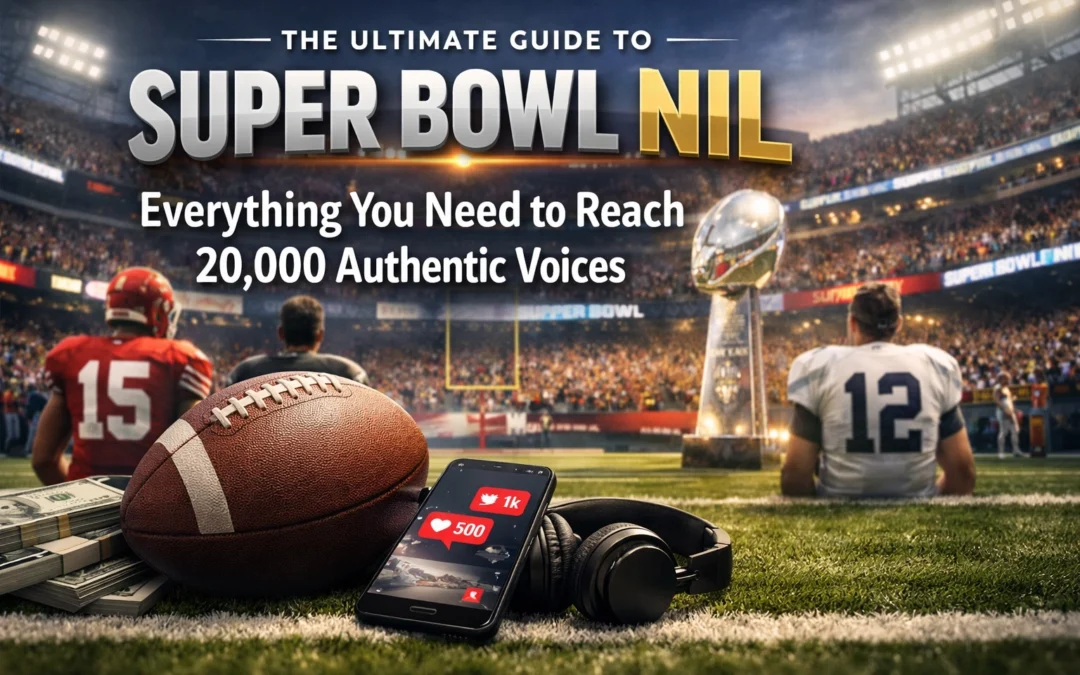
The Super Bowl has always been the peak of the advertising world. For decades, media buyers and brands focused on the 30 second television spot that cost a fortune. But in 2026, the game has changed. The focus is no longer just on the screen in the living room. It is on the screens in everyone's hands and the digital displays throughout the city. Most importantly, it is about the voices people actually trust.
Name, Image, and Likeness (NIL) has evolved from a small marketing experiment into a massive powerhouse. When you combine the reach of 20,000 authentic student-athlete voices with the infrastructure of OOH Sports, you get a marketing engine that moves faster and hits harder than any traditional campaign. This is the new standard for Super Bowl advertising.
The Shift to Authentic Voices
Authenticity is the most valuable currency in 2026. While high production commercials still have their place, audiences are becoming more skeptical of polished agency content. Data from recent campaigns shows that student-athletes who create genuine, personal content in their own voices generate engagement rates three to four times higher than professional advertisements.
This is why the OOH Sports NIL platform is a game changer. Instead of betting your entire budget on one celebrity, you can distribute your message through thousands of athletes who have direct, trusted relationships with their followers. These athletes are not just influencers. They are peers, heroes, and community leaders.
Why 20,000 Athletes Matter
Scale used to be the enemy of authenticity. If you wanted to reach millions of people, you had to use a broad, generic message. If you wanted to be authentic, you had to stay small. The OOH Sports NIL platform has solved this problem. By connecting with over 20,000 student-athlete voices, brands can achieve massive reach without losing that personal touch.
Think of it as distributed amplification. When 1,000 athletes from different sports and universities talk about a brand at the same time, it creates a cultural moment. It does not feel like an ad campaign. It feels like a conversation that is happening everywhere at once.
The Power of the Micro-Influencer
A common mistake media buyers make is chasing the athletes with the largest following. While a superstar with millions of followers offers reach, the engagement often lacks depth. Athletes with 5,000 to 50,000 followers, known as micro-influencers, consistently outperform expectations. Their audiences trust their recommendations and convert at much higher rates.
Multi-athlete campaigns create a compounding effect. Brands that partner with at least ten athletes across different sports generate 67 percent more total impressions than those that put their entire budget into one or two high profile stars.
Watch: The Future of NIL Strategy
To understand how this ecosystem works in real-time, take a look at the strategy behind the modern NIL landscape.
https://www.youtube.com/watch?v=l6J-0zileKE
The 72-Hour Super Bowl Blitz
Execution is everything during Super Bowl week. The window of opportunity is tight, and the noise is deafening. In 2026, the most successful brands used a strategy called the 72-Hour Blitz. This involved activating over 1,200 athletes from 43 different sports to flood social media channels simultaneously.
The results from this approach are staggering. During the 2026 Super Bowl cycle, these types of campaigns generated:
- Over 847 million combined social media impressions.
- An average engagement rate of 8.7 percent, which is nearly triple the industry standard.
- A 67 percent conversion rate from one-time partnerships into long-term brand deals.
This level of saturation ensures that no matter where a fan turns, they are seeing the brand through the eyes of an athlete they admire.

Integrating NIL with Digital Out-of-Home (DOOH)
NIL does not live in a vacuum. To truly dominate the Super Bowl market, brands must bridge the gap between the digital and physical worlds. This is where OOH Sports excels. By combining NIL content with the OOH Sports network, which has expanded to 25,000 digital screens across America, media buyers can create a 360-degree experience.
Imagine a fan walking through a stadium district. They see a student-athlete they follow on a massive digital billboard. Ten minutes later, they see a video post from that same athlete on their phone. This reinforces the message and makes the brand feel omnipresent. Research shows that stadium perimeter ads and surrounding digital screens capture attention far better than social media alone because they reach fans when they are at their most excited.
A Tiered Approach to Athlete Participation
To manage 20,000 voices effectively, media buyers should use a tiered structure. This ensures that the budget is allocated efficiently and the campaign has both "hooks" and "volume."
- Top-Tier (100,000+ followers): These are the anchor athletes. They provide high-production content and massive initial reach to kick off the campaign.
- Mid-Tier (10,000-100,000 followers): This group provides the bulk of the volume. They are the backbone of the campaign and drive the majority of the engagement.
- Micro-Tier (Under 10,000 followers): These athletes provide hyper-local activation. They are perfect for targeting specific university towns or niche demographics.
By balancing these three tiers, a brand can ensure that their Super Bowl message is both broad and deep.

Measurement and ROI
The biggest question for any media buyer is: "Does it work?" In the past, measuring the impact of thousands of athletes was a nightmare. Today, the OOH Sports platform provides clear attribution.
By using unique URLs and promo codes for individual athletes, brands can track website visits, app downloads, and purchases in real-time. We can also look at cost-efficiency. NIL campaigns typically deliver a lower cost-per-impression than traditional influencer marketing because the content is more organic and the athletes are more motivated to perform.
In many cases, programmatic DOOH and NIL integration deliver a much higher ROI than traditional stadium sponsorships. It is no longer about just having your logo on a wall. It is about being part of the story that athletes are telling their fans.
Timing is Everything
A Super Bowl NIL campaign should not start on Sunday. The most effective campaigns launch two to three weeks before the game. This builds awareness and allows the content to gain traction organically.
The peak activation should happen during Super Bowl week, with a final "post-game" push that references the results of the game. This extended timeline keeps the brand in the conversation much longer than a single TV spot ever could.

The Future of Sports Marketing
The 2026 Super Bowl has proven that the old rules of sports marketing are being rewritten. The power has shifted from the broadcasters to the athletes and the platforms that enable them.
As we look toward the rest of 2026, including March Madness and the upcoming baseball season, the lesson is clear. If you want to reach fans, you have to go where they are looking. You have to speak to them through the voices they trust.
OOH Sports is at the center of this revolution. With our massive network of digital screens and our connection to over 20,000 student-athletes, we are helping brands reach audiences in ways that were never possible before. The Super Bowl is just the beginning. The goal is to create a constant, authentic presence in the lives of sports fans everywhere.
Whether you are looking to drive a 74 percent lift in purchase consideration like White Claw or a 119 percent lift in brand image like AB InBev, the combination of DOOH and NIL is the most powerful tool in your arsenal. It is time to stop buying ads and start building connections. Reach out to Dan Kost and the team at OOH Sports to learn how you can activate 20,000 voices for your next big move.