
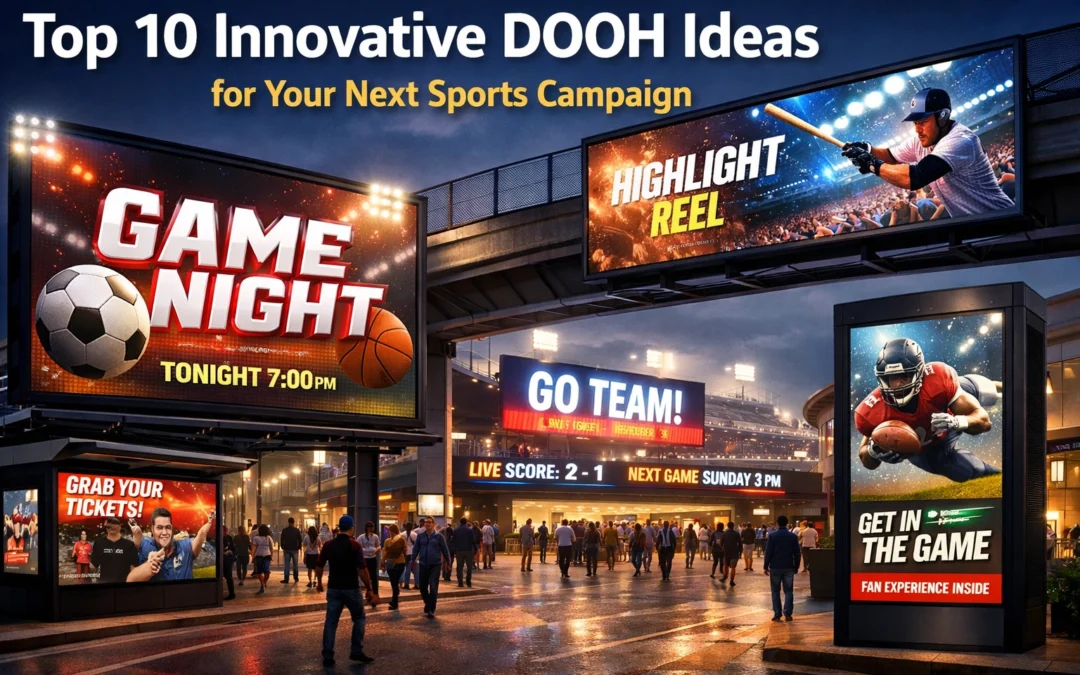
Digital Out-of-Home (DOOH) advertising has undergone a significant transformation within the sports marketing sector. As the industry moves toward a projected market value of $50 billion by 2030, brands are seeking more sophisticated ways to engage fans beyond traditional static billboards. The integration of real-time data, programmatic buying, and immersive technology has created a new standard for campaign execution.
For advertisers and partners looking to maximize impact, the following ten strategies represent the current peak of innovation in DOOH sports advertising. These methods focus on measurable results, fan engagement, and strategic placement to drive brand lift and purchase consideration.
1. Mega-Scale Immersive Displays
High-impact visual dominance remains one of the most effective ways to capture attention in a crowded media landscape. Large-scale LED structures, such as 360-degree canvases or spherical displays, offer an immersive experience that traditional panels cannot replicate.
Strategy and Objective
The objective is to create a landmark moment that generates organic social media amplification. By utilizing massive LED surfaces, brands can display custom countdowns, dynamic team matchups, or hyper-realistic 3D anamorphic content. This approach turns an advertisement into a destination, ensuring that the brand is associated with the scale and prestige of major sporting events.
Execution
Execution requires high-resolution creative assets designed specifically for the unique geometry of the display. Coordination with specialized studios ensures that the visual content wraps correctly around curved or spherical surfaces, maintaining clarity from all viewing angles.
2. Real-Time, Game-Triggered Creative
Programmatic DOOH allows for the instant modification of creative content based on live data feeds. This capability ensures that the messaging remains relevant to the current state of a sporting event.
Strategy and Objective
The strategy involves setting specific "triggers" within a Demand-Side Platform (DSP). For example, if a home team wins a game, the creative can automatically switch to a celebratory message or a limited-time offer. This relevance increases the likelihood of consumer action by aligning the brand's voice with the fan's emotional state.
Results and Impact
Real-time triggers have been shown to significantly increase purchase consideration. Similar programmatic approaches, such as those used in the White Claw DOOH campaign, have demonstrated a 74% lift in brand consideration by delivering timely and relevant messaging to target audiences.

3. Personality-Driven Localized Billboards
While national campaigns provide reach, localized, personality-driven creative provides a deeper connection with specific fan bases. Featuring star players with messaging tailored to a city's unique culture or a player's specific reputation creates a sense of community.
Objective and Strategy
The goal is to leverage the "local hero" effect. By deploying billboards in specific neighborhoods or transit routes frequently used by fans, brands can use player-specific headlines that resonate with the local vernacular. This strategy humanizes the brand and positions it as a genuine supporter of the local sports culture.
Tactics
- Deployment of creative in high-traffic urban areas.
- Use of localized slang or references to historical team moments.
- Integration of player-specific imagery that mirrors the demographics of the surrounding area.
4. Opponent-Specific Tactical Messaging
In sports, the opponent is often as important as the home team. Strategic DOOH campaigns can capitalize on specific matchups by tailoring the ad copy to the rival team currently in town.
Strategy
Brands can use programmatic targeting to update ad copy based on the game schedule. If a team is facing a long-standing rival, the ad copy can adopt a more competitive or humorous tone. This level of customization demonstrates that the brand is following the season closely, which builds trust with dedicated fans.
Technology Partners
Utilizing sophisticated platforms like the StackAdapt DSP allows for the seamless management of these creative swaps across multiple markets simultaneously.
5. Interactive Physical Activations
Transforming public spaces into functional, branded experiences moves the consumer from a passive observer to an active participant.
Objective
The objective is to increase dwell time and create a physical memory of the brand. This might involve converting a bus shelter into a mini-gym or using heat-sensitive panels to demonstrate the warming properties of athletic apparel.
Execution
These activations require a combination of DOOH screens and physical installations. For instance, a screen might display a challenge (e.g., "See how many pull-ups you can do") while sensors track the user's progress. This data can then be displayed on the screen in real-time, creating a competitive, gamified environment.

6. Stadium Surround Strategy
A comprehensive fan journey begins long before the spectator enters the stadium and continues after they leave. The "Stadium Surround" strategy maps DOOH placements along the entire commute and entry process.
Strategy and Objective
The objective is to achieve multiple touchpoints throughout the game day. This includes digital panels at transit hubs, billboards along major highways leading to the venue, and Sportrons located within the immediate vicinity of the stadium.
Tactics
- Pre-game: Messaging focused on excitement, team pride, or pre-game retail locations.
- Mid-game: Contextual ads in nearby bars and restaurants where fans gather during halftime.
- Post-game: "Thank you" messages or "Drive safe" reminders that reinforce brand affinity.
7. Multi-City Coordinated Campaigns
For brands with a national presence, coordinating DOOH across several major cities simultaneously can create a "takeover" effect that dominates the cultural conversation.
Strategy
By launching synchronized creative across multiple markets, brands can emphasize broad themes such as a player's off-court impact or a brand's commitment to youth sports. This approach ensures that the message is amplified across diverse geographic regions, reaching a wide but relevant audience.
Results
Coordinated multi-city campaigns often see a significant increase in brand image metrics. For instance, campaigns that focus on brand storytelling have seen up to a 119% lift in positive brand image, proving that consistency across locations drives perception.

8. Pop-Up Retail and Scarcity Integration
DOOH can be a powerful driver of immediate retail action, especially when combined with elements of scarcity or exclusive releases.
Objective and Strategy
The strategy involves using digital facades or urban panels to act as a countdown clock for limited-edition product drops. This creates a sense of urgency. The screens can provide directions to the nearest retail location or a QR code to access a mobile-only storefront.
Measurement
Impact is measured through foot traffic attribution and conversion rates at the point of sale. Campaigns that successfully integrate OOH with retail objectives have seen purchase consideration increases as high as 144%, as seen in Sea-Doo’s programmatic DOOH execution.
9. Omnichannel Reinforcement
DOOH is most effective when it is not used in isolation. Reinforcing DOOH messaging through other digital channels ensures that the brand remains top-of-mind.
Strategy
The process starts with a consumer being exposed to a high-impact DOOH display. Through device ID capturing (where privacy-compliant), that same consumer can then be retargeted with a mobile ad or a social media post that continues the story. This creates a seamless transition from the physical world to the digital one.
Execution
- Identify high-traffic DOOH locations.
- Sync mobile retargeting to trigger after the consumer has left the DOOH geofence.
- Use consistent creative elements across all channels to maintain brand recognition.
10. Real-Time Betting and Data Integration
As sports betting becomes more integrated into the fan experience, DOOH screens can serve as real-time information hubs.
Strategy and Objective
The goal is to provide utility to the fan. By displaying live odds, player statistics, or game scores, the DOOH screen becomes a valuable resource rather than just an advertisement. This is particularly effective for sports betting brands that need to convert users within a short window of time.
Tactics
- Integration of live API feeds from sports data providers.
- Displaying dynamic odds that update as the game progresses.
- Providing a direct "bet now" call to action via mobile deep-linking.
For more information on launching these types of high-speed campaigns, refer to the guide on launching real-time betting DOOH campaigns.
Conclusion: Driving ROI Through Innovation
The success of a DOOH sports campaign is no longer measured simply by impressions. Modern advertisers focus on brand lift, foot traffic attribution, and real-time engagement. By moving away from static placements and embracing data-driven, interactive, and strategically localized content, brands can achieve a much higher return on investment.
Whether it is through the sheer scale of immersive displays or the precision of game-triggered creative, the opportunities for innovation in the sports sector are vast. To explore more about how these strategies can be applied to specific business objectives, visit the OOH Sports marketing page or review further case studies on successful programmatic executions.