
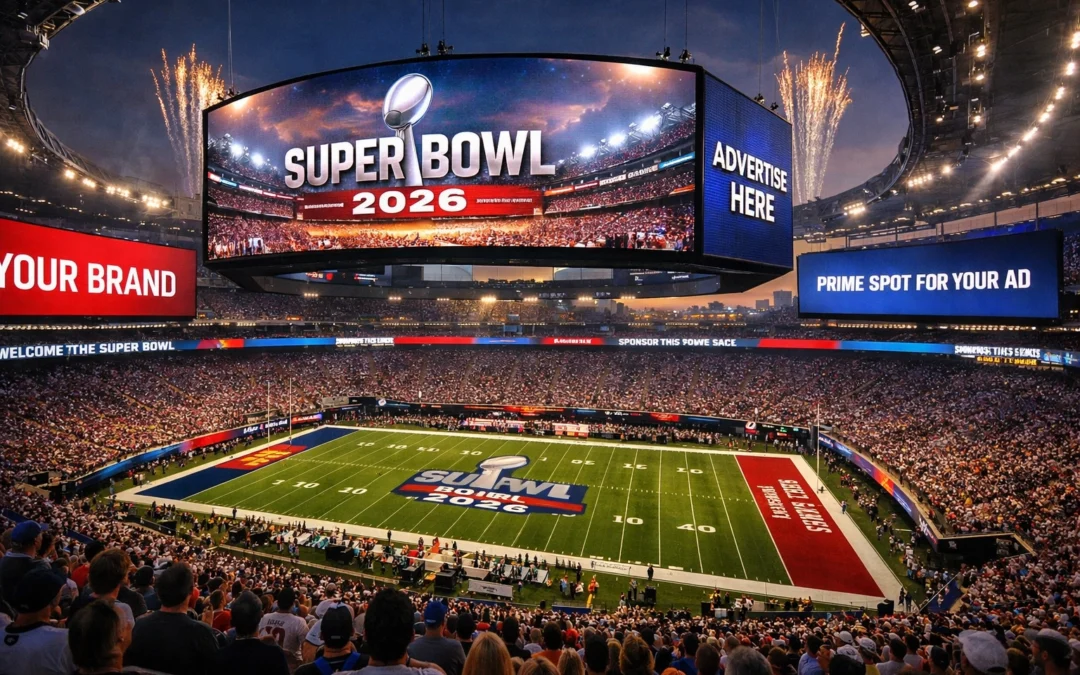
The Super Bowl represents the most significant annual milestone in the advertising industry. As the 2026 event approaches, the competition for consumer attention has reached unprecedented levels. While traditional television commercials often dominate the public conversation, venue-based advertising has emerged as a superior method for achieving sustained brand engagement and measurable return on investment.
With over 40 years of leadership in the advertising space, OOH Sports has observed the transition from static stadium signage to a fully integrated, venue-wide ecosystem. This guide outlines the strategies required to execute a successful campaign within the high-stakes environment of the Super Bowl.
The Strategic Shift: Why Venue Advertising Dominates in 2026
Traditional 30-second television spots for the Super Bowl now exceed $7 million. Despite the high price tag, these advertisements face significant challenges, including viewer distraction, channel surfing, and the transient nature of the exposure. In contrast, venue advertising offers a constant presence that cannot be skipped or muted.
Research indicates that fans spend an average of four to five hours within the stadium environment on game day. This extended exposure generates continuous impressions that a single television spot cannot match. Furthermore, strategic placements within the venue provide dual reach. These assets are visible to the tens of thousands of attendees in the stadium and the estimated 180 million viewers watching the global broadcast.
For a deeper look at how this level of exposure influences consumer behavior, consider how White Claw’s programmatic campaign achieved a 74 percent lift in purchase consideration. The same principles of high-frequency, high-impact visibility apply to the Super Bowl stage.
https://www.youtube.com/watch?v=l6J-0zileKE
Comprehensive Venue Coverage: From Floors to Billboards
A successful 2026 Super Bowl strategy requires a "surround sound" approach to physical and digital placements. Effective campaigns utilize every available square inch of the venue to create a cohesive brand narrative.
Ground-Level Impact: Floor Graphics and Entry Points
The fan journey begins at the stadium gates. Floor graphics and vinyl wraps at main entrances capture immediate attention during peak entry times. These placements are highly effective because they exist within the natural line of sight as attendees navigate security and ticket scanning. High-traffic areas like entrance plazas can generate thousands of exposures per hour.
Concourse Integration and Dwell Time
Attendees spend a significant portion of the event (between 60 and 90 minutes) in the concourse areas. This time is spent visiting food and beverage stations or navigating to seating sections. Digital out-of-home (DOOH) screens at concession stands capitalize on high dwell times. Brand messaging in these areas is often reinforced by column wraps and hanging banners that maintain visibility even in crowded environments.
Perimeter and Field-of-Play Assets
The most valuable real estate within the venue is the perimeter LED displays. These screens rotate brand messages throughout the game, ensuring visibility during commercial breaks and between plays. Because these displays are often captured in the background of the television broadcast, they serve as a bridge between the physical venue and the global audience.

Strategic Planning and Timeline Requirements
Securing a dominant presence for the 2026 Super Bowl requires a planning cycle of 12 to 18 months. Premium positions are often reserved well in advance. The planning process involves several critical stages.
- Placement Selection: Identifying high-impact zones based on fan flow data.
- Creative Adaptation: Developing assets that work across various formats. A design for a floor graphic requires a different perspective and scale than a 40-foot LED billboard.
- Integration: Ensuring that venue assets align with broader digital and social media efforts.
The complexity of these campaigns often leads to common pitfalls. To avoid these, marketers should review the 7 mistakes often made with sports DOOH campaigns to ensure their 2026 strategy is sound.
Leveraging Technology and AI in 2026
The 2026 Super Bowl will see an increased reliance on AI-powered decisioning for advertising placement. Modern venues are equipped with thousands of digital screens that can be managed programmatically. This allows for real-time adjustments based on game flow, crowd sentiment, or even weather conditions.
AI-powered analytics now provide the ability to prove campaign success with high precision. By using device ID exposure zones and tracking pixels, brands can measure how venue advertising influences subsequent digital actions or retail visits. This level of data is essential for justifying the significant investment required for a Super Bowl presence. Information regarding the 7 AI-powered DOOH analytics provides a framework for understanding these measurement tools.

Expanding the Footprint: Beyond the Stadium Walls
While the stadium is the heart of the event, the Super Bowl experience extends to the entire host city. A comprehensive strategy for 2026 must include surrounding territories.
- Airports and Transit: Advertising at major hubs reaches fans as they arrive in the city.
- Entertainment Districts: Digital displays in "Super Bowl Experience" zones and fan festivals capture the attention of those who may not have tickets to the game but are in town for the festivities.
- Highways and Approaches: Large-format billboards on major routes to the stadium build brand awareness in the days leading up to kickoff.
Geographically-targeted DOOH has been shown to boost fan engagement significantly. For instance, real-time strategies in 2025 resulted in a 90 percent increase in engagement by reaching fans at the right time and place.
Measurement and ROI: Proving the Impact
The success of a venue-wide campaign is measured through a combination of reach, frequency, and brand lift. Brand lift studies conducted after similar large-scale events have shown that brands utilizing comprehensive stadium coverage see a 119 percent improvement in positive brand image.
Measurement planning must begin at the campaign’s inception. This includes:
- Establishing baseline brand metrics before the event.
- Coordinating with retail partners to track sales spikes in the host city.
- Utilizing multi-touch attribution to see how venue ads worked alongside social media and television exposures.

Creative Excellence in the Stadium Environment
In a venue as visually loud as a Super Bowl stadium, creative quality is the deciding factor in engagement. Data shows that ads failing to evoke a strong emotional response, whether through humor, inspiration, or nostalgia, are forgotten within 48 hours.
The creative for 2026 should be narrative-driven. Instead of simple logo placement, the most successful campaigns use the stadium's various assets to tell a story that unfolds as the fan moves through the venue. A message might start on a transit wrap, continue on a floor graphic at the entrance, and reach its climax on the jumbo screens during a halftime break.
Conclusion: Securing a Legacy in 2026
The 2026 Super Bowl represents more than a single game, it is a massive opportunity for brands to cement their status in the minds of consumers. By moving beyond the limitations of the 30-second TV spot and embracing a venue-wide advertising strategy, brands can achieve a level of dominance that is both visible and measurable.
With four decades of expertise, OOH Sports continues to lead the way in navigating these complex advertising landscapes. From the ground level of the concourse to the highest billboard in the city, the goal remains the same: to create a brand presence that is impossible to ignore. Success in 2026 requires early planning, a focus on data-driven placement, and a commitment to utilizing the full spectrum of out-of-home opportunities.