
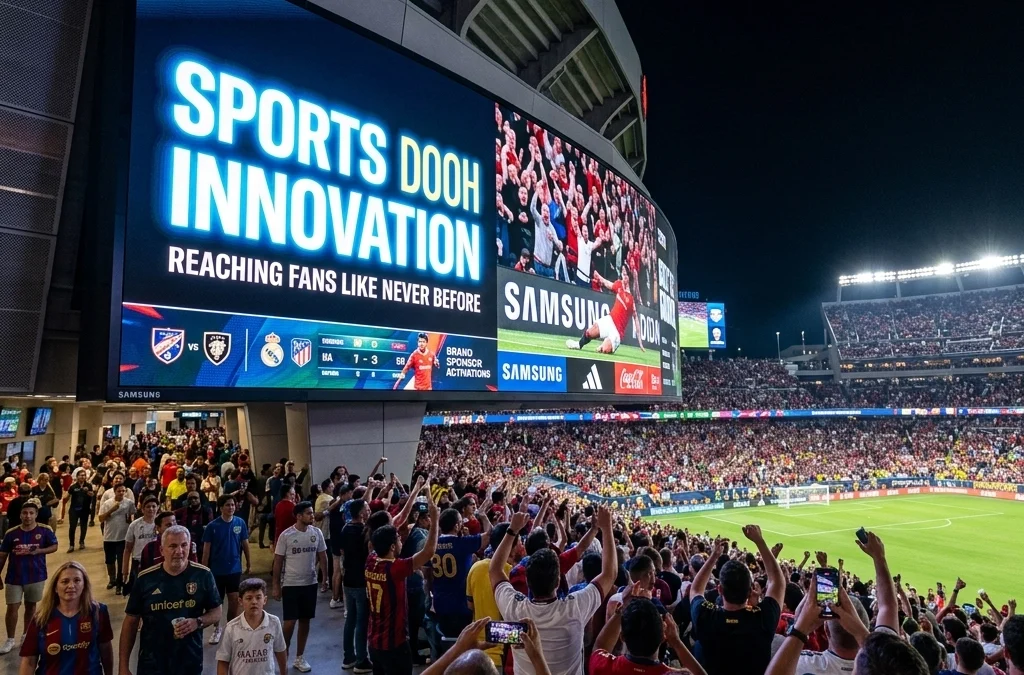
The relationship between sports and advertising has traditionally been about static logos and high-cost stadium naming rights. However, the landscape is shifting toward something more dynamic, measurable, and impactful. Digital Out-of-Home (DOOH) advertising is no longer just a passive screen on a wall. It has become a sophisticated tool that allows brands to talk to fans in real time, exactly where they are.
For media buyers and brand managers, the rise of sports DOOH innovation represents a fundamental change in how budgets are allocated. It is about moving beyond the 90 minutes of game time and capturing the attention of fans throughout their entire daily routine. Whether a fan is commuting to work, grabbing a drink at a sports bar, or walking near the stadium, the opportunity to connect is constant.
The Evolution of the Fan Journey
Reaching a sports fan used to mean buying a television spot during a broadcast or a billboard outside an arena. While those methods still hold value, they often miss the broader fan journey. The modern fan experience starts hours before kickoff and continues long after the final whistle.
Innovation in DOOH allows brands to activate across multiple touchpoints. By using location-based data, advertisers can place messaging in transit hubs, neighborhood bars, and shopping districts where fans naturally congregate. This routine-based strategy ensures that a brand is not just a background noise but a part of the excitement.
The impact of this approach is backed by data. Research indicates that 81 percent of fans feel more positive toward brands that sponsor sports. Furthermore, 66 percent of fans are more likely to purchase from these brands. By staying visible throughout the day, a brand reinforces its association with the team and the lifestyle that fans love.

Real-Time Engagement with Sportrons
One of the most significant innovations in the industry is the use of Sportrons. These are high-impact digital displays designed to capture attention in high-traffic areas. Unlike traditional billboards, Sportrons leverage real-time data to stay relevant.
Imagine a digital screen that displays a live countdown to the big game. As soon as the game starts, the creative shifts to show live scores, player statistics, or updated betting odds. If the home team scores, the screen can instantly switch to a celebratory message. This level of responsiveness transforms an advertisement into a valuable resource for the fan.
When an ad provides utility, such as a score update, the audience is much more likely to pay attention. In fact, DOOH captures approximately 99 percent of fan attention in everyday spaces because it blends seamlessly into the environment while providing information that people actually want to see.

Programmatic DOOH: Efficiency for Media Buyers
The shift toward programmatic DOOH has changed the game for media buyers. In the past, buying out-of-home media was a manual, time-consuming process involving contracts and long lead times. Today, programmatic technology allows for the same level of flexibility and targeting found in online display advertising.
Media buyers can now set specific triggers for their campaigns. A brand might choose to only run ads when the local team is winning, or when the weather reaches a certain temperature, or during specific hours leading up to an event. This level of control ensures that marketing dollars are spent efficiently, reaching the right people at the most receptive moments.
The use of specialized platforms and demand-side platforms (DSPs) has made it easier than ever to integrate DOOH into an omnichannel strategy. When a fan sees a brand on their social media feed and then sees the same brand on a large digital screen at a transit station, the memory of that brand is significantly strengthened. This "priming effect" makes every other marketing channel more effective.
Measurable Results and Brand Lift
One of the biggest hurdles in traditional out-of-home advertising was measurement. For a long time, it was difficult to prove exactly how many people saw a sign or what they did after seeing it. Innovation in data and attribution has solved this problem.
Brand managers can now access detailed reports on impression verification, audience movement, and even purchase intent. Several recent campaigns have demonstrated the power of this technology:
- White Claw: By using programmatic DOOH for a vodka launch, the brand saw a 74 percent lift in purchase consideration. You can read more about this in the White Claw case study.
- Mike's Hard Iced Tea: This campaign achieved a 119 percent lift in positive brand image by utilizing real-time triggers and strategic placements. Check out the details in the Mike's Hard case study.
- Sea-Doo: Even for high-consideration purchases, DOOH delivers. Sea-Doo saw a 144 percent increase in purchase consideration during their first digital out-of-home campaign. The full story is available in the Sea-Doo case study.
These numbers prove that sports DOOH is not just about awareness. it is a performance-driving medium that delivers a clear return on investment.

Bridging the Physical and Digital Worlds
Innovation in the sector is also about interaction. The inclusion of QR codes and scannable elements on digital screens allows fans to bridge the gap between the physical ad and their mobile devices. A fan waiting for a train can scan a code on a Sportron to enter a contest, download a coupon, or view exclusive content.
This creates a seamless pathway to conversion. It also provides advertisers with valuable first-party data. When a fan interacts with a screen, the brand can then retarget that individual across other digital platforms, keeping the conversation going long after they have moved away from the screen.
This level of integration is particularly important for younger demographics who expect their physical and digital worlds to be connected. By offering interactive elements, brands show that they understand how modern fans consume media.
The Strategic Advantage of Location
Location has always been the primary benefit of out-of-home advertising, but innovation has made location smarter. Rather than just picking a busy street, advertisers can now use movement data to find exactly where their specific audience spends time.
For example, a brand targeting marathon runners can activate screens along the race route and in the neighborhoods where participants stay. This allows for a hyper-local approach that feels personal to the fan. Even brands that are not official sponsors of an event can use DOOH to build a presence and "ambush" the competition by being visible in all the key areas surrounding an event.
This strategy was effectively used by major apparel brands to create a dominant presence during city-wide sporting events without the multi-million dollar price tag of an official sponsorship. By being where the fans are, the brand becomes part of the event's cultural fabric.

A Future-Proof Strategy
The sports advertising market is projected to reach $50 billion by 2030, and DOOH is a major driver of that growth. As more inventory becomes digitized and programmatic capabilities become the standard, the gap between traditional and digital marketing will continue to close.
For media buyers and brand managers, the takeaway is clear: sports DOOH innovation is no longer a luxury or a "cool to have" experiment. It is a necessary component of a modern media mix. It offers the scale of traditional media with the precision and measurement of digital channels.
As the technology continues to evolve, we can expect even more creative uses of live data, augmented reality, and personalized messaging. The brands that embrace these innovations now will be the ones that win the hearts and minds of fans in the years to come.
To learn more about how to implement these strategies for your brand, you can explore our case studies or reach out to our team at OOH Sports. The future of fan engagement is digital, it is out-of-home, and it is happening right now.