
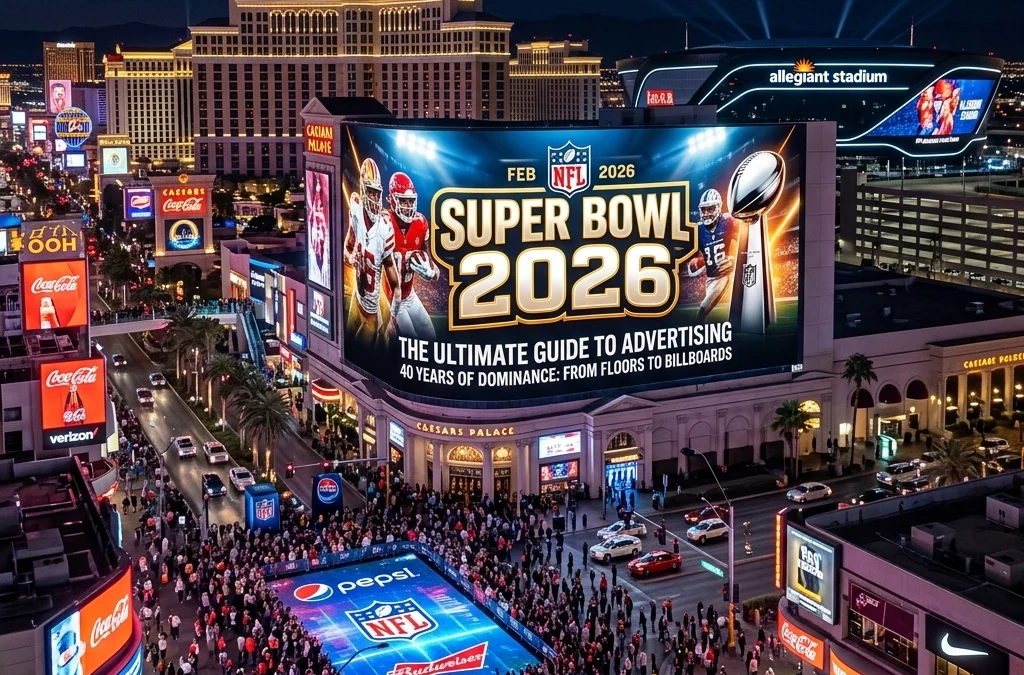
The dust has officially settled on Super Bowl LX. As the advertising world looks back at the events of February 2026, one thing is clear: the landscape of sports marketing has changed forever. What used to be a battle for 30 seconds of television airtime has evolved into a venue-wide takeover that starts at the stadium entrance floors and stretches to the massive digital billboards overlooking the city.
For OOH Sports, this year was not just another game. It represented a milestone of 40 years of advertising leadership. Under the guidance of CEO Dan Kost, the industry has transitioned from basic static signage to a complex ecosystem of programmatic digital out-of-home (DOOH) displays. This guide explores the strategies that defined the 2026 season and how 40 years of experience helped brands achieve total dominance.
40 Years of Stadium Advertising Mastery
The journey to the 2026 Super Bowl dominance began four decades ago. In the mid-1980s, stadium advertising was a simple game of printed boards and fixed signs. Today, the technology allows for real-time updates and hyper-targeted messaging. The longevity of OOH Sports in this space is built on the understanding that fans do not just watch a game, they inhabit an environment.
The evolution from traditional methods to modern digital solutions is captured in the strategic shift toward venue-wide coverage. Whether it is a floor graphic in the concourse or a high-definition screen in the parking lot, the goal remains the same: capturing attention at every possible touchpoint.
https://www.youtube.com/watch?v=l6J-0zileKE
This video illustrates the visual impact and the scale that 40 years of industry knowledge brings to the table. It highlights how the transition from simple visuals to immersive experiences has created a new standard for what it means to be a leader in the advertising space.
Total Venue Domination: From Floors to Billboards
One of the most significant trends in the 2026 Super Bowl was the move toward venue-wide saturation. Advertisers are no longer content with a single billboard. They want a presence that follows the fan from the moment they arrive at the stadium until the moment they leave.
The strategy involves a "floor to ceiling" approach. Floor graphics and digital floor mats are used to direct foot traffic while simultaneously planting brand seeds in the minds of attendees. These lower-level placements are often overlooked by novice marketers, but they offer high dwell times, especially in crowded corridors. Moving upward, the advertising ecosystem includes concourse displays, stadium perimeter boards, and eventually, the massive external billboards that dominate the local skyline.

This multi-layered approach ensures that a brand is not just a commercial during a break, but a part of the physical infrastructure of the event. The integration of technology allows these different levels to communicate with one another, creating a cohesive narrative that surrounds the consumer.
The $8 Million Question: Why Super Bowl LX Broke Records
The financial investment for Super Bowl LX was unprecedented. Standard 30-second television spots reached an average price of $8 million, with premium slots fetching upwards of $10 million. For many brands, this high barrier to entry sparked a shift in budget allocation toward out-of-home alternatives.
While television offers reach, DOOH offers presence and local relevance. In 2026, brands like T-Mobile, Pixar, and Cadillac Formula 1 utilized a mix of digital storytelling to complement their broadcast efforts. The use of programmatic DOOH vs traditional stadium ads became a major talking point as marketers sought better ROI for their massive spends.
By leveraging the surrounding city’s digital infrastructure, brands were able to reach fans who were in town for the festivities but did not have a ticket to the game. This extended the "Super Bowl effect" far beyond the stadium walls and into the streets, bars, and hotels of the host city.
Programmatic DOOH: The Secret Weapon for ROI
The 2026 season proved that programmatic DOOH is no longer a niche tactic. It is now the primary driver for successful sports marketing campaigns. The ability to launch, pause, or update ads in real-time allowed brands to react to the game’s momentum as it happened.
For instance, White Claw’s programmatic campaign demonstrated how targeted DOOH could drive a 74 percent lift in purchase consideration. Similarly, Sea-Doo’s first digital campaign saw purchase consideration jump by 144 percent. These results highlight a shift where media planners are moving away from guesswork and toward data-driven execution.

In the context of the Super Bowl, this meant brands could target specific areas based on fan demographics and behavior. If a particular team’s fans were congregating in a specific neighborhood, the ads could be adjusted to reflect that reality instantly. This level of flexibility is something traditional broadcast or static print can never achieve.
Real-Time Engagement and Fan Centricity
A major theme for 2026 was the balance between brand messaging and fan experience. The most successful campaigns were those that felt fan-centric rather than purely brand-centric. By providing value, such as real-time score updates, weather alerts, or interactive social media walls on stadium screens, brands were able to build a more authentic connection with the audience.

This strategy was particularly effective for sports betting brands. By using real-time sports betting DOOH campaigns, companies were able to update odds and prompts based on the live action on the field. This not only drove engagement but also provided a service that fans were actively looking for during the game.
The result was a 90 percent boost in fan engagement for brands that utilized geographically targeted, real-time strategies. This shift in focus proves that the most effective way to win at the Super Bowl is to put the fan at the center of the story.
Measuring Success in 2026: Beyond the Vanity Metrics
With 40 years of history, OOH Sports has seen a radical change in how success is measured. We are no longer in the era of "estimated impressions." In 2026, the focus has shifted entirely to AI-powered analytics and hard data.
Marketers now look at specific metrics like brand lift, foot traffic attribution, and purchase consideration. The use of AI-powered DOOH analytics has eliminated much of the waste that used to plague large-scale sports sponsorships. By tracking device IDs and exposure levels, advertisers can prove exactly how many people saw an ad and, more importantly, how many of those people took action afterward.

For example, AB InBev’s Mike’s Hard Iced Tea campaign showed a 119 percent lift in positive brand image by using these precise measurement tools. This level of accountability is what allows brands to justify the high costs associated with major sporting events.
Avoiding Common Pitfalls in Sports Marketing
Despite the advanced technology available in 2026, many brands still make fundamental errors. One of the most common is failing to integrate DOOH into a wider omnichannel strategy. When a stadium ad is disconnected from the brand's mobile or social media presence, the impact is diluted.
Another mistake is neglecting the perimeter of the stadium. While the internal screens are high-profile, the stadium perimeter targeting often captures the audience when they are most likely to make a purchase or visit a nearby location.
OOH Sports has spent four decades refining the process of avoiding these traps. The strategy for 2026 focused on ensuring that every screen, from the smallest concourse display to the largest highway billboard, worked together to create a unified brand experience.
Conclusion: The Next Era of Sports Marketing
Super Bowl LX was a celebration of how far the industry has come in 40 years. From the early days of simple stadium signage to the high-tech, programmatic, and AI-driven displays of today, the mission has remained the same: to place the brand in the heart of the action.
The success of the 2026 season was not just about spending money. It was about using 40 years of expertise to place the right message on the right screen at the right time. As the sports advertising market continues to grow, with projections suggesting a hit of $58 billion by 2030, the lessons learned this year will serve as the blueprint for the future.
The dominance of floors to billboards is here to stay. Brands that embrace this full-venue coverage and back it up with programmatic precision will be the ones that continue to lead the pack for the next 40 years.