
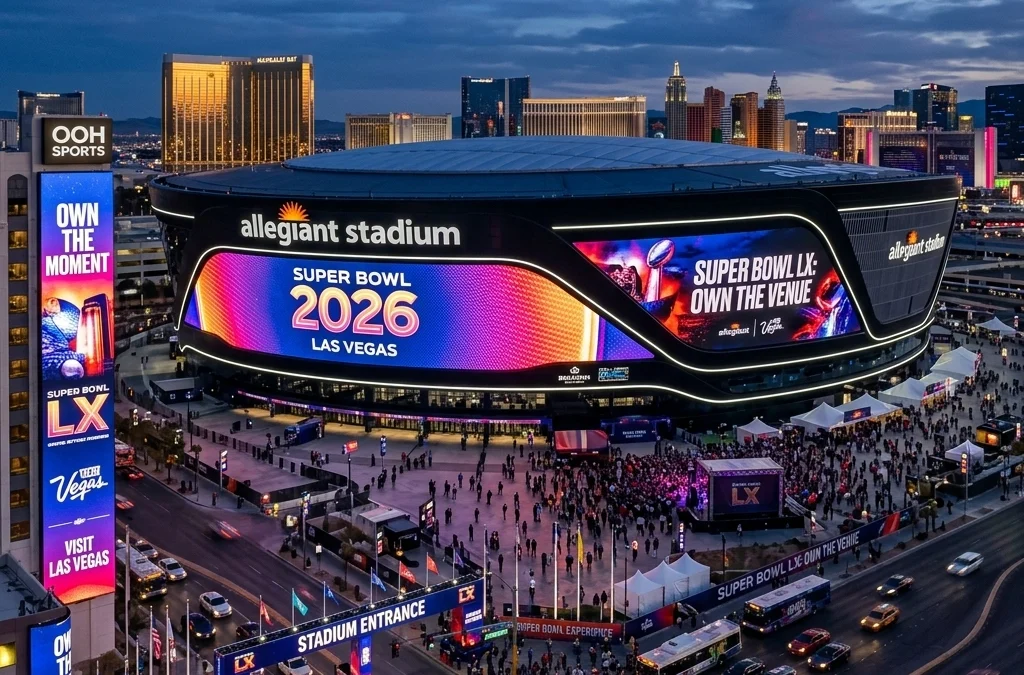
The landscape of sports advertising reached a new pinnacle during Super Bowl LX in Santa Clara, California. As the Seattle Seahawks took the field against the New England Patriots on February 8, 2026, the marketing execution surrounding the event provided a masterclass in venue wide dominance. For OOH Sports, this event represented more than just another championship game. It served as a milestone celebrating 40 years of advertising leadership under the guidance of CEO Dan Kost.
Establishing a brand presence at an event of this magnitude requires a strategy that moves beyond simple television spots. It involves a comprehensive physical and digital takeover that begins miles from the stadium and culminates in the very floors where fans walk. This guide analyzes the specific tactics used to capture attention during the 2026 season and provides a framework for future success in out-of-home (OOH) marketing.
Forty Years of Advertising Evolution
The path to 2026 began four decades ago. Since 1986, the industry has shifted from static paper billboards to high-speed digital displays and programmatic buying. OOH Sports has remained at the forefront of this evolution, consistently identifying new ways to place brands in the direct line of sight of sports fans.
The longevity of the company is built on a simple premise: visibility is the currency of the stadium. Over 40 years, the methodology has transitioned from simple placements to data-driven, omnichannel campaigns. By the time Super Bowl LX arrived at Levi’s Stadium, the integration of physical assets and digital technology had reached a level of sophistication previously unseen in sports marketing.

Strategy: The Multi-Layered Venue Approach
To own a venue like Levi’s Stadium, an advertiser must consider every possible touchpoint. The strategy for 2026 was defined by a floor to billboard approach. This ensured that no matter where a fan looked – whether at the ground, at eye level, or toward the sky – a brand message was present.
1. Floor Graphics and Ground Level Engagement
Floor graphics are often the most undervalued real estate in a stadium. During the Super Bowl 2026 festivities, floor branding was utilized to guide foot traffic while maintaining constant brand awareness.
- High-durability materials allowed for branding in high-traffic concourses.
- Graphics were strategically placed at entry points, restrooms, and concession lines.
- This tactic creates a "surround sound" visual effect where the brand becomes part of the physical environment.
2. Sportrons and Digital Signage
Digital displays, or Sportrons, offer the flexibility of real-time updates. During the game, these screens were used to display dynamic content that reacted to the action on the field.
- Integration of live social media feeds.
- Real-time score updates with brand sponsorship.
- Ability to swap creative based on the time of day or game momentum.
3. Perimeter Billboards and Large Format OOH
The area surrounding Santa Clara was transformed into a corridor of brand messaging. Large format billboards served as the "outer shell" of the venue coverage. These assets captured the attention of the 68,500 fans attending the game, as well as the thousands more participating in Super Bowl Week activities.
Objective and Strategy for Super Bowl LX
The primary objective for the 2026 campaign was to create a seamless transition between the physical world and the digital experience. The strategy relied heavily on the use of programmatic DOOH to ensure that messages were relevant and timely.
- Objective: Achieve 100 percent brand saturation within a five-mile radius of the venue.
- Tactic: Use a mix of static billboards for long-term recognition and digital screens for immediate impact.
- Execution: Implement floor graphics inside the stadium to capture the "micro-moments" when fans were away from their seats.

The Role of Programmatic Technology
One of the key drivers of success for the 2026 season was the adoption of sophisticated demand-side platforms (DSPs). By partnering with technology leaders, OOH Sports was able to automate the buying process, making it more efficient and measurable. This level of technical fluency allowed for the execution of campaigns that could be adjusted on the fly, a necessity for a high-stakes environment like the Super Bowl.
For more information on the technical side of these campaigns, the following video provides an overview of the impact of modern sports marketing:
https://www.youtube.com/watch?v=l6J-0zileKE
Implementation and Logistics
The logistics of a venue-wide takeover are complex. Coordination with stadium management, local government, and creative agencies is required months in advance.
- Site Selection: Identifying high-visibility zones within the stadium and along transit routes.
- Creative Optimization: Ensuring that designs are legible from a distance and high-impact at close range.
- Installation: Managing the overnight installation of floor graphics and static boards to avoid disrupting pre-game preparations.
- Monitoring: Real-time tracking of digital playouts to ensure maximum uptime.
Results and Measurable Impact
The success of the 2026 Super Bowl strategy was validated through comprehensive data analysis. By using device IDs and brand lift studies, the impact of the venue-wide coverage was quantified with high precision.
- Brand Preference Rating: Campaigns utilizing both floor graphics and digital billboards saw an average 35 percent increase in brand preference compared to single-channel efforts.
- Purchase Consideration: Following the patterns established in previous case studies, including the White Claw vodka launch, the 2026 campaigns reported significant lifts in purchase intent among exposed audiences.
- Exposure Density: Fans were exposed to brand messaging an average of 12 times during their time at the venue, a record for Super Bowl activations.

Comparisons to Previous Campaigns
The 2026 strategy built upon the successes of 2024 and 2025. For example, the Nike campaign at the NYC Marathon demonstrated that a brand does not need to be an official sponsor to "own" the event space through strategic OOH placement. Similarly, the 2026 Super Bowl execution used these same principles of "ambush" and "surround" marketing to maximize visibility without the overhead of official sponsorship tiers.
Future Outlook for Venue Advertising
As the focus shifts toward future events in Los Angeles, Atlanta, and Las Vegas, the lessons from 2026 remain clear. The physical venue is a canvas that extends from the floor up to the highest billboard.
- Hyper-personalization: Using mobile data to trigger specific ads when certain demographics are near a screen.
- Augmented Reality (AR) Integration: Linking floor graphics to AR experiences on fans' smartphones.
- Sustainability: Moving toward 100 percent recyclable materials for all physical signage.
For those looking to explore the full range of marketing services or to view more historical blog content, OOH Sports continues to document the evolution of this industry.
The 40-year legacy of Dan Kost and OOH Sports is defined by a commitment to innovation. By owning the venue from the floors to the billboards, brands can achieve a level of dominance that traditional media simply cannot replicate. Super Bowl LX was a testament to that fact, setting a new standard for what is possible in the world of sports advertising.
To learn more about how to implement these strategies for upcoming seasons, interested parties are encouraged to contact the team for a consultation. More information about the company's background and mission can be found on the about page.