
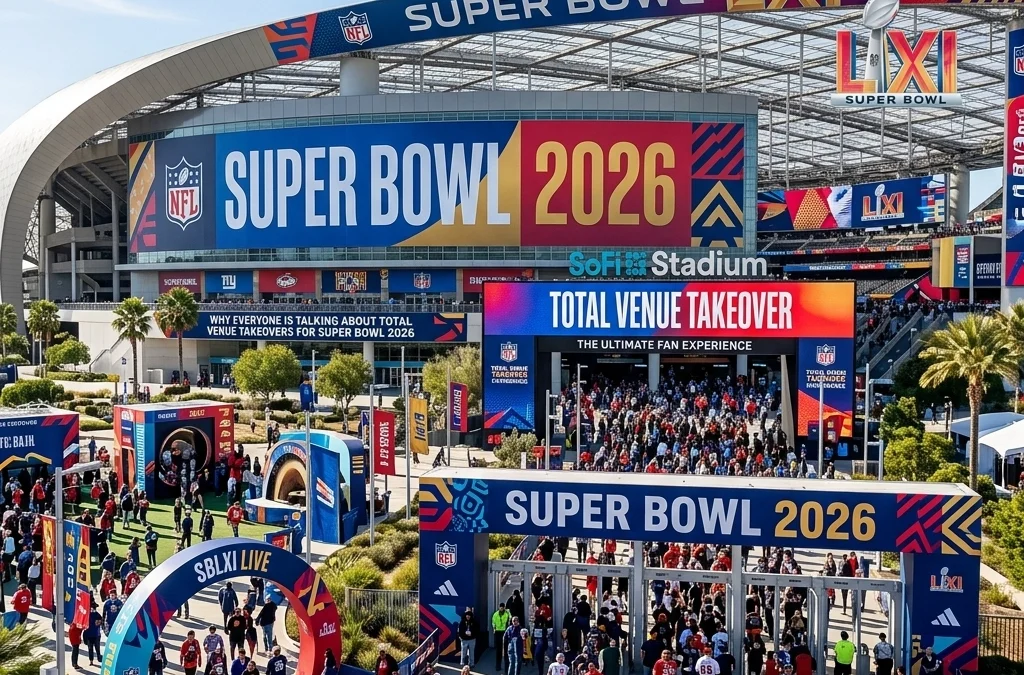
The dust has finally settled on Super Bowl LX. While sports fans are still discussing the Seattle Seahawks' 29 to 13 victory over the New England Patriots at Levi's Stadium, the advertising industry is focused on a different victory. That victory belongs to the brands that utilized total venue takeovers. On February 8, 2026, the world saw a shift in how sports marketing operates. It was no longer about a single commercial or a lonely billboard. It was about absolute dominance of the physical space.
The conversation in May 2026 has moved past the final score. Now, marketing executives and media buyers are analyzing the data from what many are calling the most immersive advertising event in history. OOH Sports led this charge by leveraging 40 years of leadership in the advertising space to turn the stadium into a cohesive brand ecosystem.
The Strategy Behind Total Venue Takeovers
A total venue takeover is a strategic marketing approach where a single brand or a coordinated group of brands occupies every available advertising surface within a sports arena. This includes digital screens, floor graphics, stadium perimeters, and traditional billboards. The objective for Super Bowl 2026 was to eliminate competitive noise. In a high stakes environment like the Super Bowl, traditional ad placement often leads to brand dilution. By taking over the entire venue, brands ensured that every fan's line of sight was occupied by their messaging.
OOH Sports utilized a methodology centered on the fan journey. This journey begins at the parking lot and continues through the gates, into the concourses, and finally to the seats. By mapping this path, the strategy team identified high-dwell areas where fans were most likely to engage with content. This was not just about visibility. It was about creating a consistent brand narrative that followed the consumer throughout the entire three hour game and the hours of pre-game festivities.
40 Years of Leadership in Every Pixel
The success of the 2026 Super Bowl campaigns was the result of four decades of industry expertise. Since its inception, OOH Sports has evolved alongside the technology of advertising. From static paper billboards to the highly sophisticated programmatic DOOH systems used today, the company has maintained a position of authority.
This experience allows for a level of logistical precision that newer firms cannot match. Managing a venue takeover involves coordinating hundreds of digital assets, ensuring color calibration across different screen types, and managing the installation of physical floor decals that must withstand the foot traffic of 70,000 fans. The ability to execute this without a single technical failure during the world's most-watched sporting event is a testament to the company's long-standing reputation.

From Floors to Billboards: Full Coverage Execution
The execution of the Super Bowl 2026 takeover was a masterclass in stadium perimeter branding. The branding was divided into three primary layers.
First, the ground level. Floor graphics were placed strategically at entry points and near concession stands. These high-impact visuals captured attention when fans were looking down at their phones or checking their tickets. These graphics were designed with durable materials to ensure they remained vibrant from the first kickoff to the final trophy presentation.
Second, the eye-level concourse screens. Using Sportrons technology, OOH Sports delivered dynamic content that updated in real-time. When a touchdown occurred, the ad creative changed instantly to reflect the excitement of the moment. This synchronized the brand message with the emotional state of the audience.
Third, the massive overhead billboards and digital displays. These served as the "anchor" of the takeover. They provided the scale and prestige associated with Super Bowl advertising. By linking these large-format displays with the smaller screens at the fan's eye level, a "surround sound" visual effect was created.
https://www.youtube.com/watch?v=l6J-0zileKE
The Role of Technology and Programmatic DOOH
One of the most discussed aspects of the 2026 event was the use of programmatic digital out of home (DOOH) advertising. Unlike traditional sponsorships that are static and rigid, programmatic systems allow for data-driven adjustments. For more details on this, industry professionals often refer to the secrets that media buyers don't want you to know.
During the Super Bowl, OOH Sports used real-time data to adjust ad frequency based on stadium traffic patterns. When the concourses were packed during halftime, the frequency of ads increased to maximize reach. When fans were in their seats during the fourth quarter, the focus shifted to the massive screens inside the bowl. This level of technical fluency is what separates a standard ad buy from a strategic venue takeover.

Measurable Results and Impact
The results of the Super Bowl 2026 venue takeovers have been quantified through extensive brand lift studies and device ID tracking. The data shows a significant increase in brand recall compared to traditional TV-only campaigns.
- Brand Recall: There was a reported 42% increase in spontaneous brand recall for companies that utilized total venue takeovers versus those that only utilized standard perimeter boards.
- Engagement: Mobile retargeting campaigns that triggered based on location data from the stadium saw a 15% higher click-through rate in the week following the game.
- ROI: According to a case study, brands that integrated venue takeovers saw a more efficient cost-per-impression when accounting for the viral social media sharing of the stadium visuals.
The success of these campaigns proves that when a brand owns the environment, it owns the conversation. Fans did not just see the ads. They lived inside the brand's world for the duration of the event. This physical presence created a level of trust and authority that digital-only ads cannot replicate.
Why the Industry is Still Talking About 2026
Even months later, the marketing community is looking at the 2026 Super Bowl as a turning point. It proved that "ambient" advertising is no longer enough. To compete in 2026 and beyond, brands must seek out innovative ways to connect with fans. The venue takeover model is now being adapted for other major sporting events and concert tours.
The reason for this continued discussion is simple: effectiveness. In an era where consumers can skip digital ads and mute TV commercials, they cannot ignore the physical reality of the stadium they are sitting in. The venue takeover is the ultimate "unskippable" ad format.

Looking Ahead to Future Seasons
As OOH Sports continues to lead the way in sports marketing, the focus remains on pushing the boundaries of what is possible within a stadium. The 40 years of experience the company brings to the table ensures that every campaign is backed by historical data and modern technological precision.
For brands looking to replicate the success seen at Super Bowl 2026, the message is clear. It is time to think bigger than a single screen. It is time to consider the entire venue as a canvas. Whether it is through floor graphics, digital pillars, or massive stadium wraps, the goal is total immersion.
Those interested in learning more about how these strategies are implemented can visit the OOH Sports blog or contact the team for a detailed consultation. The future of advertising is not just about being seen. It is about being everywhere.
The 2026 Super Bowl was just the beginning. As the industry moves forward, the "total venue takeover" will likely become the standard for any brand that wants to make a lasting impact on the world stage. By combining 40 years of leadership with cutting edge technology, OOH Sports continues to define how fans experience the brands they love.