
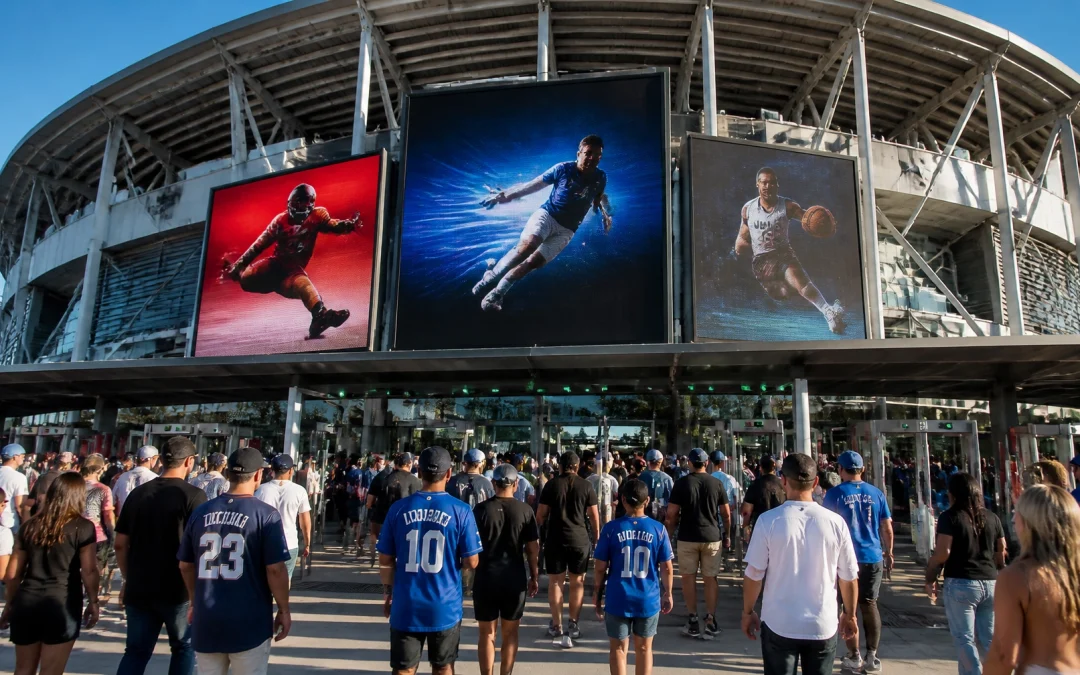
Choosing the right digital out-of-home (DOOH) placement is a fundamental decision that dictates the success of a sports marketing campaign. In the high-stakes world of sports advertising, the goal is rarely just "visibility." Instead, media buyers and brand managers seek environments that align with specific consumer mindsets, whether that is the high-octane anticipation of a fan walking through a stadium gate or the routine, high-dwell habit of a commuter in a transit hub.
While both stadium gates and transit hubs offer premium inventory, they serve vastly different strategic purposes. One offers unparalleled emotional intensity within a concentrated window, while the other provides consistent scale and frequency. This comparison examines the mechanics, audience behavior, and measurable results of each placement to help brands make data-driven decisions for their next sports marketing campaign.
The Strategy of Stadium Gates: Capturing Peak Emotion
Stadium gates represent the "front door" of the fan experience. At this physical and psychological threshold, audience engagement is at its absolute peak. Fans entering a venue are in a state of high anticipation, making them exceptionally receptive to brand messaging that reinforces the excitement of the event.
Objective and Audience Behavior
The primary objective of a stadium gate placement is to leverage emotional salience. When a brand appears at the point of entry, it becomes part of the game-day ritual. Research indicates that game-related environments are high-energy spaces where DOOH can make bold, lasting impressions.
However, the behavior at these gates is mission-oriented. Fans are often moving through security checkpoints and ticket scans, meaning dwell time is punctuated and relatively short, typically ranging from two to five minutes. Because of this, the creative strategy must prioritize bold visuals, simple copy, and high-impact branding. A stadium gate is not the place for long-form narrative, but it is the perfect location for a dominant Sportron display that establishes a brand as a primary sponsor.
The Power of Association
By placing advertisements at the gates, brands benefit from a "halo effect" from the team or event. For a media planner, this means the campaign is not just reaching a person; it is reaching a "fan" in their most passionate state. This association drives higher brand equity and perception, even if the frequency of exposure is lower than in a daily transit environment.

The Strategy of Transit Hubs: Building Scale and Recall
In contrast to the intense, event-bound nature of stadium gates, transit hubs (including airports, train stations, and bus terminals) offer a different type of value: scale and sustained attention. These locations serve as "journey spaces" where fans and the general public spend significant amounts of time during their daily routines and game-day travels.
Dwell Time and Frequency
Transit hubs are structurally designed for higher dwell times. The average commuter or traveler spends between 5 and 15 minutes in a station, while in-vehicle screens can capture attention for up to 45 minutes. This extended exposure allows for more nuanced storytelling and longer creative spots, often up to 30 seconds.
Frequency is the other major advantage. While a fan might only walk through a stadium gate twice per event, a commuter may pass a transit hub screen ten times a week. This repetition is a critical driver for message recall. According to industry studies, repeated exposures along a predictable route naturally support memory reinforcement, making transit hubs ideal for building long-term brand awareness.
Reaching the "Fan En Route"
On game days, transit hubs become strategic extensions of the stadium. Fans traveling via rideshare, trains, or airports form a captive audience. Utilizing DOOH in these locations allows brands to "prime" the audience before they even reach the venue. This omnichannel approach ensures that the brand remains top-of-mind throughout the entire fan journey, from the morning commute to the post-game celebration.

Technology Partners and the 10-Mile Perimeter
Modern DOOH is no longer a static purchase. Through programmatic platforms and sophisticated geofencing, brands can now target a 10-mile perimeter around sports venues. This technology allows media buyers to bridge the gap between stadium gates and transit hubs by activating screens in the surrounding area that cater to the same high-intent audience.
Programmatic Targeting
Programmatic DOOH enables brands to buy inventory based on real-time triggers, such as game start times, weather conditions, or even live scores. If a team wins a high-profile game, brands can instantly update creative across both stadium gates and nearby transit hubs to congratulate the fans, significantly increasing relevance and engagement.
Data-Driven Measurement
One of the most significant shifts in the industry is the ability to measure the impact of these placements. By using anonymized device ID data, brands can track how many people were exposed to a screen at a stadium gate and whether those same individuals later visited a retail location or visited a specific website. These case studies show that combining gate intensity with transit scale leads to a much higher conversion rate than using either in isolation.

Comparison at a Glance: Which Placement Wins?
To determine the best placement for a specific campaign, it is helpful to compare the core metrics of each location type.
| Dimension | Stadium Gates | Transit Hubs |
|---|---|---|
| Primary Audience | Ticketed fans with high affinity. | Mix of fans, commuters, and travelers. |
| Dwell Time | Short (2-5 minutes). | High (5-15+ minutes). |
| Frequency | Low (Event-based). | High (Daily/Weekly habits). |
| Emotional State | Peak excitement and anticipation. | Routine or travel-focused. |
| Creative Format | Short, high-impact, bold cues. | Longer spots, detailed storytelling. |
| Best KPI | Sponsorship ID and brand equity. | Reach, recall, and awareness. |
Results and Strategic Alignment
When analyzing results, the "best" placement is entirely dependent on the campaign objective.
For brands focused on a massive sponsorship launch or a "hero moment," stadium gates are the superior choice. The magnitude of the physical environment and the emotional connection of the crowd create a level of impact that transit hubs cannot replicate. A brand that "owns" the gate at the Super Bowl or a World Series game creates a memory that lasts long after the final whistle.
Conversely, for brands looking to drive consistent sales, app downloads, or sustained awareness, transit hubs offer a more cost-efficient scale. The ability to build frequency over several weeks leads to higher recall rates. In many instances, transit DOOH acts as a powerful priming mechanism. When a fan sees a brand on a transit screen during their morning commute and then sees it again at the stadium gate, the mental processing of that brand is significantly faster and more positive.
Choosing Your Play
The most successful sports marketing strategies do not choose between stadium gates and transit hubs; they integrate both. By utilizing stadium gates for emotional "peaks" and transit hubs for consistent "frequency," brands can create a surround-sound effect that captures the fan at every stage of their journey.
For media planners, the decision should be guided by the 10-mile perimeter strategy. By mapping out the fan’s path, from the train station to the stadium entrance, brands can ensure that their message is ubiquitous. This approach maximizes the strengths of both placements, resulting in a campaign that is both emotionally resonant and broadly impactful.
As the blog at OOH Sports continues to track these trends, it is clear that the integration of location-based data and high-quality digital inventory is the future of the industry. Whether it is the high-energy rush of the gate or the steady rhythm of the transit hub, the goal remains the same: putting your brand in the center of the sports experience.