
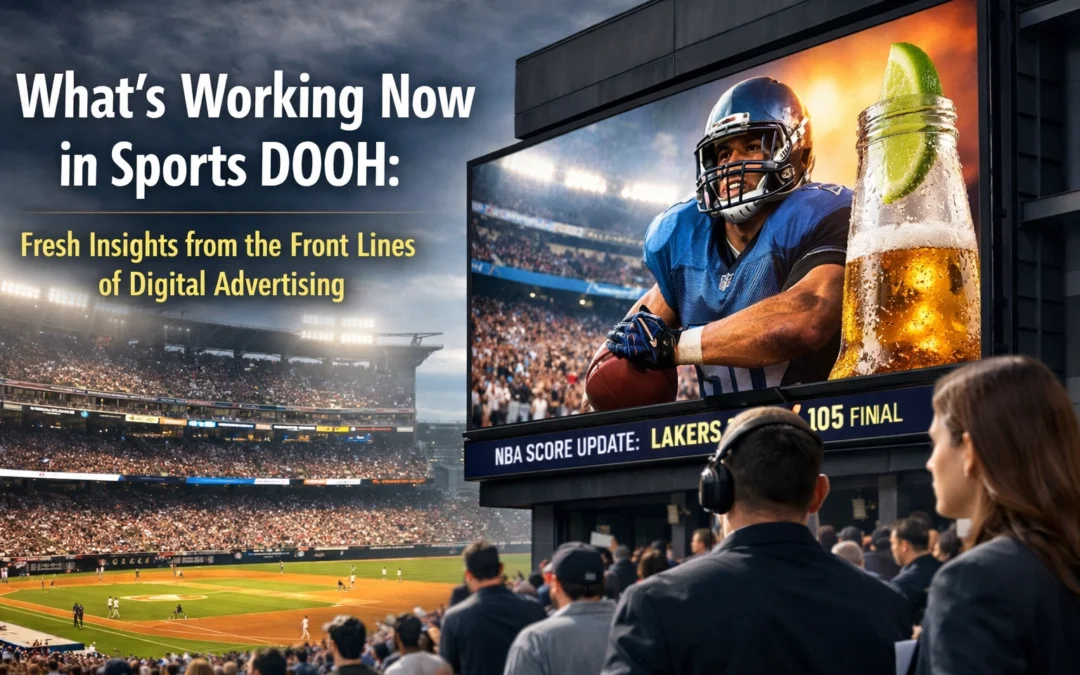
The sports digital out-of-home advertising landscape has evolved significantly beyond static billboards and permanent venue signage. Brands now leverage sophisticated targeting, real-time optimization, and multi-channel integration to reach sports fans with unprecedented precision and measurability. The following insights reveal what strategies are delivering measurable results in the current market.
Real-Time Adaptation Drives Campaign Performance
Programmatic buying paired with dynamic creative optimization has emerged as a primary driver of campaign effectiveness. Rather than locking creative assets months in advance, advertisers now update messaging in real time based on live event data, game outcomes, and performance metrics.

This approach allows brands to capitalize on unexpected moments, from playoff upsets to record-breaking performances. The technology infrastructure supporting this capability enables advertisers to:
- Adjust creative elements based on game scores and momentum shifts
- Update product messaging aligned with weather conditions at venue locations
- Modify calls-to-action based on real-time foot traffic patterns
- Deploy different creative variations across geographic markets simultaneously
The shift from static to dynamic execution has redefined how advertisers approach sports-related campaigns. Brands no longer view DOOH as a passive medium but rather as an active channel capable of responding to the evolving context of sporting events and fan behavior.
Omnichannel Integration Extends Campaign Impact
The most successful sports DOOH campaigns no longer operate in isolation. Advertisers now capture device IDs during DOOH exposure and use that data to activate follow-up messaging across mobile, connected TV, and social media platforms.
This omnichannel strategy creates multiple touchpoints throughout the fan journey:
- Initial DOOH exposure near venues or transit hubs
- Mobile retargeting as fans travel to and from events
- Connected TV messaging delivered to household screens
- Social media creative aligned with DOOH messaging themes
The technical capability to connect DOOH exposure to downstream engagement has transformed how advertisers measure campaign reach. Rather than viewing each channel as independent, successful campaigns treat DOOH as the initiating touchpoint in a coordinated sequence of brand interactions.

Engagement Metrics Demonstrate Measurable Returns
Performance data from recent campaigns reveals exceptionally strong engagement rates. Nearly six in ten fans recall seeing out-of-home advertising at major sporting events. More significantly, over 90 percent of those who notice these advertisements take a follow-up action.
The economic impact extends beyond awareness metrics. Among fans who attend games after seeing OOH advertising, 99 percent spend money at local establishments, including restaurants, retailers, and entertainment venues. This behavioral outcome provides advertisers with concrete proof that DOOH exposure translates to real-world economic activity.
These engagement rates compare favorably to other advertising channels and justify the budget allocations that media buyers continue to direct toward sports-related DOOH inventory. The combination of high recall and subsequent action demonstrates that proximity to sporting events creates an environment where advertising messages resonate with heightened impact.
Geofencing and Behavioral Targeting Refine Audience Reach
Static screen placement has given way to sophisticated audience targeting based on device data and real-world movement patterns. Advertisers now activate DOOH inventory in high-intent zones where sports fans naturally congregate:
- Airport terminals serving cities hosting major sporting events
- Stadium districts and surrounding entertainment zones
- Transit hubs with concentrated fan traffic patterns
- Hospitality areas frequented by visiting fans
- Retail corridors near venue locations

This targeting methodology ensures that advertising spend concentrates in locations where fan density and intent align with campaign objectives. Rather than pursuing broad geographic reach, successful campaigns identify specific zones where target audiences demonstrate measurable presence and engagement likelihood.
The behavioral data informing these targeting decisions extends beyond simple location tracking. Advertisers analyze historical movement patterns, dwell times, and venue visitation frequency to identify audience segments most likely to respond to specific messaging.
Context-Driven Creative Outperforms Static Approaches
The creative strategies delivering the strongest results prioritize contextual relevance over generic brand messaging. Successful campaigns use dynamic creative optimization to respond to contextual variables including:
- Game scores and competitive dynamics
- Weather conditions affecting outdoor events
- Traffic patterns and crowd density
- Time of day relative to event schedules
- Local market characteristics and fan demographics
Interactive elements have become increasingly prevalent. QR codes, mobile prompts, and direct response mechanisms allow advertisers to convert passive DOOH exposure into active engagement while simultaneously building first-party data assets.
The shift toward context-driven creativity requires advertisers to develop multiple creative variations and establish clear triggers for when each version should activate. This approach demands more sophisticated planning but delivers measurably stronger performance compared to static creative execution.
Infrastructure Expansion Creates New Opportunities
The physical footprint of digital screens surrounding sports venues has expanded dramatically. Thousands of displays now populate transit routes, entertainment districts, and hospitality zones that sports fans traverse throughout the event experience.
This expanded infrastructure creates multiple touchpoints across the fan journey:
- Pre-event exposure during travel and arrival
- Near-venue messaging in parking areas and entrance zones
- Post-event advertising along departure routes
- Extended engagement in dining and entertainment districts
The proliferation of screens has positioned sports as a significant driver of broader DOOH market growth. Industry projections indicate that DOOH will account for 45.2 percent of total out-of-home advertising spending by 2028, compared to 22.0 percent in 2016. Sports-related inventory represents a substantial portion of this growth trajectory.

Measurement Capabilities Support Budget Justification
Attribution methodologies have evolved to track real-world outcomes beyond traditional awareness metrics. Mobile location data now enables advertisers to measure how DOOH exposure influences subsequent behavior, including:
- Visits to quick-service restaurants near venue exits
- Retail store traffic in surrounding commercial districts
- Return visits to sponsor locations in home markets
- Cross-channel engagement following initial DOOH exposure
Post-event measurement has become particularly valuable for demonstrating campaign impact. Advertisers can now quantify how specific ad placements near stadium exits, transit lines, or fan zones affected downstream visitation patterns and purchase behavior.
This measurement infrastructure addresses the historical challenge of attributing business outcomes to DOOH campaigns. Media buyers can now present concrete data demonstrating how sports-related DOOH spending drives measurable results beyond impressions and reach metrics.
Strategic Implications for Advertisers
The current state of sports DOOH rewards advertisers who embrace technical sophistication and multi-channel coordination. Static campaigns with fixed creative and limited measurement capabilities underperform compared to dynamic approaches that leverage real-time optimization and comprehensive attribution.
Successful execution requires investment in programmatic infrastructure, creative flexibility, and data partnerships that enable audience targeting and outcome measurement. Advertisers must also develop internal processes that support rapid creative adaptation and cross-channel coordination.
The brands achieving the strongest results treat sports DOOH as a strategic channel requiring specialized expertise rather than as a straightforward media buy. This approach demands additional planning and technical capability but delivers measurably superior performance that justifies the incremental investment.
The sports DOOH landscape continues to evolve as technology platforms introduce new targeting capabilities and measurement methodologies. Advertisers who adapt their strategies to leverage these capabilities position themselves to capitalize on a channel that combines the reach of traditional out-of-home advertising with the precision and measurability of digital media.