
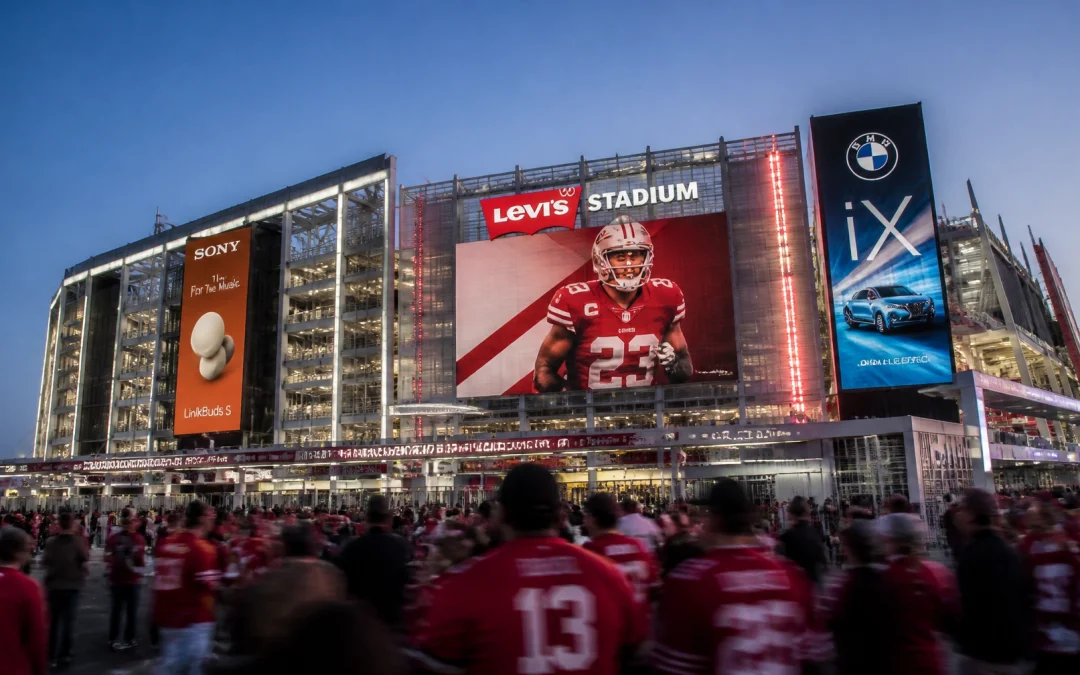
Super Bowl LX is set to arrive on February 8, 2026, at Levi’s Stadium in Santa Clara, California. For brands looking to make a massive impact, the stakes have never been higher. With national 30-second television spots projected to cost upwards of $10 million, the necessity for a comprehensive, multi-channel strategy is clear. A single television commercial is a powerful tool, but true market dominance requires owning the environment where the fans live, breathe, and celebrate.
OOH Sports, a division of the Sports Media Inc. family, leverages four decades of advertising leadership to provide brands with a tactical advantage. By moving beyond the screen and into the physical world, advertisers can create a saturation effect that begins miles away from the stadium and follows the fan all the way to their seat. This guide explores the strategic mechanics of owning the Super Bowl 2026 landscape through 40 years of refined branding secrets.
The 40-Year Evolution of Sports Advertising
The landscape of sports marketing has shifted from simple static signage to immersive, data-driven ecosystems. In the early days of championship advertising, a brand might be satisfied with a single billboard near the venue or a print ad in the official program. Today, the approach is much more sophisticated. The history of Sports Media Inc. reflects this evolution, moving from traditional media into a comprehensive network that includes digital out of home (DOOH) assets, stadium interior branding, and even athlete-led influencer campaigns.
The expertise gained over forty years has led to the development of proprietary tools like the Sporttron digital network. This system provides access to ribbon boards and jumbotrons in over 780 venues nationwide, allowing for a level of scale that was previously impossible. For Super Bowl 2026, this legacy of experience is applied to ensure that every touchpoint, from the airport to the arena floor, is an opportunity for brand engagement.
Strategy: Venue-Wide Saturation
To truly own the Super Bowl, a brand must think in three dimensions. The goal is not just to be seen, but to be unavoidable. This is achieved through venue-wide coverage that integrates the brand into the very infrastructure of the event.
Objective & Strategy
The core objective is to achieve a dominant share of voice within the host city and the stadium itself. While millions watch at home, the high-value attendees, influencers, and decision-makers are on the ground in Santa Clara. The strategy involves a layered approach:
- External Domination: Large-format digital billboards and transit advertising across the San Francisco Bay Area.
- Path-of-Travel Branding: Securing presence at San Jose International Airport and along the major transit routes to Levi’s Stadium.
- Internal Venue Integration: Utilizing the floors, walls, and digital displays within the stadium concourse.

Tactical Execution: From Floors to Billboards
One of the most effective ways to capture attention is by utilizing non-traditional ad space. When fans enter Levi’s Stadium, they are often overwhelmed by the noise and the crowd. Strategically placed floor graphics and wall wraps provide a tactile sense of brand presence. These elements are hard to ignore because they are part of the physical path the fan takes to reach their seat.
Furthermore, the integration of high-touch concession platforms and even cupholders for charity turns a passive viewing experience into a tangible one. These small but frequent interactions build brand recall in a way that a fleeting digital image cannot. By the time the game starts, the brand has already made multiple impressions on the fan’s journey.
Geographic Precision: The 10-Mile Radius
One of the secrets to modern sports branding is the use of geofencing and radius targeting. OOH Sports focuses on the perimeter up to 10 miles around sports venues. This ensures that the brand’s message is concentrated where it matters most.
For Super Bowl 2026, this means saturating Santa Clara and the surrounding areas. By using programmatic DOOH, advertisers can trigger ads to appear on digital screens based on real-time data, such as traffic patterns or weather conditions. If a brand wants to target fans as they arrive at the stadium, they can synchronize their outdoor ads with the peak arrival times, creating a synchronized "takeover" effect.

Technology Partners and Digital Integration
The modern advertiser does not work in a vacuum. Successful campaigns for Super Bowl 2026 will rely on sophisticated technology partners and platforms. Programmatic platforms like StackAdapt allow for seamless integration between digital out-of-home and other omnichannel strategies.
The use of the Sporttron network is a key component here. It allows brands to bridge the gap between the external city environment and the internal stadium experience. By using a single, unified platform, creative directors and media buyers can ensure that the messaging is consistent across all formats, whether it is a giant LED board outside the stadium or a ribbon board wrapping around the interior bowl.
The Power of NIL and Student Athletes
Beyond the physical signs, the strategy for 2026 includes the human element. Leveraging the Name, Image, and Likeness (NIL) platform allows brands to tap into over 20,000 authentic voices. These student-athletes define culture for the next generation and can amplify a brand’s presence on social media, creating a digital echo of the physical advertising happening on the ground in Santa Clara.
Measuring ROI and Predictive Modeling
In the past, out of home advertising was often seen as difficult to measure. That is no longer the case. Today, campaigns are backed by rigorous data and predictive modeling. By tracking device IDs exposed to specific billboards, advertisers can measure subsequent website visits, app downloads, or even in-store foot traffic.

Measurement strategies for a Super Bowl campaign typically include:
- Brand Lift Studies: Assessing the increase in brand awareness and favorability post-campaign.
- Attribution Modeling: Linking physical ad exposure to digital conversions.
- Fan Sentiment Analysis: Using social listening tools to gauge how the brand’s presence was perceived by the audience in real-time.
For more detailed examples of how these measurements translate into success, reviewing a case study on previous programmatic DOOH campaigns can provide valuable insights. Previous campaigns in other sectors have shown lifts in purchase consideration as high as 144 percent by using these targeted methods.
Video Overview: The Sports Media Advantage
To understand the full scope of what it takes to dominate a championship event, watch this breakdown of the Sports Media Inc. approach. It highlights the 40-year legacy and the various platforms available to modern marketers.
https://www.youtube.com/watch?v=l6J-0zileKE
Summary of Tactics for Super Bowl 2026
To own the event, media planners and brand managers should focus on the following checklist:
- Secure Perimeter Coverage: Focus on the 10-mile radius around Levi's Stadium.
- Utilize Programmatic DOOH: Use data-driven triggers for maximum relevance.
- Integrate Inside the Venue: Use floor graphics and concession branding for a 360-degree experience.
- Leverage Digital Networks: Connect with fans through the Sporttron ribbon boards and jumbotrons.
- Amplify with NIL: Use student-athlete voices to reach the next generation of consumers.
- Measure and Adjust: Use predictive modeling to prove ROI and refine tactics in real-time.
Conclusion
Super Bowl 2026 represents the pinnacle of sports marketing. Owning this moment requires more than just a television spot. It requires a strategic, multi-layered approach that utilizes the best of modern technology and decades of industry expertise. By saturating the environment from the floors to the billboards, brands can ensure their message is etched into the hearts of fans long after the final whistle blows.
For those ready to plan their 2026 dominance, the time to begin is now. Learn more about the company and its unique approach to sports marketing to see how 40 years of secrets can be put to work for any brand.