
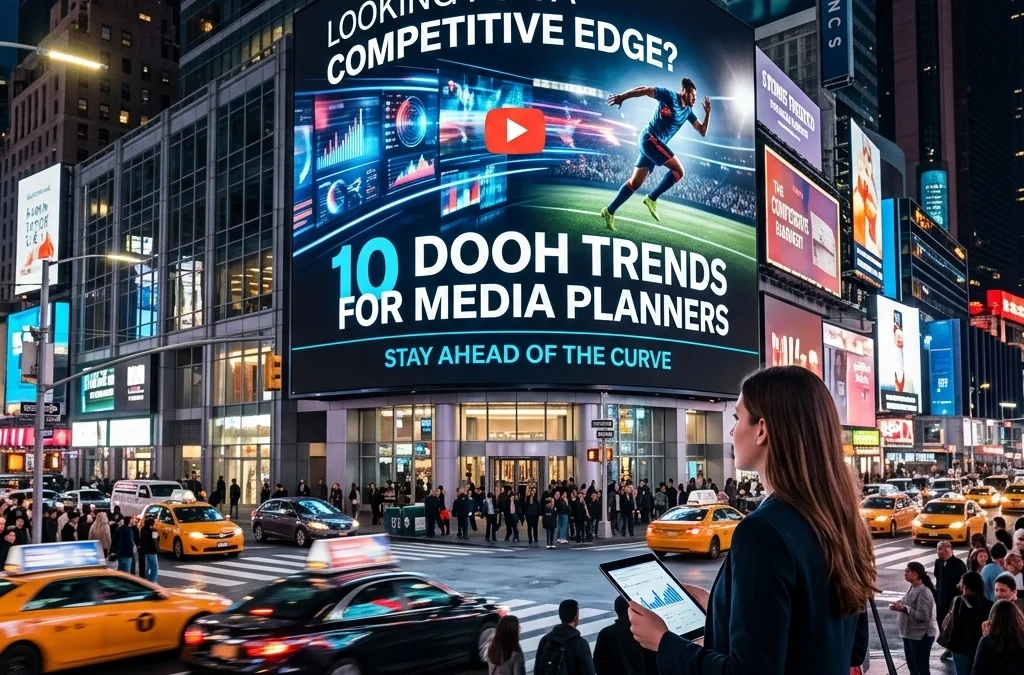
The landscape of out-of-home advertising has undergone a massive transformation, shifting from static billboards to a highly sophisticated, data-driven ecosystem. For media planners seeking a competitive edge, staying ahead of digital out-of-home (DOOH) trends is no longer optional. It is a strategic necessity. As the industry moves toward a projected 50 billion dollar valuation by 2030, the ability to leverage technology and audience insights will define the most successful campaigns.
Strategic planning now requires a deep understanding of how programmatic buying, real-time data feeds, and creative innovation intersect. The following ten trends represent the current state of DOOH and provide a roadmap for maximizing impact in an increasingly crowded marketplace.
1. The Rise of Programmatic DOOH (pDOOH) and Automation
Programmatic technology has revolutionized how media is purchased. By automating the buying process, pDOOH allows for audience-based activation rather than location-based buying. Instead of purchasing a specific screen for a fixed duration, planners can now buy impressions that target specific demographics across a network of screens.
This shift toward automation improves efficiency and allows for better integration into omnichannel strategies. Platforms like StackAdapt have been instrumental in driving this adoption, enabling planners to manage DOOH alongside digital, CTV, and mobile campaigns within a single workflow. For more on this, the spotlight on StackAdapt details how programmatic adoption is streamlining complex executions.
2. Dynamic Creative Optimization (DCO) as Core Strategy
Dynamic Creative Optimization (DCO) has moved beyond the experimental phase to become a cornerstone of effective DOOH strategy. DCO uses data signals to change the creative content of an ad in real time. This ensures that the message remains relevant to the viewer's current environment.
AI now plays a significant role in this process, accelerating the creation of thousands of variations that can be deployed based on specific triggers. This level of agility allows brands to maintain an "always-on" presence while ensuring that no two ad exposures feel identical or stale.
3. Real-Time Contextual Triggers
The true power of digital screens lies in their ability to respond to external data. Contextual triggers allow an ad to swap messaging instantly based on factors such as:
- Live sports scores and game-day momentum.
- Weather conditions (e.g., promoting iced tea when the temperature rises).
- Traffic patterns or flight delays.
- Product availability at nearby retail locations.
In the world of sports, these triggers are particularly effective. A brand can congratulate a local team on a victory within seconds of the final whistle, creating a sense of shared community and immediate relevance.

4. First-Party Data Integration
As the advertising industry moves away from third-party cookies, first-party data has become the ultimate currency. Media planners are now integrating brand-owned data, such as loyalty program insights, app usage, and purchase history, into their DOOH planning.
By matching brand data with location-based audience insights, planners can identify high-density areas where their most loyal customers or highest-value prospects are likely to be. This precise targeting ensures that ad spend is concentrated on the most impactful locations, reducing waste and increasing ROI.
5. 3D and Spatial DOOH Innovation
Creative that breaks the pattern is essential for capturing attention in busy urban environments. 3D billboards and spatial DOOH use perspective and high-definition screens to create the illusion of depth, making objects appear as if they are leaping out of the screen.
Research has shown that 3D animations can boost engagement and conversion rates significantly. By creating a "must-see" visual moment, brands can drive organic social sharing, extending the reach of a physical placement into the digital realm. This approach is highly effective for major product launches or marquee sporting events where brand presence needs to feel larger than life.
6. Superior Neuro Response and Engagement Metrics
Recent studies indicate that digital out-of-home drives 3.2 times more neuro response and memory activity compared to traditional static formats. The combination of motion, bright displays, and timely messaging creates a deeper psychological impact on the viewer.
Furthermore, DOOH has been shown to deliver greater reach than even the most expensive television placements, including Super Bowl ads. For planners, this means that DOOH is not just a secondary channel but a primary driver of brand fame and long-term memory encoding.
7. Omnichannel and Mobile Pairing Strategies
DOOH does not exist in a vacuum. The most successful campaigns use digital screens to set a foundation and then follow up with mobile retargeting. When a consumer is exposed to a DOOH ad, their mobile device ID can be captured within a geofenced area, allowing the brand to serve a follow-up ad on their smartphone later that day.
This pairing creates a seamless journey from awareness to action. For instance, a sports brand might use Sportrons to build awareness near a stadium and then offer a discount code via a mobile ad to encourage an immediate purchase.

8. A Strategic Return to Brand Building
While performance marketing has dominated the digital landscape for years, there is a clear trend toward returning to brand building. In an era of fragmented audiences and AI-generated noise, established brand trust is a massive competitive advantage.
DOOH is uniquely positioned for brand building because it occupies the physical world. It is unskippable, cannot be blocked by ad-blockers, and provides a "brand safe" environment. Large-scale placements create a sense of permanence and authority that digital-only channels often struggle to replicate.
9. Cultural Relevance and Emotional Storytelling
To turn viewers into fans, media planners are focusing on cultural relevance. This involves more than just placing an ad; it involves participating in the cultural moment. For example, during the NYC Marathon, brands that were not official sponsors used clever DOOH placements to insert themselves into the conversation.
The case of Nike's unofficial marathon presence serves as a prime example of how strategic OOH can create a high level of brand association without the cost of a traditional sponsorship.
10. Context That Connects Without Intrusion
In a world increasingly concerned with privacy, DOOH offers a way to be relevant without being "creepy." Because it targets groups and locations rather than tracking individuals across the web, it is perceived as more trustworthy.
The focus in 2026 and beyond is on delivering meaningful, contextual messaging that adds value to the viewer's environment. Whether it is providing a live score update or a helpful weather alert, the goal is to make the ad feel like a part of the landscape rather than an interruption.
Quantifiable Success: Lessons from the Field
The effectiveness of these trends is best seen in campaign results. Data-driven DOOH has consistently delivered high lifts in brand metrics:
- Purchase Consideration: White Claw achieved a 74% lift in purchase consideration for a vodka launch by using programmatic DOOH. You can read the full White Claw case study to see the mechanics of that success.
- Brand Image: AB InBev's Mike’s Hard Iced Tea saw a 119% lift in positive brand image through a pDOOH campaign that focused on high-traffic, relevant locations. More details are available in the Mike's Hard Iced Tea study.
- New Channel Success: Sea-Doo increased purchase consideration by 144% during their first-ever DOOH campaign, proving that the medium is accessible and effective even for brands new to the space. The Sea-Doo campaign overview highlights their strategic approach.
Mastering the DOOH Landscape
For media planners, the objective is clear: move beyond the traditional "buy and hold" mentality of out-of-home. The competitive edge lies in the ability to integrate these ten trends into a cohesive strategy that prioritizes data, creative agility, and audience context.
By leveraging advanced strategies, brands can ensure they are not just visible, but impactful. As DOOH technology continues to evolve, those who master the intersection of the physical and digital worlds will be the ones who lead the market.
For those looking to explore how these trends can be applied to specific sports marketing goals, visiting the OOH Sports marketing page or reviewing case studies provides a deeper look at the tactics driving today's most successful campaigns. The future of advertising is out-of-home, and it is more dynamic than ever.