
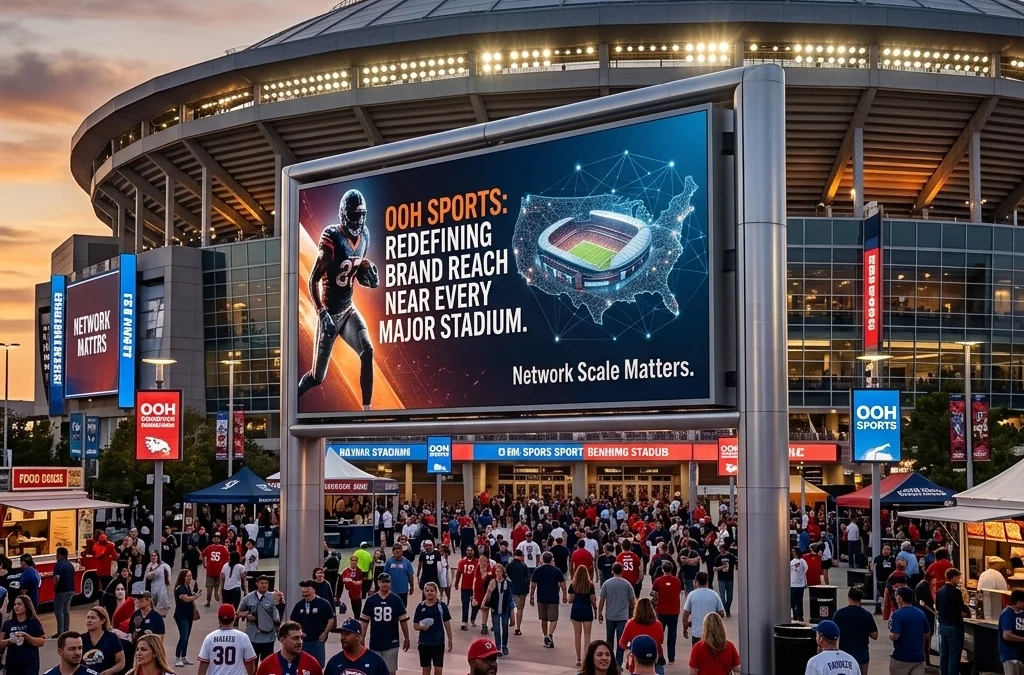
OOH Sports has officially achieved a significant milestone in the digital out-of-home advertising sector. The company has successfully expanded its digital screen network to cover the immediate perimeter of every major professional and collegiate sports stadium across the country. This expansion marks a shift in how brands approach sports marketing, moving away from limited in-stadium sponsorships toward a comprehensive network scale that captures the fan journey in its entirety.
The achievement reflects a growing demand for advertising solutions that reach audiences during moments of high emotional engagement. By saturating the three-mile radius surrounding these massive venues, OOH Sports provides a bridge between digital online advertising and physical location-based presence.
The Strategy of Perimeter Dominance
The core philosophy behind this network expansion is the concept of perimeter dominance. Traditional sports marketing often focuses on the interior of the arena, where costs are high and competition for attention is fierce among a limited number of official sponsors. OOH Sports has instead prioritized the surrounding ecosystem where fans spend the majority of their game-day time.
The network strategy targets high-traffic touchpoints including:
- Sports bars and restaurants.
- Major hotel lobbies and elevator banks.
- Convenience stores and transit hubs.
- Street-level digital displays.
By securing placements in these locations, the network ensures that a brand message is the first thing a fan sees when they arrive in the city and the last thing they see before they enter the gates. This creates a surround-sound effect that has historically been reserved for only the largest global brands with multi-million dollar sponsorship budgets.

Objective and Fan Journey Mapping
The primary objective of this network scale is to capture the fan journey during the window of peak anticipation. Research into consumer behavior indicates that the two hours preceding a game and the hour following a game are the periods of highest mobile and physical engagement.
OOH Sports maps this journey logically. A fan might check into a hotel near the stadium, grab a quick drink at a local bar, and stop by a convenience store for supplies. By having a presence at each of these points, OOH Sports allows brands to build frequency and reach without the clutter of traditional stadium signage.
This approach also addresses the issue of "ad blindness" within the stadium itself. While fans are focused on the field of play, they are less likely to process peripheral advertisements. In contrast, while waiting for a table at a restaurant or standing in line at a shop, the "dwell time" is higher, leading to better message absorption and higher recall rates.

Technology Partners and Programmatic Integration
The scale of the OOH Sports network is supported by advanced programmatic infrastructure. The company has integrated with major Demand Side Platforms (DSPs) to ensure that media buyers can access this inventory with the same ease as buying a Facebook ad or a Google search result.
A key partner in this growth has been the StackAdapt DSP, which has helped drive programmatic DOOH adoption. This integration allows for real-time bidding and dynamic creative optimization. Brands can now change their messaging based on the current score of the game, the weather, or even the specific demographic of the crowd attending a particular event.
The ability to launch real-time sports betting campaigns or promotional offers in under 24 hours has become a cornerstone of the network feature set. This level of agility was previously impossible in the out-of-home space, which often required weeks of lead time for physical printing and installation. More information on these rapid-deployment tactics can be found in the guide on how to launch real-time sports betting campaigns.
Comparative Impact and Brand Lift Results
The results of this network-scale approach are measured through rigorous brand lift studies and attribution modeling. By comparing the behavior of consumers exposed to the OOH Sports perimeter network versus those who were not, the data shows a clear advantage for the perimeter strategy.
Several recent campaigns highlight the effectiveness of this model:
- Beverage Category Performance: A campaign for White Claw saw a 74% lift in purchase consideration. By targeting fans in the vicinity of stadiums, the brand was able to capture consumers just moments before they made a purchase decision. Details on this campaign are available in the White Claw case study.
- Brand Image Improvement: Mike's Hard Iced Tea utilized the network to achieve a 119% lift in positive brand image. This was achieved by aligning the brand with the positive emotional energy of game day without the overhead of an official league sponsorship. The full analysis can be viewed in the Mike's Hard Iced Tea report.
- Direct Consideration: Sea-Doo recorded a 144% increase in purchase consideration by using digital OOH to target outdoor enthusiasts at specific stadium locations. This proves that the network is effective even for high-ticket items and non-traditional sports sponsors. Refer to the Sea-Doo campaign summary for further data.

Democratizing the Stadium Space
One of the most significant impacts of the OOH Sports expansion is the democratization of sports advertising. Historically, the area near a stadium during a major event was the exclusive playground of "Official Partners." These partnerships often cost tens of millions of dollars and are locked into multi-year contracts.
The OOH Sports network breaks this monopoly. Because the screens are located in private businesses and public spaces within the three-mile radius, any brand can now "own" the stadium atmosphere. This allows challenger brands to compete directly with industry giants. It also allows local businesses to leverage the massive influx of visitors to their city during game weekends.
The shift is significant enough that industry reports suggest a major reallocation of marketing budgets. As noted in recent analysis, approximately 67% of media planners are shifting budgets toward these more flexible and measurable digital out-of-home options.
Precision Targeting and AI Analytics
Scaling a network is only effective if the delivery is precise. OOH Sports utilizes AI-powered analytics to ensure that ads are shown to the right people at the right time. This involves using anonymized mobile location data to understand the flow of traffic around each stadium.
The system can identify when a crowd is moving toward the stadium (pre-game) and when they are dispersing into the surrounding neighborhood (post-game). This allows for tactical creative shifts. Pre-game ads might focus on "where to buy" or "get ready," while post-game ads might focus on "celebrate the win" or "order delivery."
This level of measurement fixes many of the traditional mistakes made in sports marketing. Instead of relying on guesswork or broad attendance numbers, brands can now see the actual number of "device IDs exposed" and track the subsequent lift in store visits or website traffic. For more on avoiding common measurement pitfalls, see the article on AI-powered DOOH analytics.

Execution Logistics and Future Growth
The logistics of managing a network that spans every major stadium are complex. OOH Sports maintains a decentralized maintenance and operations model, ensuring that screens remain functional and creative stays fresh across thousands of locations simultaneously.
The company plans to continue this growth by increasing the density of screens within each existing three-mile radius. While the initial goal of "every stadium" has been met, the focus now shifts to "every street corner" near those stadiums. This hyper-local saturation is what will continue to differentiate the network from broader, city-wide DOOH providers.
The expansion also includes a focus on seasonal adaptability. Whether it is the surge of shopping in New York City during the holidays or the summer rush of baseball fans, the network is designed to pivot its targeting parameters to match the seasonal ebb and flow of sports and entertainment.
A New Standard for Media Buying
The milestone reached by OOH Sports provides media buyers with a new standard for reach and frequency. By combining the massive scale of a national network with the surgical precision of stadium-perimeter targeting, the company offers a unique solution for the modern advertiser.
As the industry continues to move toward programmatic and data-driven solutions, the value of physical network scale becomes even more apparent. Brands no longer have to choose between the prestige of sports marketing and the accountability of digital advertising. With OOH Sports, they can have both.
For those looking to explore the full range of locations and strategic options, the OOH Sports sitemap provides a comprehensive look at the available network infrastructure. The future of sports marketing is no longer just about what happens inside the lines of the field, it is about every screen and every fan in the miles surrounding it.