
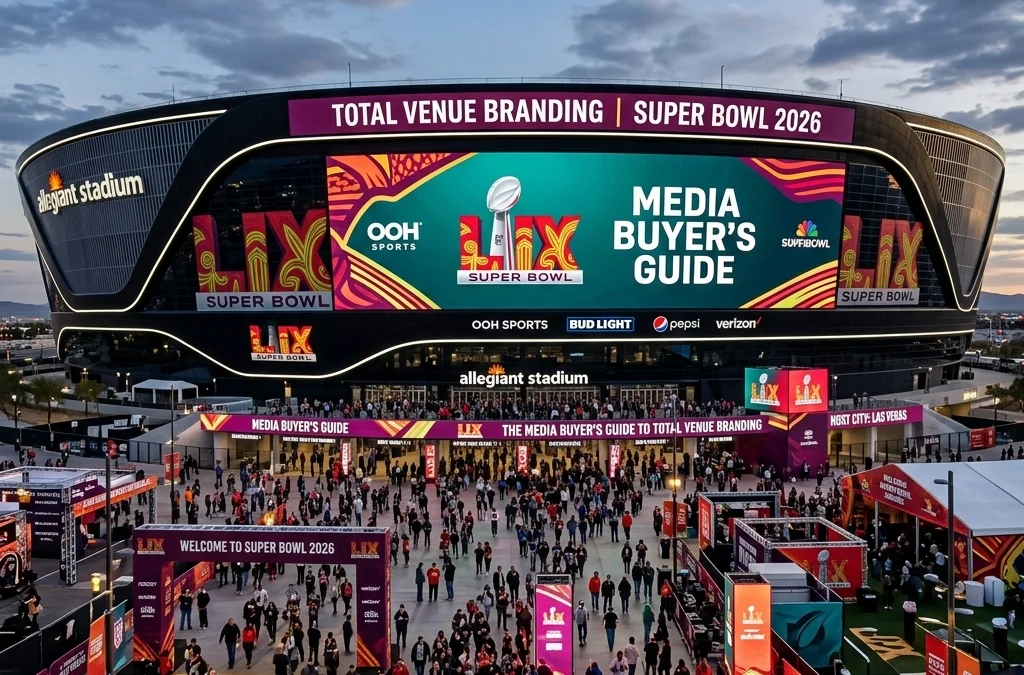
Super Bowl LX has concluded, leaving behind a trail of marketing lessons for the modern media buyer. On February 8, 2026, the world witnessed one of the most comprehensive displays of out of home advertising in sports history. As the industry moves into May 2026, the data confirms that physical venue branding has become just as essential as the traditional television spot. While millions of viewers watched from their couches, the real brand immersion happened on the ground, where every surface from the floors to the massive digital billboards served a strategic purpose.
For over 40 years, OOH Sports has led the charge in transforming sports venues into 360 degree brand environments. The approach at Super Bowl 2026 represented the pinnacle of this four-decade evolution. This guide explores how media buyers managed total venue coverage to capture attention in an era where digital noise is at an all time high.
Four Decades of Advertising Leadership
The success of Super Bowl LX was not an overnight achievement. It was the result of a strategy refined over 40 years. Advertising leadership in the sports world requires more than just buying space. It requires an understanding of fan movement, psychological triggers, and the seamless integration of physical and digital assets. OOH Sports has spent decades perfecting the art of "the surround sound" of advertising.
In the mid-1980s, venue branding was limited to static boards and simple banners. Today, the landscape is entirely different. Media buyers now look at a stadium as a living, breathing canvas. The objective is to ensure that a brand message follows the fan from the moment they exit their vehicle to the moment they take their seat. This level of expertise ensures that every placement is optimized for maximum dwell time and visibility.
https://www.youtube.com/watch?v=l6J-0zileKE
Strategy: Total Venue Coverage
Total venue branding is the practice of securing every available touchpoint within a stadium complex. For Super Bowl 2026, this meant moving beyond the scoreboard. Media buyers utilized a multi-layered approach that included several key zones.
Ground-Level Domination and Floor Graphics
One of the most effective yet overlooked areas is the literal ground fans walk on. High-durability floor graphics at main entrance gates created immediate brand impact. During Super Bowl 2026, these placements generated thousands of impressions per hour. Fans looking down at their phones or their feet were met with high-contrast logos and calls to action. These graphics are not just for show. They serve as directional markers that guide fans toward specific brand activations or retail zones.
Concourse and Pillar Integration
The concourse is where fans spend a significant portion of their time, especially during pre-game and halftime. Wrapping pillars and columns with vibrant vinyl transformed structural necessities into high-value marketing assets. This strategy ensures that even when a fan is away from the game action, the brand remains present. Digital screens located at food and beverage stations provided additional opportunities for dynamic messaging that could be updated in real time based on game events.

Objective and Strategy: The Strategic Timeline
Planning for a venue-wide takeover at an event of this magnitude typically begins 12 to 18 months in advance. Media buyers follow a structured timeline to ensure that every asset is secured and every creative element is optimized for the specific venue geometry.
- The Tease Phase (January 2026): Utilizing billboards on major approach routes and transit hubs to build anticipation.
- The Arrival Phase (Week of Game): Activating airport displays and hotel digital networks to greet arriving fans.
- The Game-Day Domination: Full activation of all in-stadium assets, including floor graphics, pillar wraps, and LED rotations.
- The Post-Game Attribution: Collecting data through device IDs and engagement metrics to measure the total impact.
This logical progression ensures that the brand is not just a guest at the party but the host of the experience. The use of Sportrons and other high-impact digital units allowed for a level of flexibility that static media simply cannot match.
Comparing Venue Branding to Traditional TV Costs
The financial landscape of Super Bowl advertising continues to shift. In 2026, the cost of a 30-second national television spot reached approximately $8 million. When production costs are added, the total investment can easily exceed $12 million for half a minute of airtime.
In contrast, a total venue branding campaign offers a different value proposition. While the investment is significant, the duration of the exposure is much longer. Physical branding is active for the entire week of the event and the full duration of game day. It cannot be skipped, muted, or ignored. For brands looking to maximize their marketing budget, venue branding provides a way to dominate the local environment at a fraction of the cost of a single national TV spot.

Technology Partners and Measurement
The modern media buyer relies heavily on technology to prove the efficacy of out of home campaigns. During Super Bowl 2026, OOH Sports utilized sophisticated tracking to provide advertisers with concrete data.
Programmatic DOOH and Real-Time Updates
Programmatic digital out of home (DOOH) played a massive role in the 2026 strategy. This technology allowed brands to change their creative on the fly. If a particular player made a historic play, brands could update their digital venue screens within seconds to reference the moment. This level of relevance drives much higher engagement than generic, pre-recorded content.
Data Driven Results
The results from recent years show why this approach is so successful. For example, a campaign for White Claw saw a 74% lift in purchase consideration by using targeted DOOH. You can read more about that in this case study. Similarly, other brands have seen triple-digit lifts in brand image when coordinating physical venue branding with digital retargeting.

Logistics and Execution
Executing a venue-wide branding project requires military-grade precision. Thousands of square feet of vinyl must be printed, shipped, and installed within tight windows. For Super Bowl 2026, teams worked around the clock to ensure that every wrap was seamless and every digital feed was synchronized.
Media buyers must account for the specific lighting conditions of the stadium, the flow of foot traffic, and the height of the displays. A billboard that looks great on a computer screen might be unreadable from 200 feet away in a crowded concourse. This is where 40 years of experience becomes the most valuable asset. Knowing how to adjust typography, color contrast, and messaging for a sports environment is a specialized skill.
The Impact of Physical Presence
There is a psychological weight to physical advertising that digital ads on a phone cannot replicate. When a fan walks into a stadium and sees a brand across the floors, walls, and screens, that brand is perceived as a leader. It creates a sense of "stature" and "permanence."
This physical presence also fuels social media content. Fans at Super Bowl LX were seen taking photos in front of branded walls and floor graphics, effectively turning a physical ad into a digital social campaign. This organic reach extends the life of the venue branding far beyond the stadium walls.

Results: Why Total Venue Branding Wins
The data from the 2026 season confirms several key outcomes for media buyers who choose venue-wide coverage:
- Increased Brand Recall: Fans exposed to multiple physical touchpoints throughout the day show significantly higher recall than those who only saw a TV commercial.
- Zero Ad-Blockers: In a stadium environment, there is no way for a consumer to block the advertisement. The message is part of the architecture.
- Enhanced Attribution: By using device ID tracking, brands can see exactly how many people who were at the stadium later visited a retail location or searched for the brand online.
Detailed case studies show that when brands combine physical presence with digital precision, the conversion rates are significantly higher than traditional siloed approaches.
Looking Forward to 2027
As we look back from May 2026, it is clear that the "Media Buyer's Guide to Total Venue Branding" is no longer an optional strategy. It is the blueprint for any brand that wants to be relevant on the world's biggest stage. The combination of 40 years of leadership and cutting edge technology has made it possible to capture the attention of fans in ways that were previously unimaginable.
For those planning for the next big game, the message is simple: start early, cover every surface, and use data to lead the way. The stadium is more than just a place to watch a game. It is the ultimate advertising platform for those brave enough to take over the entire venue.
To learn more about how OOH Sports handles these massive executions, visit the about page or check out the latest updates on the blog. Success in sports advertising is about being seen where the fans are, and in 2026, they were everywhere.