
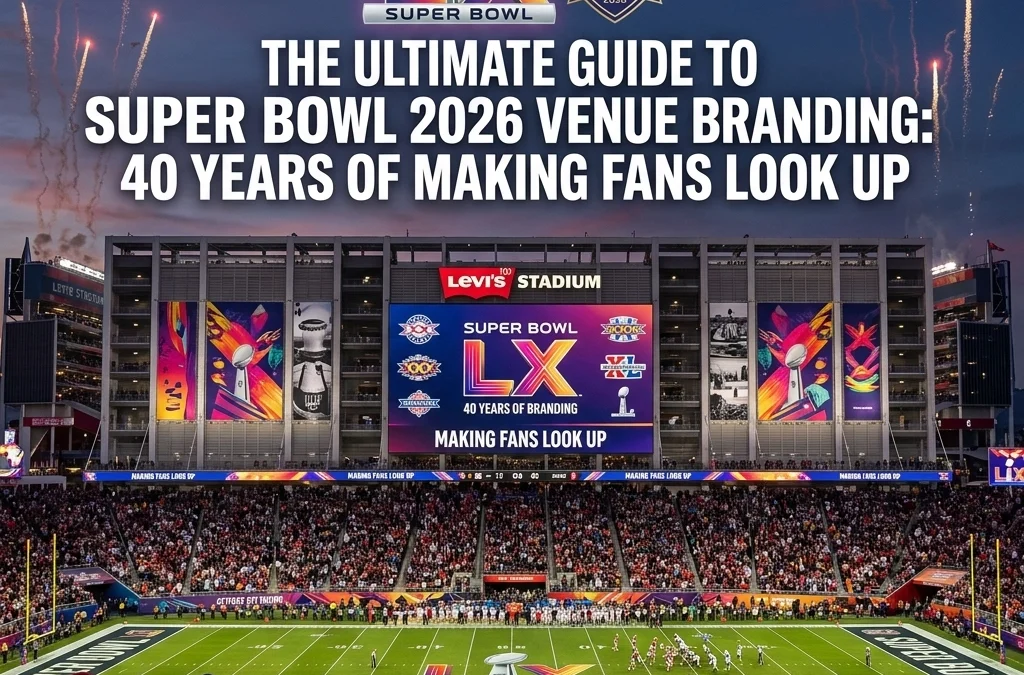
Super Bowl LX took over Levi’s Stadium in Santa Clara on February 8, 2026, marking a historic moment for the San Francisco Bay Area. It was not just a game. It was a massive visual display that combined decades of advertising tradition with the latest digital technology. For 40 years, the goal of venue branding has remained the same: to make fans look up.
Whether it was the massive wraps on the stadium exterior or the hyper-local ads at the airport, the 2026 event set a new standard for how a city and a stadium can be transformed. This guide looks back at the strategies that defined Super Bowl LX and the four decades of innovation that led to this moment.
The 2026 Context: A Bay Area Visual Masterpiece
The branding for Super Bowl LX was built around a distinct visual identity. The NFL moved away from the standardized silver logos of the past and embraced host-region imagery. The "LX" logo featured a CMYK-inspired color palette that stood out against the bright California sun. It integrated landmarks like the Golden Gate Bridge, the San Francisco skyline, and the redwood trees of the North Bay.
This creative backbone dictated every piece of advertising. From the moment fans landed at San Jose Mineta International Airport or San Francisco International, they were surrounded by this visual system. It was a cohesive experience that bridged the gap between the urban tech hubs of Silicon Valley and the natural beauty of the Pacific coast.

40 Years of Evolution: From Vinyl to Virtual
The journey to the 2026 venue branding started 40 years ago. Over those decades, the industry moved through four distinct eras of making fans look up.
The 1980s and 1990s: Static Spectacle
In the early days, branding was about physical scale. Painted signage, massive vinyl banners, and blimps were the primary tools. The goal was simple: be big and be bold. Fans looked up at the scoreboards and the fireworks. This era taught advertisers that high-contrast geometry and legible type are timeless. Even in 2026, those simple principles of long-distance visibility remained a core part of the stadium skin.
The 2000s: The Jumbotron Age
The turn of the century brought the Jumbotron. Video boards became the centerpiece of the bowl. Advertising shifted from static logos to 30-second spots and live replays. This era turned the stadium into a shared media environment. Brands realized that they could capture a captive audience by integrating their messaging into the game-day entertainment.
The 2010s: LED Immersion
As technology improved, the branding moved beyond the main screen. LED ribbon boards and fascia displays began to wrap around the entire seating bowl. This allowed for "full-bowl takes," where every digital surface in the stadium would synchronize to a single brand color or message at a specific moment. It was no longer about just one sign. It was about an immersive environment.
The 2020s: Data and AR Integration
By 2026, the technology reached a peak where fans looked up at the boards and down at their phones simultaneously. Augmented reality (AR) and real-time data feeds allowed branding to be personalized. Programmatic digital out-of-home (DOOH) began to play a massive role, allowing brands to change their creative based on the score of the game or the weather in Santa Clara.
Venue-Wide Coverage: From Floors to Billboards
One of the most impressive aspects of the Super Bowl LX campaign was the total venue coverage. The branding did not stop at the stadium gates. It started miles away and followed the fan to their seat.
The Airport Gateways
The airport is the first touchpoint. For Super Bowl LX, San Jose Mineta International served as a primary hub. The branding here included column wraps, baggage claim wallscapes, and digital screens that greeted every arrival. The visuals used the same redwood and skyline motifs seen in the stadium, creating an immediate sense of arrival.
The Stadium Skin
Levi’s Stadium has an open architecture that is perfect for large-format branding. The exterior towers were covered in massive mesh wraps. These were designed specifically for aerial shots. When the broadcast drones and helicopters flew over Santa Clara, the "LX" logo was clearly visible from thousands of feet in the air.
Inside the Bowl: Digital Dominance
Inside the stadium, the branding was a mix of traditional and digital. The LED ribbons were used for real-time engagement. For instance, when a touchdown was scored, the entire stadium would flash in the colors of the scoring team, integrated with sponsor logos.
The move toward digital has significantly changed how budgets are allocated. Many media planners have shifted toward these dynamic options. In fact, research shows that the sports DOOH gold rush is real, with a massive percentage of budgets moving to digital screens that offer more flexibility than old-school banners.

Digital vs. Traditional: The ROI Factor
For years, there has been a debate about whether traditional stadium ads or digital screens deliver better results. At Super Bowl LX, the answer was a combination of both, though digital provided the most flexibility. Traditional wraps provided the "prestige" and the permanent look of the game, while digital screens handled the engagement.
Digital screens allow for programmatic bidding, meaning an advertiser could buy space specifically for the four hours of the game rather than renting a wall for a month. This level of precision is why programmatic DOOH often delivers better ROI for sports marketers. It allows for real-time adjustments and better audience targeting.
The Visual Impact of OOH Sports
To understand the sheer scale of venue branding, one must see it in action. The following video showcases how modern sports marketing transforms a physical space into a brand story.
https://www.youtube.com/watch?v=l6J-0zileKE
Strategy: Making Every Angle Count
The branding for Super Bowl LX was meticulously planned to satisfy three different audiences: the in-person fan, the VIP guest, and the home viewer.
- The In-Person Fan: Focused on wayfinding and photo opportunities. 3D "LX" sculptures were placed in high-traffic plazas, encouraging fans to take selfies and share them on social media.
- The VIP Guest: In the clubs and suites, the branding was more refined. It used metallic textures and toned-down versions of the CMYK palette to create an upscale feel.
- The Home Viewer: This was the biggest audience. Placements were chosen specifically to be in the "sightline" of the main broadcast cameras. Every time a quarterback dropped back to pass, a brand logo or the Super Bowl LX identity was visible in the background.

Measurement: Proving the Value of Looking Up
In 2026, measurement moved beyond simple "impressions." Brands now use AI-powered analytics to see exactly how many people looked at a sign and for how long. By using device ID data and heat mapping, advertisers could see which zones of the stadium had the most engagement.
This data-driven approach is essential for modern campaigns. Many brands have moved away from guesswork and toward AI-powered DOOH analytics that prove exactly how successful a campaign was. For Super Bowl LX, this meant tracking social media mentions alongside physical foot traffic to get a complete picture of the brand's impact.
The Future of Venue Branding
As we look past 2026, the trend of total venue immersion will only grow. The lessons learned over the last 40 years show that while technology changes, the human desire for spectacle remains. Whether it is a painted sign from 1986 or a holographic display in the future, the goal is always to create a moment that makes people stop and look up.
Super Bowl LX was a celebration of this evolution. It proved that when you combine the right creative vision with the right technology, you don't just advertise to a fan. You create a memory.
For more information on how to dominate the sports advertising space, you can explore the OOH Sports sitemap or learn more about our advertising strategies.
The next 40 years of sports branding are just beginning, and the view from the top has never looked better.