
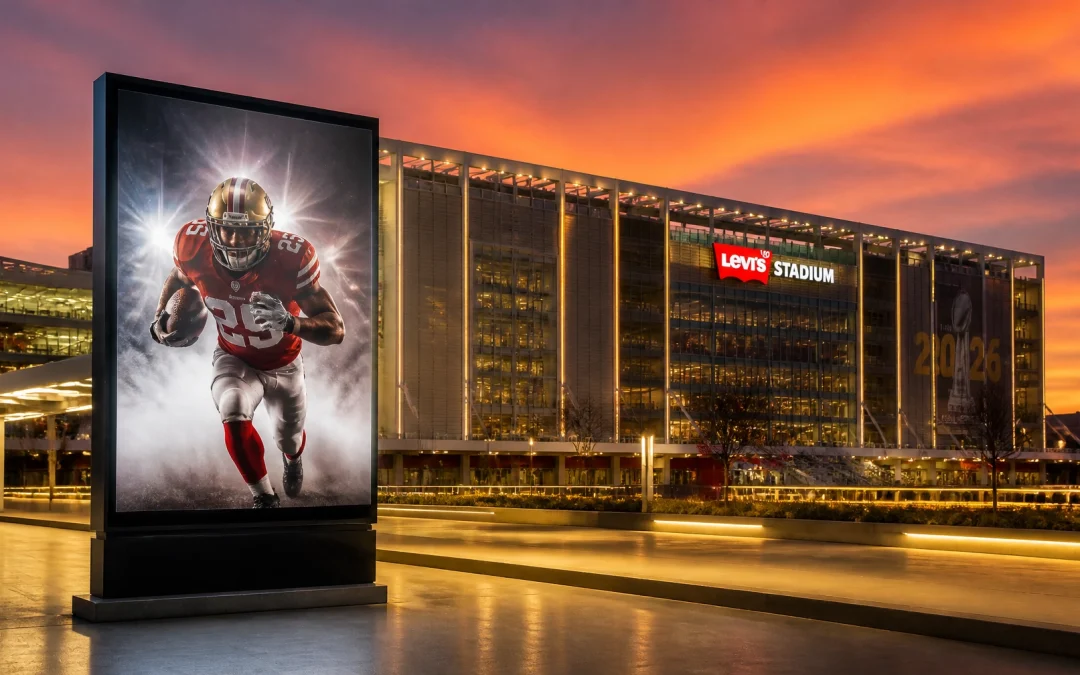
The landscape of Super Bowl advertising is undergoing a fundamental shift. As the 2026 Big Game at Levi’s Stadium in Santa Clara approaches, the traditional $8 million 30-second television spot is no longer the sole path to dominance. For media buyers and brand managers, the emergence of Name, Image, and Likeness (NIL) platforms has created a new "cultural ecosystem" that extends far beyond the four quarters of play.
The 2026 Super Bowl will be defined by the "NIL Layer." This strategy involves shifting budgets into scaled portfolios of college athletes to drive authentic, always-on engagement. With access to over 20,000 student-athlete voices, brands can now build a decentralized influencer network that mirrors the reach of a national broadcast but with the precision of a digital buy.
This guide outlines the five essential steps to operationalizing an NIL campaign that integrates with digital out-of-home (DOOH) assets to maximize impact during the biggest sports event of the year.
https://www.youtube.com/watch?v=l6J-0zileKE
Step 1: Prioritize Roster Scale Over Individual Stars
The most common mistake in NIL planning is betting the entire budget on a single "hero" athlete. For a high-stakes event like Super Bowl 2026, the data-backed strategy is "scale over stars." By activating a portfolio of mid-tier athletes rather than one celebrity, brands achieve better reach, frequency, and engagement.
Media buyers should focus on:
- The Portfolio Mix: Combine 1 or 2 high-profile names for PR value with 15 to 20 mid-tier athletes (50k to 100k followers).
- Niche Communities: Mid-tier athletes often possess highly engaged peer networks, teammates, and hometown circles that offer higher trust ratings than global celebrities.
- Accessing the Network: Utilize platforms that manage large rosters. OOH Sports provides access to a network of over 20,000 authentic student-athlete voices, allowing for rapid scaling and compliance management.
This approach functions like a Reach and Frequency buy. It stabilizes performance and ensures the brand message is distributed across various fan segments simultaneously.

Step 2: Implement a Triple-Phase Flighting Plan
A Super Bowl campaign is a month-long story, not a one-day event. To "crush" the 2026 season, media buyers must flight NIL content across three distinct windows:
- The Pre-Game Hype (3-4 weeks prior): Athletes create "behind-the-scenes" training content and brand-integrated teasers. This phase is critical for testing creative and building retargeting pools.
- Game Day Execution: Real-time reactions and "watch party" content. This is the peak moment for brand visibility. Using perimeter targeting within 10 miles of Levi’s Stadium allows brands to reach the 70,000+ fans in attendance and the thousands more in the surrounding Santa Clara area.
- The 72-Hour Post-Game Window: This is often the most neglected phase. Athletes can push highlights and follow-up offers while the game is still the primary cultural conversation.
By treating the Super Bowl as a 30-day campaign arc, media buyers can stretch the impact of their assets far beyond the final whistle.
Step 3: Shift from Polished Ads to Athlete-Led Content
Gen Z audiences, a primary target for NIL campaigns, favor authenticity over high production value. For Super Bowl 2026, the most successful content will be co-created with athletes in their own native voices and formats.
Key tactics include:
- Whitelisting: Running paid amplification through the athletes' own social handles rather than the brand's handle. This maintains the "peer-to-peer" feel of the content.
- Short-Form Focus: Research indicates that 15-second spots can match 30-second spots in brand impact across YouTube and Instagram. Short, social-native clips from 20,000+ athletes create a "wall of sound" that is harder to ignore than a single expensive commercial.
- Creative Guardrails: Provide athletes with "must-have" brand points but allow them to control the delivery. Over-produced, scripted content underperforms in the NIL space.

Step 4: Sync NIL with Programmatic DOOH and Perimeter Targeting
To achieve true omnichannel dominance, the digital NIL content must be mirrored in the physical world. This is where programmatic digital out-of-home (DOOH) becomes the force multiplier.
Strategy for Super Bowl 2026:
- The 10-Mile Perimeter: Deploy DOOH ads on every digital video board within 10 miles of Levi's Stadium. When fans see an athlete on their phone and then see the same campaign on a billboard on their way to the game, it creates a "surround sound" brand experience.
- Real-Time Triggers: Use real-time sports betting and scoring triggers to update DOOH creative based on the game's progress.
- Geographic Nuance: Leverage regional NIL athletes for local DOOH buys in their home markets (e.g., San Francisco, Phoenix, or Denver) to reach specific fanbases more efficiently than a national celebrity buy.
This integration ensures that the campaign is not just a digital interaction but a physical presence in the city hosting the game.

Step 5: Adopt a Performance-Based Measurement Model
The final step is moving away from vanity metrics (like raw impressions) and toward performance data. Media buyers should treat NIL and DOOH as performance channels.
Important metrics to track:
- Brand Lift Studies: Measure the increase in brand awareness and purchase consideration. Previous campaigns have shown up to 74% lift in purchase consideration through similar programmatic strategies.
- Conversion and ROI: Use performance-based compensation for athletes (paying for clicks, installs, or sales) to align incentives with the brand’s ROI goals.
- Device ID Exposure: Track "exposed" audiences who saw both the DOOH ads and the NIL content to measure the cumulative impact of the omnichannel approach.
By using data to iterate creative during the pre-game phase, media buyers can optimize spend toward the highest-performing athletes and formats before the peak game-day window.
Conclusion
Launching an NIL campaign for Super Bowl 2026 is no longer about finding one star. It is about leveraging a platform of 20,000+ voices to create a scalable, authentic, and high-frequency brand presence. By combining this influencer layer with precision DOOH sports advertising, media buyers can achieve better results and higher ROI than traditional broadcast methods alone.
As the competition for consumer attention intensifies, the brands that win in 2026 will be the ones that integrate human voices with digital scale.