
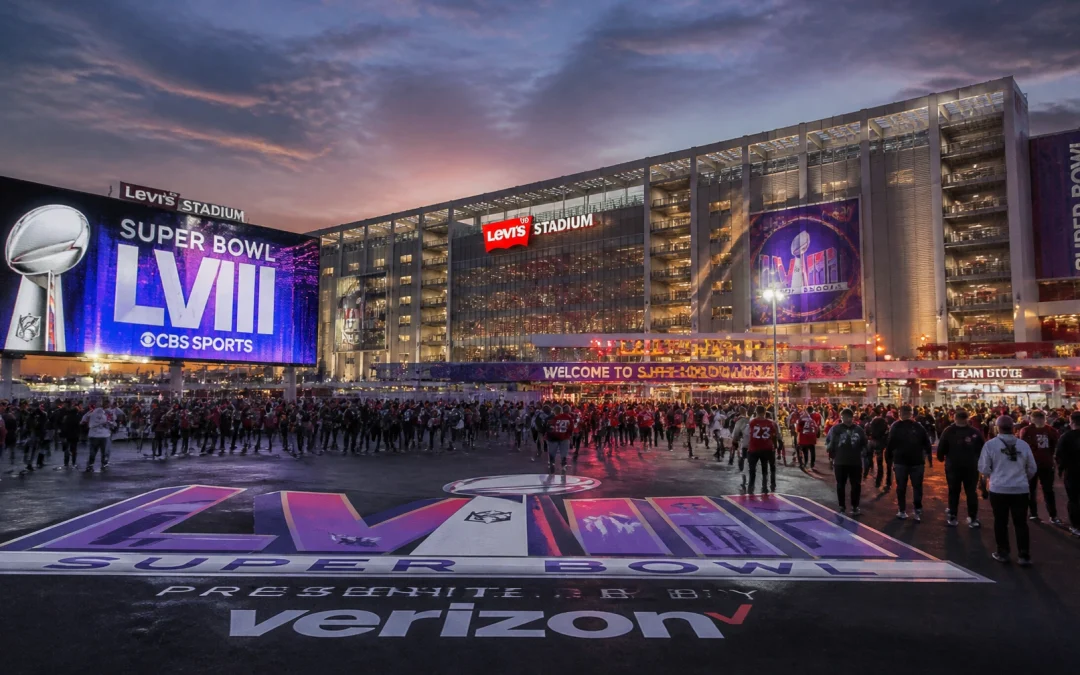
Super Bowl LX is scheduled for February 8, 2026, at Levi’s Stadium in Santa Clara, California. As the pinnacle of American sports, this event represents the most significant advertising opportunity of the year. For brands looking to make an impact, the strategy must extend beyond the 60 minutes of game time. Success in this environment requires a comprehensive approach that captures fan attention from the moment they arrive in the San Francisco Bay Area until they leave the stadium.
OOH Sports, a division of the Sports Media Inc. family, brings 40 years of advertising leadership to this event. Since 1985, the organization has been at the forefront of sports marketing, evolving from static signage to high-tech digital out-of-home (DOOH) solutions. This guide outlines the tactics and logistics required to dominate the Super Bowl LX landscape, from the floor graphics underfoot to the massive billboards in the sky.
Objective & Strategy
The primary objective for any Super Bowl campaign is to achieve total venue saturation and high-frequency brand exposure. Given the 70,000 plus fans attending the game and the hundreds of thousands more participating in surrounding festivities in San Francisco and Santa Clara, a fragmented approach is insufficient.
The strategy focuses on two main pillars:
- Venue-Wide Coverage: Implementing a floor-to-ceiling presence that includes high-traffic floor graphics, digital kiosks, and stadium-adjacent boards.
- Perimeter Dominance: Establishing a 10-mile perimeter around Levi's Stadium to reach fans during their commute, at transit hubs, and within fan activation zones.
By integrating these elements, a brand ensures that its message is the first thing fans see when they exit their hotel and the last thing they see as they enter the stadium gates.
40 Years of Advertising Leadership
The expertise of OOH Sports is rooted in four decades of sports media history. The journey began in the mid-1980s, a period when stadium advertising was largely limited to fixed wooden panels. Today, the network provides access to digital video advertising boards in every category, spanning the entire country.
This long-standing history provides a unique advantage in navigating the complex "clean zone" regulations enforced by the NFL during Super Bowl week. Understanding the logistics of Santa Clara and the broader Bay Area is essential for media buyers and planners who want to avoid the common pitfalls of major event marketing. More information on the history and leadership of the firm can be found on the About Page.

Strategy: The 10-Mile Perimeter
A critical component of the Super Bowl 2026 plan is the 10-mile advertising perimeter. This zone covers the primary transit routes, hotel clusters, and official fan zones like the NFL Experience.
Perimeter Tactics
- Transit Hubs: Targeting the Santa Clara – Great America station and other key rail nodes feeding into the stadium.
- Roadside Billboards: Utilizing large-format digital boards along the 101 and 880 freeways to reach the massive influx of vehicle traffic.
- Digital Street Furniture: Placing advertisements on kiosks and bus shelters in high-footfall areas of San Francisco and Santa Clara.
The goal is to create a "surround sound" effect where the brand becomes synonymous with the event itself. This is achieved through a mix of static and digital inventory that adapts to the time of day and fan movement patterns.
Technology Partners and Programmatic DOOH
Modern sports marketing relies heavily on data and automation. For Super Bowl 2026, the use of programmatic digital out-of-home (pDOOH) platforms allows for real-time creative updates and precise targeting. By partnering with leading Demand Side Platforms (DSPs) like StackAdapt, campaigns can be optimized on the fly based on attendance data and game-day conditions.
Tech Integration
- Mobile Retargeting: Using device IDs exposed to OOH ads to serve follow-up digital ads on fans' smartphones.
- Dynamic Creative: Updating billboard content with live scores or social media feeds to increase engagement.
- Attribution Modeling: Measuring the lift in brand search and purchase consideration following the event.
The following video showcases the dynamic nature of these sports marketing solutions and how they come to life in a stadium environment.
https://www.youtube.com/watch?v=l6J-0zileKE
Logistics and Execution: From Floors to Billboards
Executing a campaign of this magnitude requires precise logistics. One of the most effective yet overlooked tactics is the use of stadium floor graphics. These placements are positioned in high-dwell areas such as concession lines, stadium entrances, and concourses.
Execution Steps
- Site Selection: Identifying the highest-traffic points within the stadium and the 10-mile perimeter.
- Creative Production: Developing high-resolution visuals that are optimized for the specific dimensions of floor graphics and digital Sportrons.
- Installation: Coordinating with local crews for the rapid deployment of materials during the narrow window provided by venue management.
- Monitoring: Ensuring all digital boards are running correctly and that physical signage remains in pristine condition throughout the event.
The use of floor graphics provides a tactile, "ground-up" brand experience that complements the high-altitude visibility of traditional billboards.

Anticipated Results and Benchmarks
Data from previous high-impact campaigns provides a roadmap for what brands can expect during Super Bowl LX. The effectiveness of DOOH in the sports vertical is well-documented.
Key Performance Metrics
- Brand Lift: In similar programmatic DOOH campaigns, brands like White Claw saw a 74% lift in purchase consideration. Detailed findings are available in this White Claw case study.
- Brand Image Improvement: A campaign for Mike's Hard Iced Tea resulted in a 119% lift in positive brand image by utilizing well-timed digital placements near sports venues.
- Audience Reach: A Super Bowl perimeter campaign typically generates millions of impressions over the course of a single week, with a high concentration of affluent, sports-minded consumers.
By focusing on measurable outcomes, media planners can justify the investment in premium Super Bowl inventory. The use of brand lift studies and foot traffic attribution ensures that the success of the campaign is based on hard data rather than just the prestige of the event.

Conclusion
Super Bowl 2026 at Levi’s Stadium is not just a game. It is a massive cultural moment that requires a sophisticated, multi-layered advertising strategy. By leveraging 40 years of industry experience and a network that spans from floors to billboards, brands can achieve a level of visibility that is simply not possible through traditional channels alone.
The 10-mile perimeter and venue-wide saturation strategy offered by OOH Sports provides the tools necessary for CMOs and creative directors to succeed on the world's biggest stage. To begin planning your Super Bowl LX presence, visit the OOH Sports Case Study page to see how these tactics have been successfully deployed for the world's leading brands.