
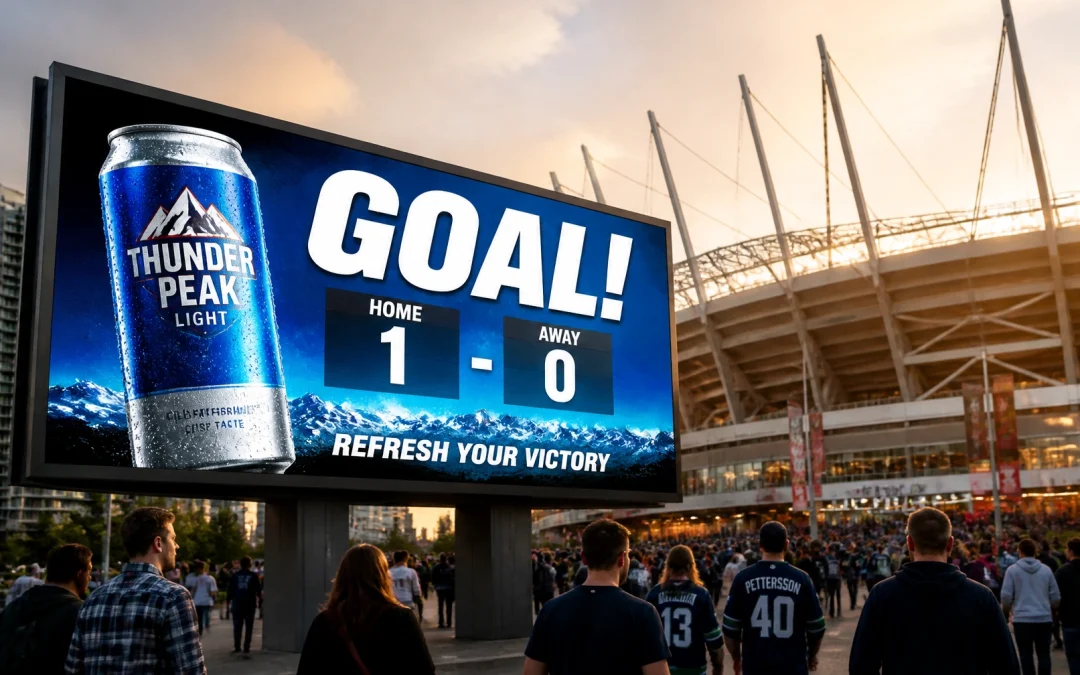
The landscape of sports marketing is undergoing a significant transformation. Traditionally, out-of-home (OOH) advertising relied on static placements that remained unchanged for weeks or months. However, the rise of programmatic digital out-of-home (DOOH) technology has introduced a new capability that is fundamentally altering how brands interact with fans: real-time score triggers.
These triggers allow advertisers to sync their messaging with the live events occurring on the field. When a goal is scored, a touchdown is made, or a game enters halftime, the advertising creative updates automatically across a network of digital screens. This level of synchronization ensures that the brand message is not just seen, but felt by the audience in a moment of peak emotional engagement.
Strategy
The core strategy behind score-triggered advertising is contextual relevance. In the world of sports, timing is everything. A generic advertisement for a sportsbook or a beverage brand might have some impact, but an advertisement that acknowledges a home team victory within seconds of the final whistle carries significantly more weight.
By leveraging automated data feeds, brands can deploy a "moments-based" marketing approach. This strategy prioritizes the emotional state of the consumer. For instance, if a local team wins, the creative can shift to celebratory messaging. Conversely, if the game is high-stakes and tied, the messaging can pivot to reflect the tension and excitement. This responsiveness transforms the billboard from a passive display into an active participant in the sports experience.
Objective & Strategy
The primary objective of implementing real-time triggers is to maximize the attention and recall of a targeted audience. Sports fans are among the most attentive consumers, with 46 percent of sports streamers reporting higher attention levels during games compared to other genres. The goal of a score-triggered campaign is to capture this existing attention and channel it toward a specific brand outcome.
To achieve this, the following strategic pillars are often utilized:
- Dynamic Creative Optimization (DCO): Utilizing templates that allow for real-time text and image updates without the need for manual design intervention.
- Geographic Precision: Focusing campaign efforts on perimeter networks within a 10-mile radius of the stadium or arena to capture fans entering and exiting the venue.
- Data Integration: Linking programmatic buying platforms directly to official sports league data providers to ensure accuracy and minimize latency.
- Emotional Alignment: Tailoring different creative assets to the possible outcomes of a game, such as "Win," "Loss," or "Close Game" scenarios.

Technology Partners & Integration
Executing a successful real-time trigger campaign requires a sophisticated technological stack. The process involves three main components working in concert: the data source, the programmatic platform, and the digital screen network.
- Live Sports Data Feeds: Brands partner with sports data companies that provide real-time APIs. These feeds include everything from scores and player statistics to betting odds and injury reports.
- Programmatic DSPs (Demand Side Platforms): The advertiser sets "if-this-then-that" rules within the DSP. For example, "If the score is tied in the fourth quarter, then increase bid price and activate the 'Clutch Moment' creative."
- Digital Out-of-Home Networks: The final piece is the physical infrastructure. Platforms like the OOH Sports Network provide the scale necessary to reach thousands of fans simultaneously across different venues and transit hubs.
The integration must be seamless to avoid delays. If a "Touchdown" ad appears five minutes after the play occurred, the relevance is lost. Modern systems can now process these triggers and update screens across a national network in less than 30 seconds.
Results & Impact
The data supporting the effectiveness of real-time score triggers is compelling. According to industry studies, dynamic and contextually relevant OOH creative can deliver a 30 percent lift in ad recall compared to static placements. Furthermore, brand recall is often up to 2.5 times higher when the digital content is adapted to the immediate environmental context.
Measurable outcomes from recent campaigns include:
- Increased Click-Through Rates (CTR): Campaigns utilizing "moment-triggers" have shown up to a 65 percent increase in engagement when connected to mobile retargeting efforts.
- Return on Ad Spend (ROAS): Some advertisers in the sports betting sector have reported a 2.1 times improvement in ROAS when using live odds-based triggers in their DOOH campaigns.
- Brand Affinity: 81 percent of sports fans feel more positive toward brands that sponsor or actively engage with their favorite sports. Score triggers prove that the brand is "watching" the game alongside the fan.
By focusing on data-driven case studies, it becomes clear that the value of the impression increases as the relevance of the content increases. A screen that shows a live score is a destination for the eye, making the adjacent brand message much more likely to be processed and remembered.

Execution Tactics
Implementing these campaigns involves a series of logical steps to ensure the message reaches the right fan at the right time.
- Define the Trigger Events: Advertisers must determine which game moments align best with their brand. A pizza brand might trigger ads during halftime, while a luxury watch brand might focus on the final buzzer of a championship game.
- Automate Creative Variations: Multiple versions of the creative should be pre-loaded into the system. This allows the technology to switch between "Home Team Scores," "Visitor Team Scores," and "Final Result" without human oversight.
- Utilize Proximity Targeting: The most effective campaigns often focus on screens in high-fan-density areas. This includes sports bars, transit routes leading to stadiums, and digital billboards in the immediate vicinity of the arena.
- Synchronize with Mobile: By capturing device IDs of individuals exposed to the score-triggered billboard, brands can retarget those same fans on their mobile devices later in the day, creating an omnichannel experience that reinforces the message.
Future Implications for Brands
As the technology continues to mature, the granularity of triggers will increase. We may soon see triggers based on individual player performance, such as a star athlete breaking a personal record or a specific player being substituted into the game. For brands, this means the ability to hyper-personalize the advertising experience at a massive scale.
Real-time score triggers move the needle because they solve the primary challenge of modern advertising: noise. In a world where consumers are bombarded with thousands of messages daily, the only way to stand out is to be undeniably relevant. By anchoring a brand message to the live, unpredictable, and high-energy world of sports, advertisers can ensure their message is never ignored.

For media buyers and planners, the shift to score-triggered programmatic DOOH is no longer a luxury: it is a strategic necessity. Those who embrace these dynamic capabilities will find themselves at the forefront of the next era of sports marketing, building deeper connections with fans and driving measurable results that traditional OOH simply cannot match. To learn more about how to integrate these strategies into your next campaign, explore our latest industry insights or contact the OOH Sports team directly.