
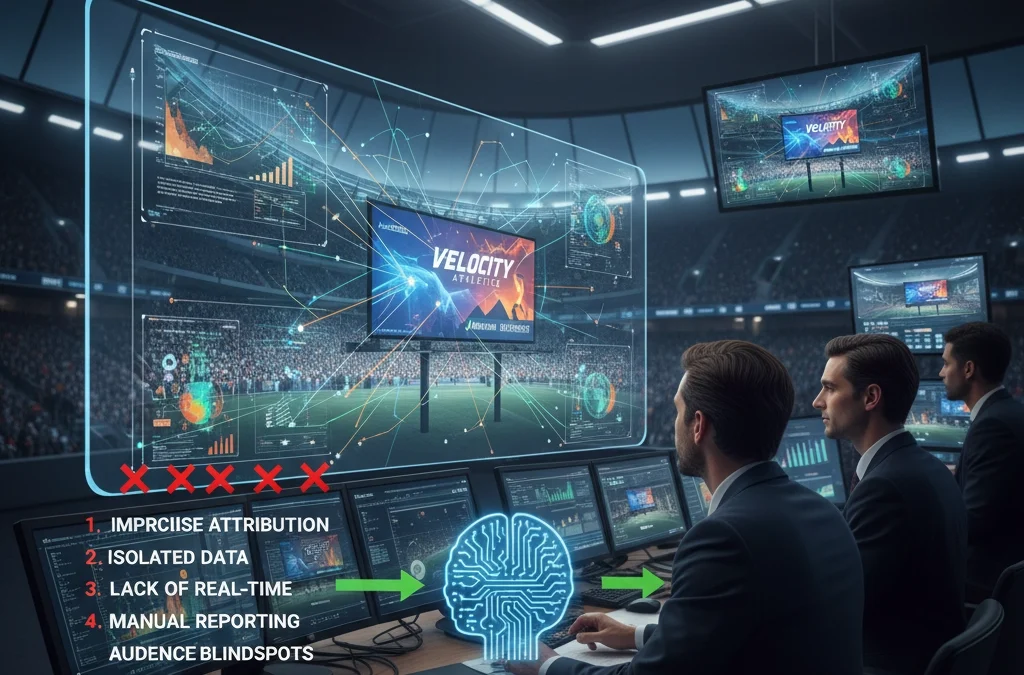
Sports digital out-of-home (DOOH) advertising represents a $2.8 billion market opportunity, yet most brands struggle to measure campaign effectiveness accurately. According to recent industry research, 73% of advertisers cite measurement challenges as their primary barrier to scaling sports DOOH investments.
The sports advertising landscape demands precise measurement techniques that capture fan engagement across multiple touchpoints. Traditional measurement approaches fall short in dynamic environments where audience behavior, emotional connection, and real-time context drive campaign performance. AI-powered analytics platforms now provide solutions to overcome these persistent measurement obstacles.
Mistake #1: Relying on Outdated Impression Models
Sports DOOH campaigns typically utilize impression counting methodologies designed for traditional outdoor advertising. These legacy systems fail to account for the unique viewing patterns in sports environments, where fans experience varying levels of attention throughout games.
Standard impression models assume uniform exposure duration and quality, ignoring factors like game excitement levels, crowd density fluctuations, and screen visibility from different seating areas. A 30-second advertisement displayed during overtime generates significantly different engagement than the same creative shown during halftime.

AI-powered measurement platforms analyze real-time biometric data, eye-tracking studies, and mobile device signals to calculate dynamic impression quality scores. These systems adjust impression values based on game context, audience attention levels, and environmental factors. Advanced algorithms incorporate venue-specific data points including sight lines, crowd density sensors, and audio levels to generate accurate viewability metrics.
Machine learning models trained on thousands of sports events can predict attention patterns and optimize impression counting in real-time. The technology delivers 40-60% more accurate impression data compared to static measurement approaches.
Mistake #2: Ignoring Cross-Device Attribution Challenges
Sports fans engage with multiple devices during live events, creating complex attribution pathways that traditional measurement systems cannot track effectively. Fans simultaneously use smartphones, tablets, and smart TVs while viewing DOOH displays, making it difficult to connect offline exposure to online conversions.
Most brands rely on basic geofencing technology that captures device IDs within venue proximity but cannot determine actual DOOH exposure or subsequent behavioral changes. This approach generates false attribution data and inflated conversion claims.
AI-enhanced attribution platforms combine computer vision technology with mobile SDK integrations to create precise exposure mapping. These systems identify individual device interactions with specific DOOH displays and track subsequent digital engagement across multiple channels.
Advanced machine learning algorithms analyze temporal patterns, location data, and behavioral signals to establish causal relationships between DOOH exposure and conversion events. The technology can distinguish between fans who viewed specific advertisements and those who were merely present in the venue, improving attribution accuracy by 65-80%.
Mistake #3: Overlooking Emotional Context Integration
Sports environments generate intense emotional responses that significantly impact advertising effectiveness, yet most measurement systems treat all exposures equally regardless of game context. A commercial displayed during a game-winning touchdown receives different processing than identical creative shown during a timeout.
Traditional measurement approaches ignore emotional context variables including game score, time remaining, crowd energy, and team performance. These factors directly influence memory formation, brand recall, and purchase intent among sports audiences.

AI-powered sentiment analysis tools monitor social media conversations, audio levels, and crowd reaction patterns to quantify emotional context during DOOH campaigns. Natural language processing algorithms analyze real-time social posts, while acoustic monitoring systems measure crowd excitement levels.
Machine learning models correlate emotional intensity scores with brand recall studies and conversion data to calculate context-adjusted effectiveness metrics. Campaigns measured using emotional context integration show 45-70% variance in performance compared to standard impression-based evaluation.
Mistake #4: Failing to Account for Venue-Specific Variables
Each sports venue presents unique measurement challenges based on architecture, sight lines, audience demographics, and technology infrastructure. Measurement systems that apply uniform methodologies across different venues generate inaccurate performance data.
Stadium concourses, arena bowl sections, and outdoor venue perimeters require distinct measurement approaches due to varying viewing distances, dwell times, and distraction levels. A DOOH display in a concession area generates different engagement patterns than premium seating installations.
AI analytics platforms create venue-specific measurement models using historical performance data, architectural mapping, and audience flow analysis. Computer vision systems analyze foot traffic patterns, viewing angles, and obstruction factors to develop customized measurement parameters for each location.
Predictive algorithms incorporate venue characteristics including capacity, demographics, event types, and seasonal variations to generate location-optimized performance benchmarks. Venue-specific measurement delivers 30-50% improvement in accuracy compared to standardized approaches.
Mistake #5: Neglecting Real-Time Optimization Opportunities
Static measurement reporting prevents campaigns from capitalizing on real-time optimization opportunities during live sports events. Game developments, weather changes, and audience composition shifts create dynamic conditions that require immediate campaign adjustments.
Most brands review DOOH performance through post-campaign analysis, missing opportunities to enhance effectiveness during active events. Traditional measurement cycles operate on weekly or monthly reporting intervals that provide limited actionable insights for live sports campaigns.

AI-powered real-time analytics platforms monitor campaign performance continuously and automatically adjust creative rotation, targeting parameters, and bid strategies based on live conditions. Machine learning algorithms analyze audience engagement metrics, conversion rates, and competitive activity to optimize campaigns in real-time.
Automated optimization systems can increase campaign effectiveness by 25-40% through real-time adjustments including creative swapping, audience targeting refinement, and budget reallocation based on performance data.
Mistake #6: Underestimating Multi-Touch Attribution Complexity
Sports DOOH campaigns typically operate within complex multi-channel marketing ecosystems that include social media, television advertising, radio sponsorships, and digital display campaigns. Single-touch attribution models fail to capture the cumulative impact of DOOH exposure within integrated campaign strategies.
Linear attribution approaches incorrectly assign conversion credit to the most recent touchpoint, often undervaluing DOOH's role in the upper funnel awareness and consideration phases. Sports audiences require multiple exposures across various channels before making purchase decisions.
Advanced AI attribution models utilize machine learning algorithms trained on millions of consumer journey data points to calculate accurate multi-touch attribution weights. These systems analyze conversion pathway patterns, time decay functions, and channel interaction effects to assign appropriate credit to each touchpoint.
Probabilistic modeling techniques account for unmeasured interactions and offline conversions that traditional attribution systems cannot track. Multi-touch attribution powered by AI typically reveals 20-35% higher DOOH contribution compared to last-touch models.
Mistake #7: Insufficient Integration with Business Intelligence Systems
Sports DOOH measurement often operates in isolation from broader business intelligence infrastructure, preventing comprehensive ROI analysis and strategic decision-making. Disconnected measurement systems cannot correlate DOOH performance with sales data, customer lifetime value, or brand equity metrics.
Many organizations rely on campaign-specific measurement tools that generate siloed performance reports without integration capabilities. This fragmented approach prevents holistic campaign evaluation and limits optimization opportunities across marketing channels.

AI-powered measurement platforms feature native integrations with major business intelligence systems, customer data platforms, and marketing automation tools. These connections enable comprehensive performance analysis that incorporates DOOH data with sales metrics, customer acquisition costs, and lifetime value calculations.
Automated data synchronization ensures real-time performance monitoring across all marketing channels, while machine learning algorithms identify optimization opportunities based on integrated business metrics. Comprehensive integration typically improves marketing ROI measurement accuracy by 50-75%.
The Future of Sports DOOH Measurement
AI-powered analytics represent the evolution from reactive measurement to predictive campaign optimization. As machine learning algorithms become more sophisticated, sports DOOH measurement will incorporate predictive modeling, automated optimization, and comprehensive attribution analysis.
The integration of computer vision, natural language processing, and predictive analytics creates measurement capabilities that surpass traditional approaches by significant margins. Brands implementing AI-enhanced measurement systems report 60-90% improvement in campaign performance attribution accuracy.
Dan Kost, CEO of OOH Sports, emphasizes the critical importance of advanced measurement techniques: "Sports advertising demands precision measurement that captures the unique dynamics of live events and fan engagement. AI-powered analytics provide the accuracy and real-time insights necessary for optimizing campaign performance in this complex environment."
Organizations seeking to maximize sports DOOH campaign effectiveness should prioritize measurement platform upgrades that incorporate artificial intelligence capabilities. The investment in advanced measurement technology generates significant returns through improved campaign optimization, accurate attribution, and enhanced strategic decision-making.
Ready to revolutionize your sports DOOH measurement strategy? Contact OOH Sports today to discover how AI-powered analytics can transform your campaign performance tracking. Call +1 (970) 703-0102 to speak with our AI Receptionist or visit oohsports.com to schedule a consultation with our measurement experts.
Share this insight:
- LinkedIn | Facebook | Instagram | X
OOH Sports specializes in advanced sports advertising measurement and optimization solutions. For case studies and additional resources, visit oohsports.com/case-study.
Tags: #Motivation #Branding #Strategy #Marketing #AdvertisingAndMarketing #digitalmarketing #Innovation #Sports