
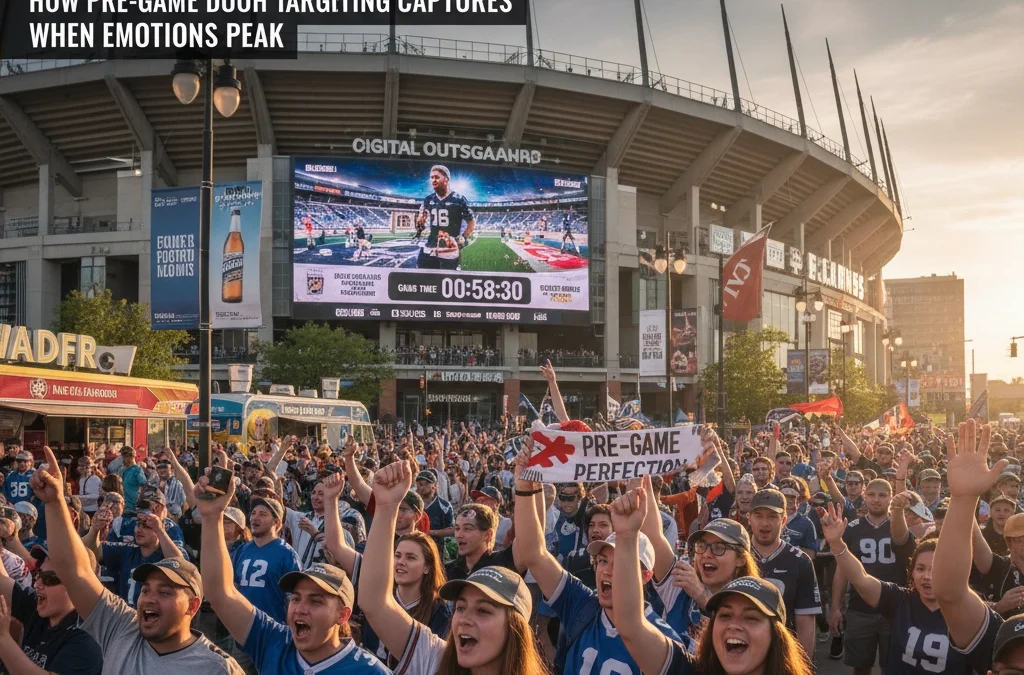
Traditional stadium advertising operates on a flawed premise: that fans are most receptive to brand messaging during the game itself. The reality reveals a different story. Pre-game periods represent the optimal window for sports advertising, when fan excitement builds to fever pitch and emotional investment peaks without the distractions of live action.
Rather than competing for attention during gameplay or targeting empty venue spaces, strategic brands redirect budgets toward Digital Out-of-Home (DOOH) placements that intercept fans during their pre-game rituals. These touchpoints occur when fans grab food at restaurants, meet friends at bars, or travel through city centers wearing team colors.
The Financial Case for Pre-Game DOOH Strategy
The economic argument for shifting to pre-game DOOH proves compelling through measurable data points. A month-long DOOH campaign delivers 7.5 times greater reach and 10 times better cost-per-thousand (CPM) value compared to a 30-second Super Bowl commercial in the top 25 U.S. markets. With nearly 1 billion impressions at a fraction of traditional costs versus the Super Bowl's 123 million viewers, the financial calculation becomes straightforward for brands questioning their game-day budgets.
DOOH achieves 86% ad recall, representing the highest rate of any major media format. This memory advantage proves particularly valuable during pre-game windows when fans actively seek sports content and plan their viewing experiences rather than passively consuming during gameplay.

Strategic Targeting During Peak Emotional Investment
Pre-game targeting succeeds because fans follow predictable patterns in the hours and days before kickoff, creating concentrated opportunities in high-traffic locations. Major metropolitan areas pulse with energy as fans gather in bars, restaurants, malls, and transportation hubs leading up to game time.
Primary Pre-Game Targeting Locations
- Transportation corridors: Airports, subway stations, and highway digital billboards capture traveling fans
- Entertainment districts: Sports bars and restaurant clusters where fans congregate for pre-game festivities
- Shopping centers: Malls and retail areas where fans purchase team merchandise and game-day supplies
- Urban business districts: High-traffic areas with significant foot traffic during commute hours
Brands deploy DOOH to target specific audience segments with precision, including fans of major tentpole events like the Super Bowl or World Cup, loyal supporters of regional teams, and venue attendees who recently visited stadiums and arenas. This granular targeting ensures messages reach high-affinity audiences when their emotional investment peaks, not during the distracted chaos of game time.
The spending impact validates this targeting approach. Research indicates that 99% of fans who attended an event after seeing an out-of-home ad spent money locally on hotels, restaurants, and transportation, with two-thirds spending a "significant" amount. Pre-game DOOH placements effectively position brands at the exact moment fans open their wallets.
Dynamic Creative Execution for Maximum Impact
The most effective pre-game DOOH campaigns leverage dynamic creative that evolves as game day approaches. Rather than static messaging, brands deploy countdown timers in the weeks and days leading up to matches, building anticipation and encouraging tune-in behavior.
Countdown Campaign Elements
- Multi-week buildups: Initial awareness messages transform into specific game-day countdowns
- Real-time updates: Scores, standings, and player statistics integrate into creative executions
- Location-specific messaging: Geotargeted content reflects local team preferences and rivalries
- Time-sensitive offers: Limited-time promotions create urgency during peak engagement periods

Pre-game digital releases carry strategic advantages particularly with younger demographics who actively seek advertising content before game day, allowing brands to build early excitement and extend engagement beyond the broadcast window. This multi-day approach maximizes impressions before traditional game-time advertisements air, while emotional connections formed during pre-game periods create stronger brand recall than rushed in-game messaging.
Measurable Action and Engagement Results
Pre-game DOOH campaigns drive immediate behavioral responses beyond simple awareness metrics. Research shows that 76% of consumers report that a DOOH advertisement recently prompted them to take action, and 74% of mobile users acted on their devices after seeing a DOOH advertisement. This behavioral response intensifies during pre-game windows when fans actively plan their viewing experiences, coordinate meetups, order food, and make last-minute purchases.
Key Performance Indicators for Pre-Game Campaigns
- Immediate mobile engagement: Device activity spikes following DOOH exposure
- Location-based actions: Store visits, restaurant reservations, and ticket purchases
- Social media amplification: Fan-generated content featuring advertised brands
- Purchase intent increases: Measurable lifts in consideration and purchase likelihood
The emotional resonance factor amplifies these results. Studies indicate that 81% of consumers feel more positively toward brands that sponsor sports they love, and 66% report increased purchase inclination from such brands. By connecting with fans during high-emotion pre-game buildup rather than the saturated in-game environment, brands position themselves as part of the anticipation and celebration rather than another commercial interruption.

Technology Integration and Programmatic Capabilities
Advanced DOOH platforms enable sophisticated pre-game targeting through programmatic buying and real-time optimization. These systems integrate multiple data sources to identify optimal placement timing and creative variations based on fan behavior patterns and engagement metrics.
Programmatic DOOH Advantages for Sports Marketing
- Automated bidding: Real-time auction systems optimize cost efficiency across multiple venues
- Audience segmentation: Device ID matching connects online behaviors with physical location data
- Creative optimization: A/B testing determines most effective messaging approaches during pre-game periods
- Attribution tracking: Conversion measurement links DOOH exposure to downstream actions
Weather data, social media sentiment, and ticket sales information feed into these systems to adjust campaigns dynamically. For instance, increased precipitation might trigger indoor venue emphasis, while viral team-related content could prompt creative modifications to capitalize on trending topics.
Implementation Framework for Pre-Game Success
Successful pre-game DOOH campaigns require strategic coordination across multiple variables, from timing and placement to creative execution and measurement protocols. The implementation process begins with comprehensive market analysis to identify peak fan traffic patterns and emotional engagement windows.
Campaign Planning Methodology
- Market Research Phase: Analyze local fan behavior patterns, venue traffic data, and competitive advertising schedules
- Audience Definition: Create detailed targeting parameters based on team affinity, geographic location, and behavioral indicators
- Creative Development: Design dynamic assets that adapt to countdown timers, team performance, and real-time data feeds
- Media Planning: Select optimal screen networks, timing schedules, and budget allocation across pre-game periods
- Performance Monitoring: Establish measurement frameworks to track engagement, actions, and attribution metrics

The campaign timeline typically spans multiple weeks leading up to major sporting events, with message intensity and specificity increasing as game day approaches. Early phases focus on general awareness and excitement building, while final days emphasize specific calls-to-action and last-minute engagement opportunities.
Return on Investment Measurement
Pre-game DOOH campaigns generate measurable returns through multiple channels, from immediate mobile engagement to longer-term brand preference shifts. Attribution studies demonstrate clear connections between pre-game advertising exposure and subsequent consumer behaviors, validating the strategic shift away from traditional in-game placements.
Brand lift studies consistently show elevated awareness, consideration, and purchase intent among audiences exposed to pre-game DOOH campaigns compared to control groups. These improvements persist beyond the immediate game period, suggesting that emotional connections formed during peak anticipation create lasting brand associations.
The data supports a fundamental shift in sports marketing strategy. Rather than competing for attention during oversaturated game broadcasts or targeting empty stadium spaces, brands achieve superior results by intercepting fans during their natural pre-game behaviors when emotions peak and attention remains available for brand messaging.
Contact OOH Sports at www.OOHSports.com to develop targeted pre-game DOOH strategies. Dan Kost, CEO, provides consultation at +1 (970) 703-0102 for brands seeking to maximize sports marketing ROI through strategic timing and placement optimization.
Keywords: #Motivation #Branding #Strategy #Marketing #AdvertisingAndMarketing #digitalmarketing #Innovation #Sports