
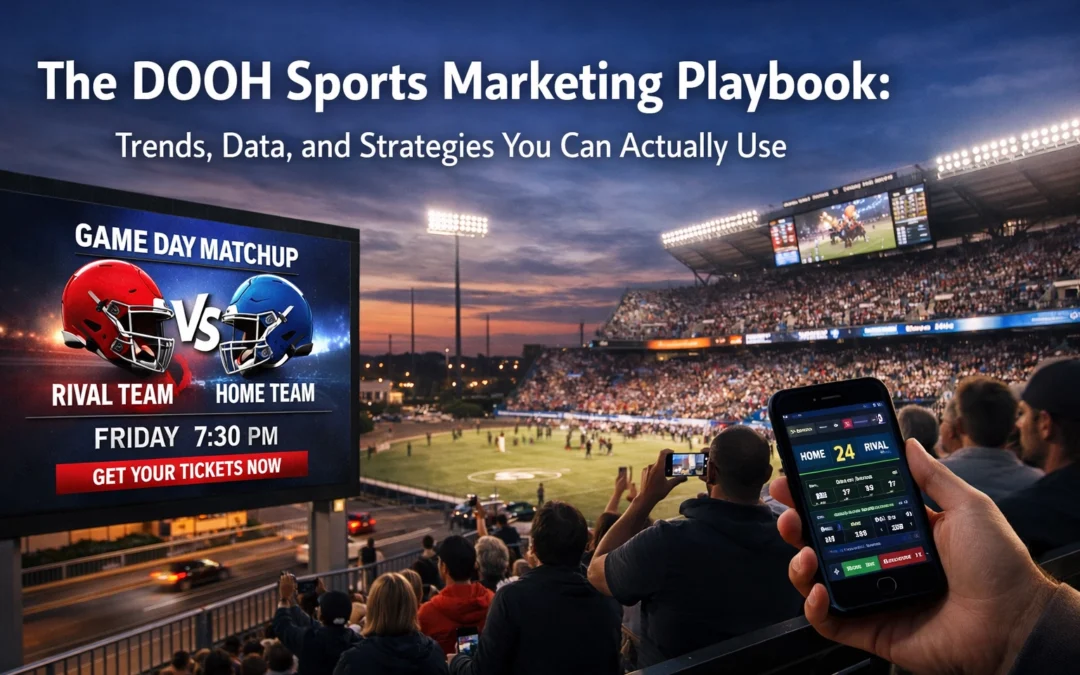
Digital out-of-home advertising in the sports sector continues to deliver measurable results that justify increased investment. For brands targeting sports audiences, understanding current trends and applying proven strategies can mean the difference between visibility and genuine impact.
This playbook synthesizes recent industry data, emerging trends, and practical tactics for sports marketers evaluating or optimizing their DOOH campaigns.

The Data: Why DOOH Works in Sports Environments
Nearly 60% of US adults recall seeing out-of-home advertisements at major sporting events. More significantly, 90% of those individuals take action after exposure, whether that means tuning into broadcasts, sharing content online, or discussing the brand with others.
The conversion impact extends beyond awareness. Among consumers who attend a game after viewing OOH advertising, 99% report spending money locally. This pattern creates a multiplier effect, as 42% of consumers discuss sporting events with friends or family after seeing OOH ads, according to Harris Poll research.
The value proposition for brands centers on attention capture at high-intent moments. Fans in transit to venues, gathering in entertainment districts, or consuming sports content in public spaces represent audiences already primed for engagement. DOOH advertising intercepts these audiences when sports messaging carries heightened relevance.
Key Trends Reshaping Sports Marketing
Dynamic, Real-Time Activation
Static campaigns are losing ground to dynamic creative that responds to live events. Brands now deploy Dynamic Creative Optimization (DCO) to mirror fan experiences in real time, adjusting messaging based on game developments, weather shifts, or crowd reactions.
Major sporting events illustrate this shift. Campaigns around tournaments increasingly feature creative that reacts to match outcomes, player performances, and unexpected moments. This approach transforms DOOH from a broadcast medium into a responsive channel that aligns with the emotional arc of live sports.

Authentic Athlete-Led Content
Highly polished brand campaigns are giving way to athlete partnerships that prioritize authenticity. Brands now collaborate with athletes to create content that reveals behind-the-scenes moments, training routines, personal milestones, and individual perspectives.
This trend reflects broader audience expectations. Sports fans increasingly value genuine connection over production quality. Campaigns that empower athletes to share conversational, story-driven content aligned with their values generate stronger emotional resonance than traditional endorsement formats.
Hybrid Sports Experiences
The boundaries between sports, entertainment, and lifestyle content continue to blur. Basketball events designed like music festivals, esports formats integrating live athletic challenges, and interactive broadcasts featuring gamification attract audiences beyond traditional sports demographics.
These hybrid experiences prioritize participation and shareability, appealing particularly to younger consumers who expect multi-dimensional engagement. Brands activating within these environments position themselves at the intersection of sport, culture, and technology.
Interactive Viewing and Gamification
Interactivity has evolved from supplementary feature to core broadcast element. Leagues redesign viewing experiences to incorporate real-time data, participatory elements, and game mechanics that deepen engagement.
Examples include NBA partnerships featuring animated characters during broadcasts and platforms enabling quiz-based interaction during major tournaments. These formats transform passive viewing into active participation, creating multiple touchpoints for brand messaging.

Actionable Strategies for DOOH Campaigns
Plan Around Fan Movement Patterns
Effective sports marketing campaigns map inventory to predictable fan behavior. High-value locations include stadium perimeters, fan zones, sports bars, entertainment districts, transit corridors, and airports.
Early planning secures premium placements during high-demand periods. However, programmatic DOOH (pDOOH) provides flexibility to activate closer to events or during unexpected moments. The combination allows brands to lock foundational inventory while maintaining tactical agility.
Geofencing and device data enhance targeting precision. Rather than broad demographic assumptions, campaigns can target audiences based on actual movement patterns and location history, reaching individuals who demonstrate sports venue visitation or engagement with related content.
Activate Across Three Time Windows
Sports campaigns achieve maximum impact by coordinating messaging across distinct engagement phases:
Pre-event activation builds anticipation in commuter corridors and city centers where fans consume sports content and plan attendance. Messaging during this window focuses on upcoming matchups, ticket availability, or event preparation.
During-event activation deploys real-time, context-aware creative at halftime or following major plays. This approach capitalizes on emotional peaks when fans are most receptive to aligned messaging.
Post-event activation extends campaign momentum as fans share highlights, discuss outcomes, and carry excitement into subsequent days. Creative during this phase reinforces brand association with memorable moments while audiences remain engaged.

Layer Interactivity Into Static Screens
Traditional DOOH screens gain functionality through interactive elements. QR codes, mobile prompts, and live polls transform passive impressions into active exchanges.
This strategy serves dual purposes. Interactivity deepens engagement by inviting participation rather than observation. Simultaneously, interactive elements support first-party data collection, enabling brands to measure specific actions tied to OOH exposure.
The shift from awareness to conversion actions makes DOOH campaigns more accountable to performance metrics beyond impression counts.
Leverage Owned Fan Communities
Building direct relationships across owned channels reduces dependence on rented platforms where algorithms and policies change unpredictably. Brands that develop proprietary fan communities gain control over data, messaging frequency, and experience design.
Fans increasingly share performance data, recovery metrics, and personal milestones. This willingness to exchange information creates opportunities for brands that demonstrate clear value in return. First-party data collected through owned communities informs more precise targeting and personalization across all channels, including DOOH.
Embrace Omnichannel Integration
DOOH achieves greater impact when integrated with broader marketing programs rather than executed as standalone tactics. Coordinating messaging across streaming platforms, social channels, in-app experiences, and physical venues creates seamless touchpoints that reinforce core narratives.
Omnichannel approaches also enable sequential messaging strategies. A consumer exposed to DOOH creative near a transit hub can receive complementary messaging through mobile apps or social platforms, building progressive engagement across touchpoints.

Measuring Real-World Impact
Accountability in DOOH sports marketing requires connecting exposure to tangible outcomes through multiple measurement approaches:
Sales lift and footfall data track conversion impact, particularly for quick-service restaurants and retailers near stadium exits and fan routes. Point-of-sale data correlated with campaign timing reveals direct attribution.
Digital conversion metrics measure app installs, loyalty program registrations, or website traffic spikes on match days. These indicators demonstrate how OOH drives digital actions.
Brand studies assess messaging influence on awareness, perception, and consideration. Survey-based research conducted before and after campaigns quantifies attitudinal shifts attributable to OOH exposure.
Mobile location data verifies how advertising near transit lines or fan zones drove physical visits to targeted locations. Device IDs exposed to DOOH creative can be tracked to destination venues, establishing causal relationships between exposure and behavior.
Brands applying early planning, dynamic creative, behavior-based targeting, and rigorous measurement position themselves to capitalize on moments when fan attention and movement reach peak levels. The sports marketing landscape rewards those who combine strategic foresight with tactical agility, transforming audience enthusiasm into measurable business outcomes.