
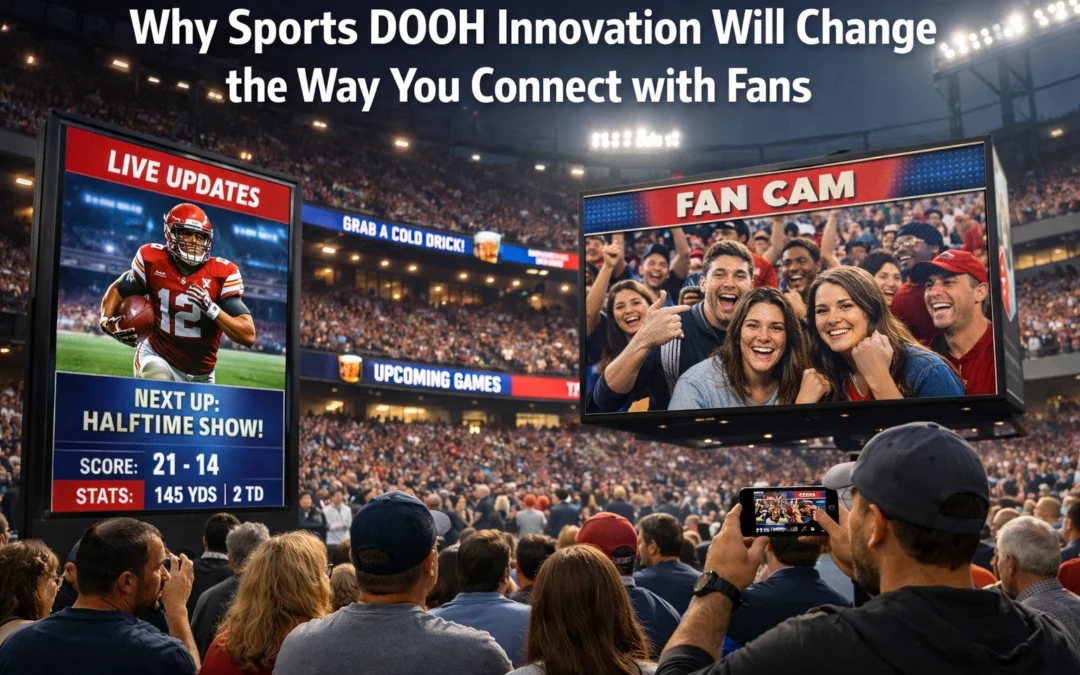
The sports marketing landscape has shifted. Traditional advertising approaches no longer deliver the same impact they once did, particularly when audiences are fragmented across streaming platforms, cord-cutting has become standard, and attention spans have shortened. Digital out-of-home (DOOH) advertising in sports environments offers a solution that addresses these challenges head-on.
For media buyers and brand managers, sports DOOH represents a fundamentally different approach to fan engagement. Rather than static billboards or pre-planned campaigns that remain unchanged regardless of game outcomes, DOOH technology enables real-time, context-aware messaging that responds to live sporting moments. This innovation transforms how brands connect with fans by meeting them at the precise moment their emotional investment peaks.
Real-Time Responsiveness Creates Living Advertisements
Digital out-of-home technology operates on a different timeline than traditional media. Campaigns can populate instantly with live game data, current scores, fan social media feeds, and event outcomes as they unfold. This capability means messaging stays synchronized with the emotional energy of sports moments rather than operating independently from them.

When a team scores a decisive goal, DOOH screens can celebrate that victory alongside fans within seconds. During halftime, messaging can shift to build anticipation for the second half. After a game concludes, ads can pivot to post-game specials or next-match promotions. This responsiveness creates advertisements that feel less like interruptions and more like extensions of the fan experience itself.
The distinction matters because sports fandom is inherently emotional and time-sensitive. A promotional message that feels relevant during a championship game loses impact when displayed days later. DOOH technology eliminates this lag, ensuring brands participate in sporting moments rather than merely reference them after the fact.
This real-time capability extends beyond scores and game outcomes. Brands can integrate trending fan tweets, player statistics, weather conditions affecting outdoor events, or even traffic patterns around venues. Each data point becomes an opportunity to demonstrate relevance and awareness of the fan's immediate context.
Strategic Proximity Amplifies Emotional Investment
Location determines everything in sports DOOH. Placements near stadiums, sports bars, fan-congregation areas, and transit routes to venues ensure brands reach audiences when they are most emotionally invested and receptive to messaging. This strategic proximity creates a multiplier effect on ad effectiveness.
Fans traveling to a game are already in a heightened state of anticipation. Those gathered at sports bars are actively seeking community around the sporting event. Audiences leaving a stadium after a victory are celebratory and energized. Each of these moments represents a psychological window where brand messages land with greater impact than they would during routine daily activities.

Programmatic buying technology enhances this proximity advantage by enabling geographic precision. Different neighborhoods can receive different messages based on local team loyalties, demographic patterns, or venue-specific contexts. A restaurant chain can highlight game-day specials in one area while a sports apparel brand showcases championship merchandise in another. This granular targeting ensures fans encounter ads that feel personally relevant to their specific situation.
The combination of location-based targeting and programmatic capabilities means campaigns operate with surgical precision rather than broad-stroke awareness plays. Media buyers gain the ability to allocate budget dynamically based on foot traffic patterns, game schedules, and real-time performance data. This flexibility allows for continuous optimization that static billboard placements cannot match.
Closing the Reach Gap in Fragmented Media Landscapes
A persistent challenge facing media buyers involves reaching audiences who have opted out of traditional advertising channels. Cord-cutting, ad-free streaming subscriptions, and ad-blocking technology have created significant blind spots in media plans. Sports DOOH fills these gaps effectively.
A five-year study demonstrated that out-of-home advertising outperforms connected TV, traditional television, and digital channels across key performance metrics. This advantage proves particularly pronounced among households with ad-free streaming subscriptions, a demographic segment that continues expanding year over year.

The implications for media strategy are substantial. Rather than struggling to reach cord-cutters through limited channels, brands can intercept them in physical environments where ad avoidance is impossible. A fan cannot install an ad blocker on a digital screen in a stadium concourse. They cannot skip a promotion displayed on transit shelter screens near a venue. This unavoidable exposure, when executed with relevant messaging and strategic timing, delivers reach that other channels cannot provide.
For brand managers constructing omnichannel campaigns, sports DOOH serves as a critical component that ensures comprehensive audience coverage. The channel reaches both traditional media consumers and digital-native audiences who actively avoid advertising in other contexts.
Measurable Impact Validates Strategic Investment
Performance data from sports DOOH campaigns demonstrates genuine business impact beyond vanity metrics. The technology's ability to track device IDs, measure foot traffic patterns, and conduct brand lift studies provides concrete evidence of effectiveness.
PrizePicks deployed sports venue campaigns that achieved an 80% lift in brand consideration, 121% increase in message association, and 103% improvement in brand favorability. These metrics indicate that DOOH placements not only reached audiences but fundamentally shifted brand perception in measurable ways.
New Balance leveraged DOOH to celebrate Dutch athlete Femke Bol's championship victory with timely, contextual messaging that achieved significant positive perception by feeling personal and immediate rather than generic and delayed. The campaign demonstrated how real-time responsiveness translates to emotional resonance with sports audiences.
Mad Mex restaurant chain implemented location-based DOOH activation that generated a 9% sales increase, proving direct attribution between ad exposure and purchase behavior. This outcome validates DOOH as a performance channel rather than merely an awareness play.

These results share common characteristics. Each campaign leveraged timing, location, and contextual relevance to create meaningful connections with sports audiences. Each deployed measurement methodologies that traced impact beyond impressions to business outcomes. Each demonstrated that sports DOOH delivers returns that justify strategic investment.
For media buyers evaluating channel allocation, this performance data provides the evidence needed to shift budget toward sports DOOH with confidence. The channel delivers not just reach and frequency but measurable influence on consideration, preference, and purchase behavior.
Strategic Considerations for Implementation
Successful sports DOOH campaigns require different planning approaches than traditional media buys. The channel's strengths emerge through strategic execution rather than simple placement purchases.
Creative assets must be designed for flexibility and modularity. Rather than single static designs, campaigns benefit from template systems that allow dynamic content insertion. Scores, player names, game times, and contextual messages should populate automatically based on real-time data feeds.
Programmatic buying capabilities enable responsive budget allocation, but they require clear parameters and decision frameworks. Media buyers should establish rules for when and how spend shifts based on game outcomes, attendance patterns, weather conditions, or competitive factors. This strategic framework ensures automation serves campaign objectives rather than operating blindly.
Measurement planning should begin before campaign launch rather than after. Device ID tracking, geofencing for foot traffic analysis, brand lift study design, and attribution modeling all require advance coordination. Establishing these measurement systems early ensures accurate performance assessment.
Partnership selection matters significantly. Not all DOOH networks offer equivalent technology, inventory quality, or data capabilities. Media buyers should evaluate partners based on their specific sports venue relationships, programmatic integration sophistication, and measurement infrastructure.
The Evolution Continues
Sports DOOH innovation represents more than incremental improvement over traditional out-of-home advertising. The technology fundamentally restructures how brands participate in sports culture by enabling real-time relevance at scale.
For media buyers and brand managers, this evolution creates both opportunity and obligation. The opportunity lies in reaching emotionally invested audiences with precisely timed, contextually relevant messaging that traditional channels cannot deliver. The obligation involves adapting planning processes, creative development, and measurement approaches to leverage these capabilities effectively.
The brands that recognize sports DOOH as a strategic channel rather than a tactical placement option will gain competitive advantages in fan engagement. Those that continue treating it as digital billboards will miss the transformative potential that real-time, location-aware, data-driven advertising offers.
Sports fans expect brands to understand their passion, respect their intelligence, and add value to their experience. DOOH technology provides the tools to meet these expectations at scale. The question for marketers is not whether sports DOOH will change fan connections, but rather how quickly they will adapt their strategies to capitalize on this change.