
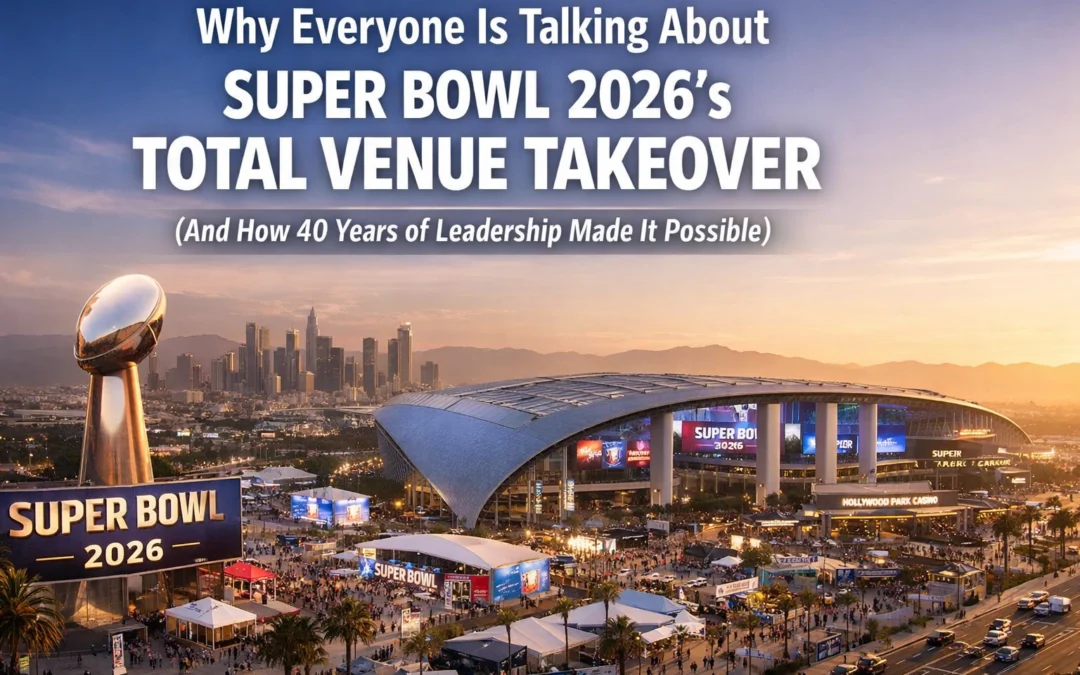
Super Bowl LX is rewriting the playbook for sports advertising. Set to take place in February 2026, this year's championship game represents the culmination of four decades of innovation in out-of-home advertising, with a venue-wide integration strategy that extends far beyond traditional stadium placements.
The Evolution of Super Bowl Advertising: Four Decades in the Making
The Super Bowl has long served as advertising's most visible stage. What began in 1986 as simple static signage around playing fields has transformed into a sophisticated, multi-layered advertising ecosystem that now encompasses every surface within and around the venue.
Over the past 40 years, advertising leadership in major sporting events has progressed through distinct phases. The 1980s and 1990s focused on perimeter boards and static displays. The 2000s introduced digital screens and rotating messaging. The 2010s brought programmatic capabilities and data-driven targeting. Now, 2026 marks the arrival of total venue integration, where every touchpoint becomes an advertising opportunity.

This progression reflects broader shifts in the out-of-home advertising industry. Brands no longer settle for isolated placements. They demand comprehensive coverage that creates immersive brand experiences across multiple touchpoints throughout the fan journey.
What Makes Super Bowl 2026 Different
Super Bowl LX distinguishes itself through unprecedented venue-wide coverage. The advertising strategy encompasses floor graphics, column wraps, concourse displays, digital billboards, LED ribbons, escalator risers, and even restroom mirror frames. No surface remains untapped.
This approach aligns with NBC's "Legendary February" initiative, which bundles Super Bowl LX with the 2026 Winter Olympics and NBA All-Star Game. The cross-promotion strategy creates sustained advertising momentum across three weeks and multiple sporting events, maximizing brand visibility during peak viewership periods.
The Bay Area location adds another dimension. Super Bowl festivities span multiple venues, including the San Jose Convention Center for Opening Night on February 2 and the Moscone Center in San Francisco for the Super Bowl Experience and Pro Bowl Games on February 3. This geographic distribution extends advertising opportunities beyond the stadium itself, creating a regional takeover that amplifies brand presence throughout the entire week.
Understanding Total Venue Takeover
https://www.youtube.com/watch?v=l6J-0zileKE
Total venue takeover represents a fundamental shift in sports advertising strategy. Rather than competing for limited premium placements, brands can now secure comprehensive coverage that ensures consistent messaging throughout the fan experience.
The execution requires meticulous planning and coordination. Advertising teams must consider:
- Entry and arrival zones: First impressions as fans approach and enter the venue
- Concourse circulation: High-traffic areas where fans move between sections
- Seating bowl visibility: Placements visible from seats and on broadcast feeds
- Concession and amenity areas: Dwell-time zones where fans queue and congregate
- Digital integration: Synchronized messaging across LED displays and video boards
- Floor-level branding: Graphics on stairs, escalators, and walking surfaces

Each placement serves a specific function within the broader brand narrative. Floor graphics guide foot traffic while reinforcing brand identity. Concourse wraps create immersive environments during high-traffic periods. Digital displays deliver dynamic messaging that responds to game action and audience engagement.
Technology Enabling Comprehensive Coverage
The technical infrastructure supporting total venue takeovers has advanced significantly. Modern venues feature extensive LED networks, fiber-optic connectivity, and centralized content management systems that enable real-time updates and synchronized messaging across hundreds of display units.
Programmatic DOOH technology plays a crucial role. Advertisers can now deploy, modify, and optimize campaigns dynamically based on audience composition, weather conditions, game progression, and social media sentiment. This flexibility allows brands to maximize relevance and impact throughout the event.
The integration extends to mobile devices through location-based targeting. Brands can retarget attendees who were exposed to venue advertising with follow-up messages on their smartphones, creating a seamless omnichannel experience that extends the campaign beyond the physical venue.
Measurement and Attribution
Measuring the impact of total venue takeovers requires sophisticated attribution methodologies. Device ID tracking enables advertisers to identify which attendees were exposed to specific placements and monitor their subsequent behavior, both online and at retail locations.

Brand lift studies conducted before, during, and after the event quantify changes in brand awareness, consideration, and preference among exposed audiences. These studies provide concrete data on campaign effectiveness, moving beyond impressions to measure actual shifts in consumer perception and behavior.
The integration of multiple touchpoints creates a multiplier effect. Research indicates that consumers exposed to brand messaging across three or more surfaces within a venue demonstrate significantly higher recall and purchase intent compared to those exposed to single placements.
Strategic Implications for Brands
The shift toward total venue takeovers has important implications for advertising strategy. Brands must now think holistically about the fan journey rather than focusing on isolated moments of visibility.
Successful implementations require:
- Consistent creative: Visual elements that work across diverse formats and surfaces
- Strategic layering: Complementary messages that build narrative as fans move through spaces
- Budget reallocation: Investment shift from traditional media to comprehensive venue packages
- Cross-functional coordination: Alignment between media buyers, creative teams, and venue operators
- Long-term planning: Securing inventory well in advance as total takeovers become more competitive
The investment required for total venue coverage exceeds traditional placements, but the comprehensive nature of the exposure delivers superior return on investment. Brands achieve saturation-level visibility that competitors cannot match without similar commitments.
Looking Beyond Super Bowl LX
The total venue takeover strategy pioneered at Super Bowl 2026 will likely influence advertising approaches at major sporting events globally. As venues upgrade infrastructure and brands recognize the value of comprehensive coverage, this model will become standard practice for championship games, playoff series, and premium sporting events.
The convergence of physical and digital advertising continues to accelerate. Future iterations will incorporate augmented reality overlays, personalized messaging based on seat location, and interactive elements that engage fans through their mobile devices while they experience branded environments.

For brands seeking to maximize impact in sports marketing, the lessons from Super Bowl LX are clear. Comprehensive coverage delivers superior results compared to fragmented placements. Four decades of advertising evolution have led to this moment, where technology, strategy, and execution converge to create truly immersive brand experiences.
The sports advertising industry stands at an inflection point. Total venue takeovers represent not just an incremental improvement but a fundamental reimagining of how brands can activate around major sporting events. Super Bowl 2026 demonstrates what becomes possible when advertising leadership, technical infrastructure, and strategic vision align.
For more insights on programmatic DOOH and sports marketing ROI, explore additional resources on effective venue advertising strategies.