
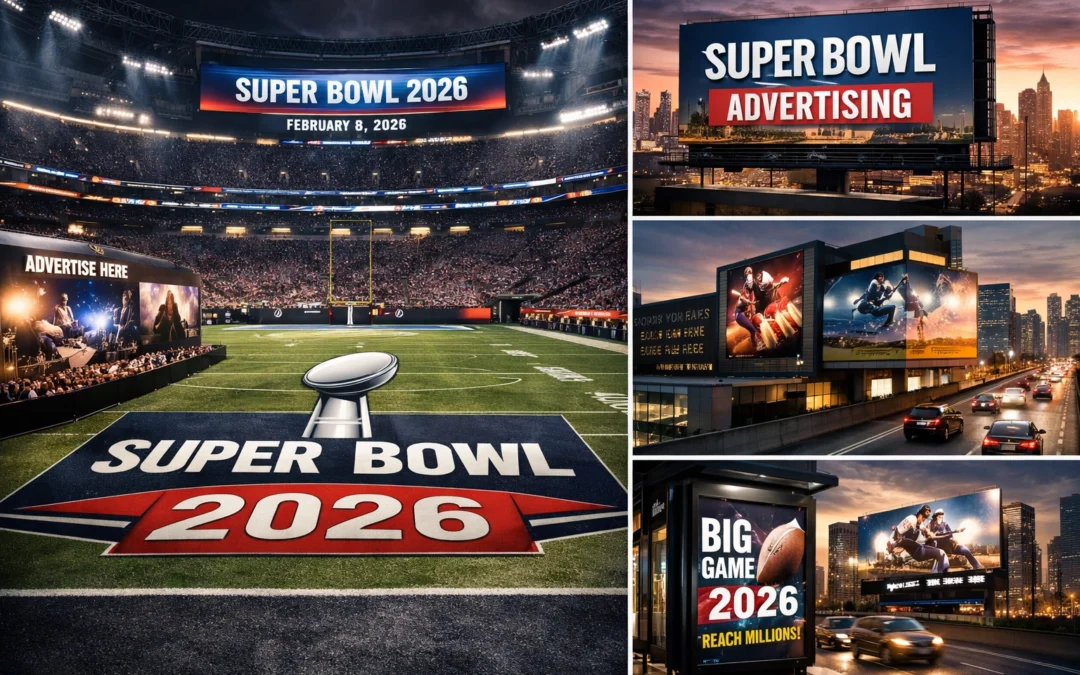
The Super Bowl Advertising Reality Check
Super Bowl LX in 2026 proved once again that the Big Game commands the biggest advertising dollars in sports. A single 30-second TV spot cost advertisers $8 million, with some premium placements reaching $10 million. When factoring in production costs, celebrity talent fees, and supporting digital campaigns, total advertising investments ranged from $15 million to $50 million or more for a single campaign.
The question brands faced was not whether the Super Bowl delivered eyeballs. It absolutely did. The question was whether a single 30-second commercial represented the most effective use of an annual marketing budget, or whether a more strategic, venue-wide approach could deliver superior reach, frequency, and engagement.

The Shift to Venue-Wide Advertising Coverage
While national TV spots dominated headlines, savvy advertisers explored a broader spectrum of advertising opportunities surrounding the Super Bowl event. Venue-wide out-of-home (OOH) advertising provided brands with multiple touchpoints throughout the fan experience, from pre-game arrival to post-game departure.
This approach recognized a fundamental truth: Super Bowl fans do not only engage with the game during the broadcast. They travel to the stadium, walk through concourses, visit fan zones, drive past billboards, and interact with branded environments across the host city for days surrounding the event.
Venue-wide OOH coverage included:
- Stadium floor graphics and field-level LED displays
- Concourse advertising and directional signage
- Parking structure branding
- Billboard networks on major approach routes
- Transit advertising on buses, trains, and rideshare vehicles
- Street furniture in high-traffic pedestrian zones
- Digital billboards in entertainment districts
This layered approach created multiple impressions across the customer journey, reinforcing brand messages through repeated exposure in contextually relevant moments.
The Economics of Distributed Advertising Investment
A $10 million TV spot delivered 30 seconds of attention during a four-hour broadcast. By contrast, distributed OOH investment across stadium and city-wide placements delivered continuous visibility for days or weeks, with brands present at every stage of the fan journey.
Consider the mathematics: A comprehensive venue-wide OOH campaign covering stadium interiors, approach routes, and city center locations could be executed for a fraction of a single prime TV spot cost. The result was not a single moment of attention but sustained brand presence across multiple high-value environments.

Advertisers increasingly recognized that premium Super Bowl placement, while impactful, could be inefficiently expensive compared to adjacent advertising strategies. Connected TV, digital video, contextual targeting, and venue-wide OOH placements captured heightened viewer attention during the Super Bowl window without requiring the premium broadcast price.
Four Decades of Advertising Leadership
Organizations with 40 years of experience in sports advertising understand this dynamic intimately. Longevity in the industry provides perspective on what delivers measurable results versus what generates buzz without corresponding ROI.
https://www.youtube.com/watch?v=l6J-0zileKE
Four decades of leadership means understanding how to layer advertising placements for maximum cumulative impact. It means knowing which stadium zones deliver the highest engagement, which billboard locations capture pre-game traffic, and which digital formats complement static placements.
This depth of experience translates into strategic advantages:
- Established relationships with venue operators and municipalities
- Historical performance data across multiple Super Bowl events
- Understanding of permit processes and installation logistics
- Knowledge of optimal placement timing and duration
- Expertise in integrating physical and digital advertising channels
Brands working with experienced OOH partners benefit from this accumulated knowledge, avoiding common pitfalls and maximizing the efficiency of advertising spend.
Coverage Spectrum: From Floors to Billboards
The phrase "from floors to billboards" captures the vertical and horizontal reach of comprehensive venue-wide advertising. This spectrum approach ensures brand visibility regardless of where fans look or how they move through the environment.
Stadium Floor Graphics: These placements position brands directly in the field of play, visible to both in-stadium attendees and broadcast viewers. Floor graphics in high-traffic areas such as tunnel entrances, club sections, and premium seating zones create premium brand associations.
Perimeter LED Displays: Digital screens surrounding the field deliver dynamic content that can be updated in real-time, allowing brands to respond to game developments or shift messaging throughout the event. Research has demonstrated that stadium perimeter ads capture hearts and wallets more effectively than many digital channels.

Concourse and Interior Signage: Fans spend significant time in stadium concourses before kickoff, during halftime, and after the game. Strategic placement in these zones captures attention during high-dwell-time moments when fans are relaxed and receptive to brand messages.
Exterior and Approach Billboards: The Super Bowl generates massive traffic flows as tens of thousands of fans converge on the stadium. Billboard networks on major approach routes, parking structures, and nearby highways deliver impressions to 100% of attendees plus additional commuter and resident audiences.
City-Wide Digital Networks: Modern digital billboard networks allow for programmatic activation, delivering targeted messages based on time of day, traffic conditions, or proximity to other events. This technology enables brands to extend reach beyond the immediate stadium zone.
The Case for Strategic OOH Investment
Traditional programmatic DOOH campaigns have consistently delivered measurable lift across key brand metrics. White Claw achieved a 74% lift in purchase consideration through programmatic digital out-of-home activation. Mike's Hard Iced Tea saw a 119% increase in positive brand image. Sea-Doo increased purchase consideration by 144% in its first digital OOH campaign.
These results demonstrate that well-executed OOH strategies deliver quantifiable business outcomes. When applied to the concentrated attention and massive audience of the Super Bowl, the potential for impact scales proportionally.
The strategic question becomes: Does a brand achieve greater total lift from a single $10 million TV spot or from $10 million distributed across venue-wide OOH placements that deliver hundreds of impressions per attendee across multiple days?

Integration with Broader Marketing Ecosystems
Venue-wide OOH advertising does not exist in isolation. The most effective Super Bowl marketing strategies integrate physical placements with digital activation, social media amplification, and experiential marketing.
QR codes on stadium signage drive traffic to mobile experiences. Hashtags on billboards encourage social sharing. Geofenced mobile advertising targets fans based on their physical proximity to OOH placements. This omnichannel approach multiplies the impact of each individual touchpoint.
Brands with experience across multiple channels understand how to orchestrate these elements into cohesive campaigns that reinforce consistent messaging while adapting creative execution to the strengths of each medium.
Looking Beyond the Broadcast
Super Bowl advertising in 2026 featured numerous celebrity-driven TV campaigns. Hellmann's enlisted Andy Samberg for a "Sweet Caroline" parody. Kinder Bueno debuted with a sci-fi blockbuster spot. Frank's RedHot featured Ludacris in a rap-driven commercial with a goat mascot.
These campaigns generated social media conversation and earned media coverage. But the total audience impact extended far beyond the 30 or 60 seconds of airtime. Supporting OOH placements, digital extensions, and experiential activations created sustained engagement across multiple customer touchpoints.
The lesson for brands: Super Bowl advertising success requires thinking beyond the broadcast itself. Venue-wide coverage from stadium floors to billboard tops ensures continuous brand presence throughout the entire fan experience.
Making Smarter Advertising Investments
Forty years of industry leadership provides clear perspective: advertising effectiveness comes from strategic placement, sustained visibility, and integration across channels. A single expensive TV spot may generate momentary attention, but venue-wide OOH coverage delivers lasting impressions that accumulate throughout the customer journey.
For brands evaluating Super Bowl advertising opportunities, the strategic choice is clear. Invest where fans actually spend their time, attention, and money. Build presence from the moment they leave home until they return. Create multiple touchpoints that reinforce brand messaging in contextually relevant moments.
That is how advertising leadership works. Not through a single expensive moment, but through comprehensive coverage that surrounds audiences with consistent brand presence. From stadium floors to billboard tops, and everything in between.