
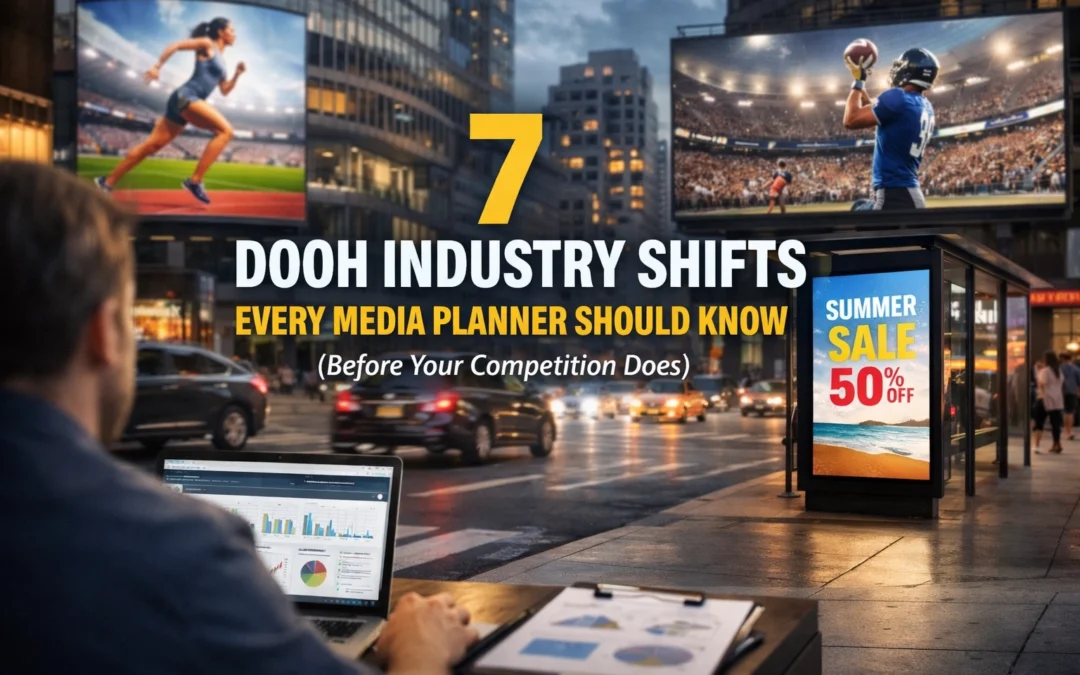
The digital out-of-home landscape is evolving faster than most media planners realize. What worked last quarter may already be outdated, and the playbook that secured wins in previous campaigns is being rewritten in real time.
For media planners operating in the sports advertising ecosystem, staying ahead of these industry shifts is not optional. The brands capturing attention at stadiums, arenas, and high-traffic venues are the ones adapting to structural changes in how DOOH inventory is bought, optimized, and measured.
These seven shifts represent the new baseline for competitive media planning. Understanding them provides a strategic advantage. Ignoring them creates risk.
1. Programmatic DOOH Has Transitioned From Innovation to Infrastructure
Programmatic buying is no longer a differentiator in out-of-home advertising. It has become the standard framework through which inventory is secured and activated. DOOH now represents 67% of total OOH spend, with the global market projected to reach $84.03 billion by 2033, growing at 13.20% annually.
Media planners must treat programmatic DOOH as a core pillar of integrated media strategies rather than a complementary tactic. The implications extend beyond procurement efficiency. Programmatic infrastructure enables real-time optimization, dynamic budget allocation, and seamless integration with broader digital campaigns.
Brands that continue to approach DOOH through traditional direct-buy frameworks are operating with structural limitations that competitors have already moved beyond.

2. Automation Has Become Embedded in Campaign Workflows
Manual campaign adjustments are being replaced by automated optimization protocols. Brands now expect to launch campaigns rapidly, modify frequency and time slots without intervention, and reallocate budgets based on performance data captured in real time.
Programmatic DOOH spend is projected to reach into the billions, and this growth is driven by workflow automation that removes friction from the buying process. Media planners who build campaigns around automated triggers, contextual adjustments, and performance-based budget shifts are operating with a velocity advantage that manual processes cannot match.
The shift is not simply about speed. Automation enables strategic complexity that would be logistically impossible through manual execution. A campaign that adjusts creative messaging based on weather conditions, game outcomes, or local traffic patterns requires automated infrastructure to function at scale.
3. Dynamic Creative Optimization Has Moved From Experimentation to Core Strategy
Dynamic creative optimization (DCO) has transitioned from a test-and-learn tactic to a strategic capability that defines campaign effectiveness. AI now plays an active role in accelerating creative ideation and enabling variations at scale.
This shift allows campaigns to respond to contextual triggers in real time. A sports venue campaign can adjust messaging based on the home team's performance, local weather, time of day, or proximity to game time. These adjustments happen automatically, driven by data inputs and pre-defined creative logic.
Media planners who treat creative as a static asset are leaving performance on the table. The most effective campaigns deploy multiple creative variations that respond dynamically to environmental and behavioral signals. This approach requires upfront investment in creative production and logic mapping, but the performance gains justify the additional planning complexity.

4. AI Has Democratized Sophisticated Media Planning Capabilities
At least one-quarter of global DOOH campaigns are now AI-planned, allowing regional and challenger brands to access sophisticated planning capabilities previously reserved for large brands with substantial budgets.
This democratization reshapes competitive dynamics. Smaller brands can deploy audience modeling, predictive optimization, and multi-touchpoint attribution without building internal data science teams. AI-powered planning tools analyze historical performance data, identify high-value audience segments, and recommend inventory allocations that maximize efficiency.
The strategic implication is clear. Budget size no longer determines access to advanced planning capabilities. Execution quality and strategic sophistication are becoming the primary differentiators in campaign performance.
5. In-Advance Programmatic Automation Has Emerged as Standard Practice
Guaranteed OOH buying has gained momentum through automated, in-advance transactions that combine the certainty of direct deals with the efficiency of programmatic infrastructure. This approach addresses a long-standing tension in programmatic buying between inventory certainty and operational efficiency.
Media planners can now secure premium inventory programmatically while preserving booking certainty. This shift is particularly relevant for sports advertising, where specific venue placements carry strategic value that cannot be replicated through open auction buying.
The result is a hybrid buying model that captures the benefits of both direct and programmatic approaches. Planners can lock in high-value placements while maintaining the flexibility to optimize frequency, dayparts, and budget allocation through programmatic tools.

6. Measurement Has Evolved Beyond Impressions to Business Outcomes
DOOH networks now layer mobile signals and AI analytics to enable privacy-safe audience insights and attribution linking screen exposure to store visits, website traffic, and incremental sales. This measurement evolution fundamentally changes how media planners evaluate campaign performance.
Reach and frequency metrics remain relevant, but they are no longer sufficient to justify media investments. Brands expect measurement frameworks that connect exposure to business outcomes. Store lift, website conversions, app downloads, and brand preference shifts are becoming standard success metrics for DOOH campaigns.
Media planners must shift evaluation frameworks accordingly. Campaign briefs should define success metrics beyond impressions, and measurement plans should incorporate attribution methodologies that connect screen exposure to downstream actions. This approach to measurement allows DOOH to compete for budget allocation on the same terms as digital channels.
7. Audience-First Planning Has Replaced Location-Only Targeting
Instead of simply buying high-traffic locations, planners now target audience behavior patterns. Campaigns are structured around "weekday commuters," "shoppers within five miles," or "fans attending evening games" rather than static venue placements.
This shift enables more precise activation and accountability. Audience-first planning allows DOOH to integrate seamlessly with digital channels while preserving the visual impact and urban presence that make out-of-home media effective.
The strategic value lies in flexibility and relevance. A campaign targeting sports fans can adjust inventory allocation based on where that audience is at different times and days. Venue placements become dynamic rather than fixed, optimizing for audience presence rather than static location value.
Strategic Implications for Media Planners
These seven shifts represent a structural evolution in how DOOH campaigns are planned, executed, and measured. Media planners who adapt their workflows, measurement frameworks, and strategic approaches will operate with a compound advantage over competitors still using legacy methods.
The shifts are interconnected. Programmatic infrastructure enables automation. Automation makes dynamic creative feasible at scale. AI democratizes access to sophisticated planning. Advanced measurement justifies budget allocation. Audience-first planning ties everything together into integrated, outcome-driven campaigns.
For brands operating in sports advertising, these shifts create opportunity. The visual impact of stadium and venue placements, combined with programmatic efficiency and outcome-based measurement, positions DOOH as a performance channel that delivers both brand impact and measurable business results.
The question is not whether these shifts will reshape the industry. They already have. The question is how quickly media planners will adapt their strategies to leverage the new capabilities these shifts enable.