
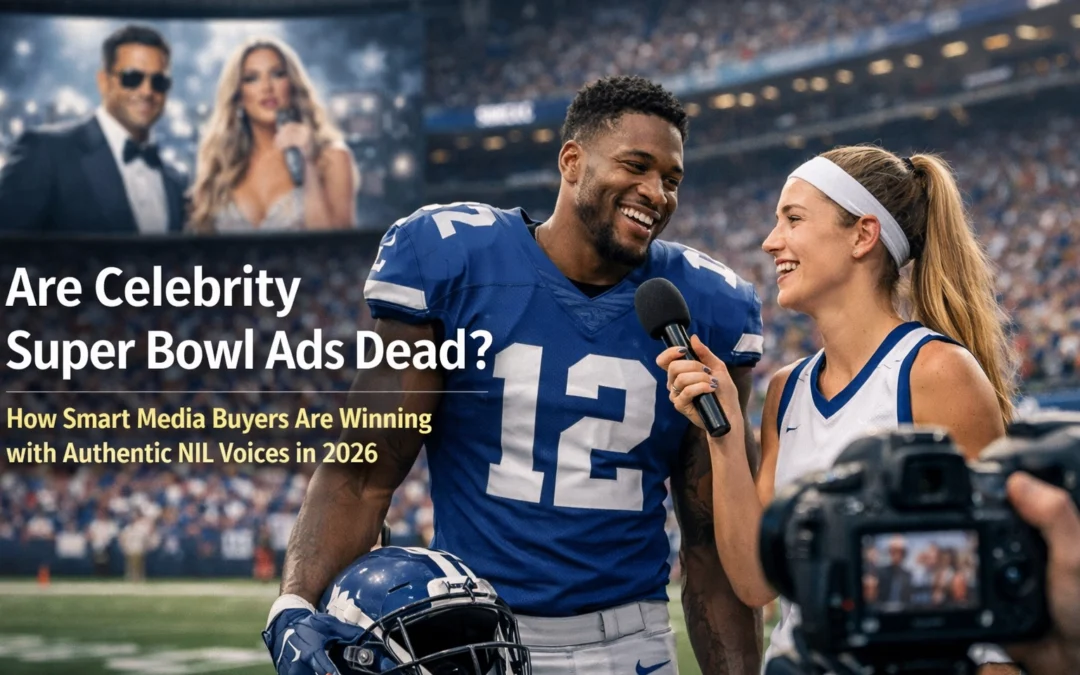
The 2026 Super Bowl just wrapped, and the numbers are in. Over 102 celebrity appearances across 39 commercials, the highest count since tracking began in 2020. But here's the thing media buyers need to know: celebrity stacking isn't delivering the ROI it used to.
Bud Light dropped an estimated $8-10 million on a spot featuring Peyton Manning, Shane Gillis, and Post Malone. Three massive names. The result? #22 in social engagement. TurboTax featured Oscar-winner Adrien Brody at the same price point and landed at #17. Meanwhile, authentic storytelling from MrBeast generated 37.3x the engagement of the median celebrity appearance.
The market has shifted. Media buyers are realizing that raw celebrity power without authentic connection is burning budget. The solution? Authentic NIL voices that deliver genuine engagement at a fraction of the cost.

The Celebrity Fatigue Problem
Celebrities still matter, but the formula has changed. When every brand throws A-listers at Super Bowl audiences, the noise level drowns out the message. Viewers are scrolling past celebrity appearances that feel transactional or forced.
The data reveals what smart media buyers already suspected: authenticity beats star power. MrBeast's Salesforce scavenger hunt worked because it felt real. Brad Pitt and Chris Hemsworth followed at 14.1x and 13.3x engagement rates respectively, not because of their fame alone, but because the creative aligned with genuine storytelling.
Traditional celebrity ads face three critical challenges in 2026:
Cost inefficiency. A single Super Bowl celebrity spot costs $8-10 million. That budget could fund campaigns with hundreds of authentic voices reaching targeted demographics over months.
Diminishing returns. With 102 celebrities in 39 ads, celebrity presence has become the baseline expectation rather than the differentiator.
Audience skepticism. Gen Z and Millennial consumers, who represent the highest purchasing power demographics, actively distrust celebrity endorsements that feel manufactured.
The NIL Platform Advantage
Name, Image, and Likeness platforms provide access to over 20,000 authentic student-athlete voices. These athletes have built genuine followings in their communities and sports verticals. Their endorsements carry weight because audiences trust them.
Media buyers working with NIL platforms in 2026 are seeing measurable advantages across multiple metrics:
Authentic engagement. Student-athletes create content that resonates with their audiences because they understand their followers. A college basketball player promoting athletic gear or energy drinks speaks with credibility that no Hollywood celebrity can manufacture.
Hyper-targeted reach. NIL platforms allow media buyers to connect with specific demographics through athletes who already reach those audiences. Need to reach college football fans in the Southeast? Connect with SEC athletes. Targeting women's soccer enthusiasts? Partner with Division I women's soccer players.
Cost efficiency at scale. Instead of one celebrity at $8 million, media buyers can activate 200 student-athletes at $40,000 each, creating distributed campaigns that reach diverse audiences with authentic voices.
Extended campaign lifespan. Celebrity Super Bowl spots live for 60 seconds during the game and then fade into social media clips. NIL campaigns run continuously, building sustained engagement over weeks or months.
https://www.youtube.com/watch?v=l6J-0zileKE
How Smart Media Buyers Are Activating NIL
Forward-thinking media buyers are restructuring their 2026 strategies around NIL voices. The approach combines traditional media buying expertise with authentic athlete partnerships.
Strategic athlete selection. Media buyers work with NIL platforms to identify athletes whose audiences align with campaign demographics. Selection criteria include engagement rates, audience demographics, content quality, and brand affinity.
Multi-channel activation. NIL campaigns extend beyond social media. Athletes appear in stadium signage, local broadcast spots, digital out-of-home placements, and experiential marketing events. This creates multiple touchpoints where audiences encounter authentic endorsements.
Performance-based measurement. NIL platforms provide detailed analytics tracking engagement rates, audience reach, conversion metrics, and brand lift. Media buyers optimize campaigns in real-time based on performance data rather than waiting for post-campaign reports.
Content authenticity guidelines. Successful NIL campaigns give athletes creative freedom within brand parameters. Athletes create content in their authentic voice rather than reading scripts. This authenticity translates to higher engagement and better brand perception.

The ROI Comparison
When media buyers compare NIL campaigns to celebrity Super Bowl spots on a cost-per-engagement basis, the numbers favor NIL activation by significant margins.
A single celebrity Super Bowl spot at $8 million reaching 120 million viewers generates approximately $0.067 per impression. However, engagement rates average below 0.5% for celebrity-heavy spots without compelling storytelling, meaning actual engaged viewers cost $13.40 each.
An NIL campaign with the same $8 million budget activating 200 student-athletes over three months generates sustained engagement. With average athlete followings of 50,000 and engagement rates of 3-5%, the cost per engaged viewer drops to $2.67-$4.44, delivering 3-5x better ROI than celebrity spots.
The performance gap widens when measuring conversion metrics. NIL campaigns typically see 2-3x higher conversion rates than celebrity endorsements because audiences trust recommendations from athletes they follow regularly.
Implementation Strategy for Media Buyers
Media buyers transitioning budget from celebrity spots to NIL platforms should follow a structured approach:
Audit current celebrity spend. Calculate cost-per-engagement and conversion rates from existing celebrity partnerships. Identify budget that could be reallocated to NIL activation.
Define campaign objectives. Determine whether the goal is awareness, engagement, conversion, or brand lift. NIL campaigns can optimize for different objectives through athlete selection and content strategy.
Partner with established NIL platforms. Work with platforms that provide access to thousands of verified student-athletes, compliance support, and performance analytics.
Start with pilot campaigns. Test NIL activation with smaller campaigns before committing full budgets. Measure performance against celebrity benchmarks to validate effectiveness.
Scale successful approaches. Once pilot campaigns demonstrate ROI, expand athlete activation across multiple sports, schools, and demographics.

The 2026 Media Buying Reality
Celebrity Super Bowl ads are not dead, but they are no longer the default strategy for smart media buyers. The brands winning in 2026 combine traditional advertising with authentic NIL voices that deliver sustained engagement at superior ROI.
The shift represents a fundamental change in how audiences respond to advertising. Consumers increasingly value authenticity over celebrity status. They trust recommendations from athletes they follow and respect over paid celebrity endorsements.
Media buyers who adapt to this reality will outperform competitors still relying on celebrity stacking. The tools exist today to activate thousands of authentic student-athlete voices across multiple channels. The platforms provide the analytics to measure performance and optimize campaigns in real-time.
The question for media buyers in 2026 is not whether to incorporate NIL voices into their strategies. The question is how quickly they can reallocate budget from celebrity spots to authentic athlete partnerships before their competitors capture the advantage.
The data is clear. The platforms are available. The authentic voices are waiting to be activated. Smart media buyers are already making the shift. The only question remaining is whether others will follow before the market moves past them entirely.