
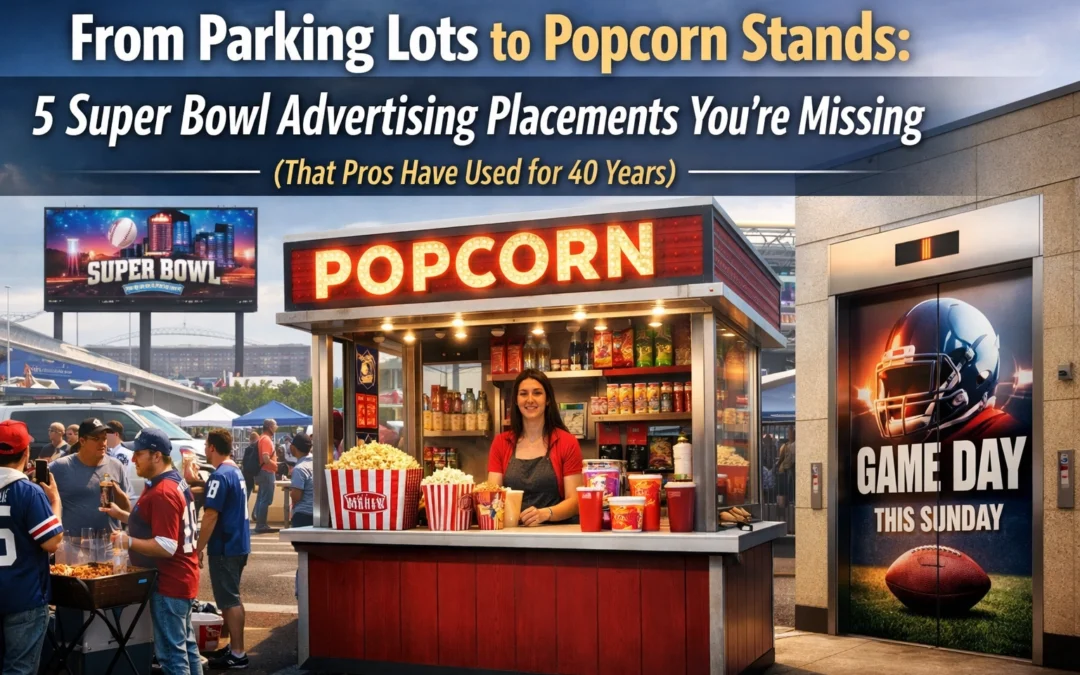
While most advertisers obsess over securing a 30-second spot during the Super Bowl broadcast, a select group of marketing professionals has quietly dominated a different playing field for the past four decades. These advertisers understand that the game day experience extends far beyond the television screen. From the moment fans arrive at the venue to their final steps leaving the stadium, every surface represents an opportunity to connect with an engaged, captive audience.
Super Bowl LX in 2026 showcases this reality more than ever. Traditional television spots command prices exceeding $7 million for 30 seconds, yet venue-based advertising placements deliver extended exposure to fans who are already in a spending mindset, surrounded by brands, and primed for engagement. The professionals who have leveraged these placements for decades understand a fundamental truth: game day advertising success is not limited to halftime.
The Five Placements That Deliver Consistent Results
1. Parking Lot Directional Signage and Barricades
The fan experience begins in the parking lot, often hours before kickoff. Tailgating culture transforms parking areas into social hubs where thousands gather, creating an extended pre-game environment. Directional signage, branded barricades, and parking lot perimeter displays capture attention during this high-energy period.
Advertisers have utilized these placements since the mid-1980s, recognizing that fans spend 2-4 hours on average in parking areas before entering the stadium. The dwell time, combined with the festive atmosphere, creates multiple brand impressions in a relaxed, receptive setting. Brands targeting the beverage, automotive, and consumer packaged goods categories have consistently maintained parking lot presence across major sporting events for decades.

2. Concession Stand Wraps and Point-of-Purchase Displays
Concession areas represent high-traffic zones where fans make purchase decisions in real time. Menu boards, counter wraps, cup holders, and product displays at these locations deliver brand messages at the precise moment consumers are ready to spend.
Industry data indicates that fans visit concession stands an average of 2.3 times during a single game. Each visit involves wait time, menu consideration, and transaction completion, creating multiple touchpoints with surrounding advertising. Beverage brands, snack manufacturers, and quick-service restaurants have prioritized these placements since the 1980s, understanding that proximity to purchase drives immediate action.
Food and beverage categories see the most direct conversion from these placements, though automotive, technology, and financial services brands have successfully utilized concession advertising to build brand awareness in environments where consumers are already in spending mode.
3. Concourse Floor Graphics and Walkway Decals
Floor graphics represent one of the most overlooked yet effective advertising placements in venue environments. Positioned along main concourses and high-traffic walkways, these advertisements capture attention through unexpected placement and creative execution.
The effectiveness of floor graphics stems from their novelty and unavoidable nature. Unlike wall-mounted or overhead signage that competes for attention, floor placements occupy space that fans naturally observe while navigating the venue. Studies measuring eye-tracking behavior in stadium environments have documented that floor graphics receive 3-5 seconds of attention per pass, with fans encountering the same graphic multiple times throughout an event.
Major sporting events have featured floor graphic advertising since the late 1980s, with technology improvements in materials and printing expanding creative possibilities. Current floor graphics utilize slip-resistant, high-resolution printing that withstands heavy foot traffic while delivering vibrant brand messages.
https://www.youtube.com/watch?v=l6J-0zileKE
4. Restroom Advertising Networks
Restroom environments provide a unique advertising opportunity characterized by captivity and repetition. Advertisers have recognized this placement's value for over 30 years, utilizing mirror clings, stall posters, and above-urinal displays to reach audiences in moments of undivided attention.
The average restroom visit during a sporting event lasts 4-7 minutes when accounting for wait times and facility use. This extended exposure occurs in an environment with minimal distractions, creating conditions for message retention. Additionally, fans typically visit restrooms 2-3 times during an event, resulting in repeated exposure to the same advertising messages.
Restroom advertising has historically served a wide range of categories, from entertainment and automotive to public service announcements and health campaigns. The environment allows for more detailed messaging than high-traffic areas, as viewers have time to read and process information.

5. Entry Corridors and Tunnel Wraps
The transition from exterior to interior stadium spaces creates a natural funnel where all attendees pass through defined entry points. Tunnel wraps, corridor branding, and entry gate displays capture 100% of venue attendance, delivering guaranteed impressions to every fan entering the facility.
These placements have served as cornerstone advertising opportunities since major venues began modernization efforts in the 1980s and 1990s. The controlled environment allows for immersive brand experiences, with some advertisers creating themed tunnels or multi-panel storytelling sequences that unfold as fans move through the space.
Entry corridor advertising benefits from the anticipation and excitement fans experience upon arrival. The emotional state of attendees entering a Super Bowl creates heightened receptivity to brand messages, particularly those that align with the energy and significance of the event.
The Venue-Wide Strategy: Four Decades of Integrated Coverage
The most successful advertisers do not select individual placements in isolation. Instead, they develop venue-wide strategies that create consistent brand presence across multiple touchpoints throughout the fan journey. This integrated approach has defined professional venue advertising for 40 years.
A comprehensive venue strategy synchronizes messaging across parking areas, entry points, concourses, concessions, restrooms, and seating bowl perimeters. Fans encounter the same brand multiple times in different contexts, reinforcing message recall and building familiarity. The repetition occurs within a compressed timeframe of 4-6 hours, creating frequency that traditional media campaigns require weeks to achieve.

Results That Validate the Investment
Measurement methodologies for venue-based advertising have evolved significantly over four decades. Current tracking capabilities include impression counting through device ID exposure, brand lift studies conducted with attendees, and post-event surveys measuring recall and purchase intent.
Recent brand lift studies conducted at major sporting events have documented awareness increases ranging from 40-80% among attendees exposed to integrated venue campaigns compared to control groups. Purchase consideration lifts of 30-60% are common for categories with products available at point of sale within the venue.
The durability of venue advertising as a strategy, maintained by professional advertisers for 40 years despite shifting media landscapes, speaks to consistent performance and reliable returns. Brands that establish venue presence at marquee events like the Super Bowl benefit from association with premium content and passionate audiences, advantages that remain constant regardless of broader advertising trends.
Planning Considerations for Super Bowl LX
Super Bowl LX venue advertising inventory operates on extended lead times, with prime placements secured 12-18 months in advance. The limited availability of high-impact positions creates competition among advertisers seeking to establish venue presence.
Categories that historically dominate venue advertising include automotive, beverages (both alcoholic and non-alcoholic), wireless carriers, financial services, and quick-service restaurants. These categories understand the alignment between their target demographics and Super Bowl audiences, justifying the investment in comprehensive venue coverage.
Successful venue campaigns begin with clear objectives tied to specific placements. Brands seeking immediate conversion prioritize concession and point-of-purchase locations. Those focused on awareness and brand building invest in high-frequency placements across entry corridors, concourses, and floor graphics. The most sophisticated campaigns combine both approaches, creating a funnel that moves audiences from awareness to consideration to action within the venue environment.
The Next 40 Years
As Super Bowl advertising enters its next era, venue-based placements continue evolving through technology integration. Digital displays replace static signage in premium locations, enabling dynamic creative and real-time content updates. However, the fundamental principles established over 40 years remain unchanged. Fans attend events in person, they navigate physical spaces, they make purchase decisions within venues, and they remember brands that enhance their experience.
The advertisers who have maintained venue presence for decades understand this enduring reality. While media consumption fragments and traditional broadcast audiences decline, the Super Bowl venue remains a contained environment where brands access engaged consumers across multiple touchpoints. From parking lots to popcorn stands, every surface tells a story, and the professionals who have leveraged these placements for 40 years have proven their value time and again.