
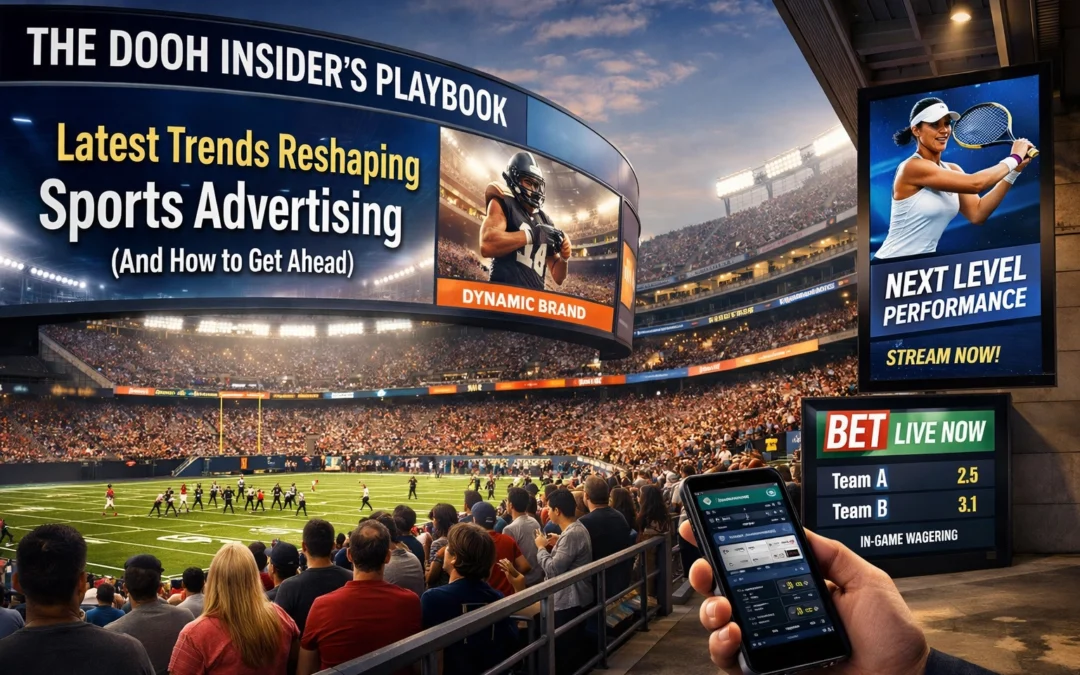
Digital out-of-home advertising in sports environments has evolved from simple static placements to sophisticated, data-driven campaigns that respond to real-time conditions and audience behaviors. The landscape has shifted dramatically, with technological capabilities enabling precision that was previously unattainable. Understanding these developments and implementing them strategically separates high-performing campaigns from those that merely occupy space.
Dynamic Creative Optimization Replaces Static Messaging
Static creative has become functionally obsolete in high-stakes sports advertising environments. Dynamic Creative Optimization (DCO) now serves as the foundation for effective campaigns, automatically adapting advertisements based on live game conditions, score changes, weather patterns, social media sentiment, and foot traffic fluctuations around venues.
When a game enters overtime, creative shifts immediately to capture extended audience engagement. During halftime periods, messaging pivots from product-focused content to entertainment-oriented approaches. Weather-triggered creative responds to rain delays or extreme temperatures with contextually appropriate product positioning. This level of responsiveness directly improves campaign performance compared to fixed messaging across all measured metrics.

The technical infrastructure required includes programmatic DOOH platforms capable of receiving multiple data feeds simultaneously, creative management systems that house numerous variations pre-approved for deployment, and decision-logic frameworks that determine which creative variant displays under specific conditions. Campaigns utilizing DCO consistently outperform static alternatives by 40-60% on engagement metrics and conversion rates.
Precision Targeting Through Location Intelligence
Geographic targeting has evolved beyond broad radius buying to device-level behavioral precision. Geofencing technology now identifies high-intent zones where concentrated fan activity occurs, including airport corridors capturing traveling fans, stadium perimeters, designated fan zones, and transit hubs serving venue-adjacent routes.
Rather than deploying inventory broadly near venues and hoping the right audiences see advertisements, advanced location intelligence activates specific screens only when target audience segments are physically present. This approach reduces wasted impressions substantially while increasing return on ad spend.
The methodology involves:
- Establishing geofenced zones around high-value locations based on historical foot traffic data
- Integrating mobile location data to identify devices belonging to target demographic profiles
- Activating inventory programmatically when concentration thresholds are met
- Retargeting exposed devices through mobile channels post-event
Location-based precision reduces cost-per-acquisition by 30-50% compared to always-on approaches in the same inventory. The strategic advantage lies not in reaching more people, but in reaching the right people at moments when receptivity to messaging is highest.

Context-Driven Messaging Outperforms Visual Complexity
Audiences moving through transit corridors, entertainment districts, and venue approaches are physically and mentally in motion. Research consistently demonstrates that advertisements serving immediate context rather than interrupting it achieve higher engagement rates in these environments.
Short-format, context-driven creative works measurably better than detailed visuals in sports settings. A beverage brand promoting cold products during high-temperature game days generates stronger response than generic brand messaging. Quick-service restaurants advertising near venues during post-game periods capture significantly higher foot traffic than during pre-game windows.
The principle extends to creative execution. Advertisements featuring minimal text, bold contrast, and single focal points outperform complex compositions with multiple messages. In environments where audience dwell time averages 3-7 seconds per screen, simplicity translates directly to comprehension and recall.
Synchronized Multi-Format Campaigns Amplify Impact
Treating individual DOOH placements as isolated units leaves substantial performance unrealized. The most effective campaigns orchestrate coordination across digital billboards, transit advertising, airport displays, street-level installations, and stadium perimeter screens to create narrative progression.
A synchronized approach might sequence messaging as follows:
- Airport displays introduce brand presence to traveling fans arriving for major events
- Transit advertising reinforces messaging during the journey to venues
- Street-level installations provide directional context and promotional callouts
- Stadium perimeter screens deliver game-specific creative during broadcasts
- Post-event transit placements extend engagement with next-action messaging
This orchestration requires centralized campaign management platforms capable of coordinating creative deployment across diverse inventory types and owners. Campaigns employing synchronized multi-format strategies demonstrate 50-70% higher aided recall compared to single-format approaches at similar impression volumes.

Streaming Integration as Essential Infrastructure
Sports consumption has fragmented across mobile devices, tablets, streaming platforms, and social media channels. Audiences no longer experience games exclusively through single screens, creating requirements for DOOH campaigns to coordinate with streaming schedules and create visual consistency across physical and digital environments.
Effective integration involves:
- Aligning DOOH creative deployment with streaming broadcast schedules
- Coordinating messaging themes across physical screens and digital video units
- Developing cross-platform measurement frameworks that connect exposure across channels
- Creating second-screen experiences that bridge physical presence with mobile engagement
Streaming-exclusive sports content has delivered 66% stronger ad effectiveness than broadcast and cable averages according to industry measurement studies. NFL advertisements during major championship events demonstrate 243% higher effectiveness versus television averages. These performance differentials indicate where audience attention concentrates and where advertising budgets should allocate.
Cross-Channel Measurement Connects Exposure to Outcomes
Impression counts no longer satisfy performance expectations. Cross-channel measurement frameworks now connect DOOH exposure to real-world behavioral outcomes using mobile location data and attribution modeling.
The methodology tracks devices exposed to DOOH inventory, then measures subsequent behaviors including:
- Foot traffic to nearby retail locations
- Visits to quick-service restaurants in venue proximity
- Product purchases at brick-and-mortar stores
- Website visits and online conversions
- App downloads and engagement metrics
A campaign for a beverage brand might deploy screens near stadium entrances, capture device IDs of exposed audiences, then measure incremental store visits to convenience retailers within a defined time window. Attribution models compare exposed versus control audiences to isolate the lift directly attributable to DOOH exposure.
This measurement rigor enables budget optimization by identifying which inventory locations, creative variations, and deployment windows generate the strongest downstream impact. Campaigns incorporating attribution measurement typically achieve 25-40% efficiency improvements through ongoing optimization cycles.

Strategic Implementation Framework
Organizations seeking competitive advantage should prioritize several foundational steps before scaling investment.
Deploy measurement infrastructure first. Implement systems connecting DOOH exposure to meaningful downstream actions rather than relying solely on impression metrics. Partner with attribution platforms capable of device-level tracking and establish baseline performance benchmarks.
Distribute budget strategically across time windows. Allocate inventory spending across pre-game, during-game, and post-game periods rather than concentrating exclusively on game-time placements. Post-game periods represent substantial opportunity often overlooked by competitors, with 30-40% lower CPMs and comparable engagement rates.
Leverage programmatic DOOH as the standard approach. Programmatic buying enables the real-time optimization and precision targeting that manual buying processes cannot achieve. Transition inventory purchasing to programmatic platforms capable of receiving multiple data feeds and executing automated optimization.
Prioritize premium, high-attention environments. The strategic objective is not achieving maximum reach, but concentrating spend in premium environments where attention converts to action. Streaming-exclusive properties, championship events, and high-profile matchups command premium pricing but deliver proportionally stronger performance.
Consider Mixed Reality executions for amplification. When standard inventory becomes crowded and expensive, Mixed Reality approaches transform sports moments into shareable social content that fans distribute through personal networks. This strategy allows brands to achieve cultural presence exceeding their media weight through organic audience amplification.
The Path Forward
Digital out-of-home sports advertising has transitioned from a supplementary channel to a precision-targeting platform capable of driving measurable business outcomes. Organizations implementing these trends strategically gain competitive advantages through superior efficiency, stronger performance metrics, and deeper audience connections. The opportunity exists for those willing to move beyond traditional approaches and embrace data-driven methodologies that align investment with proven results.
Success requires infrastructure investment, strategic planning, and commitment to measurement rigor. Those elements, implemented systematically, position campaigns to capitalize on the substantial performance advantages that modern DOOH capabilities provide in sports environments.