
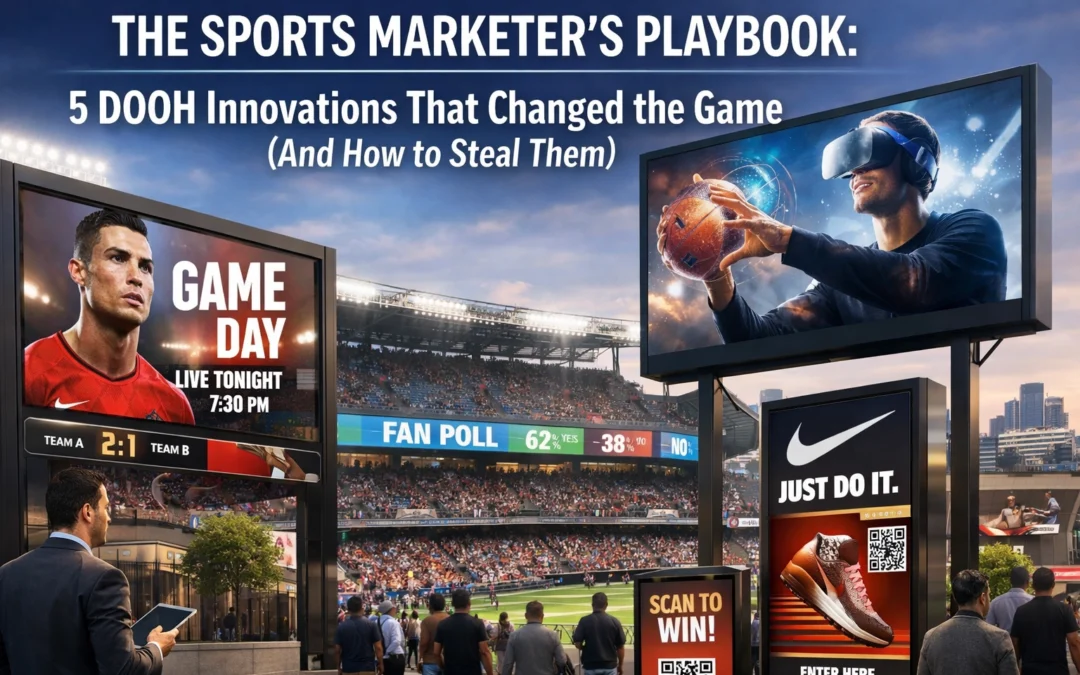
Sports marketing has undergone a fundamental shift. Traditional out-of-home advertising, once limited to static billboards and unchangeable placements, has evolved into a dynamic, data-driven system. Digital out-of-home (DOOH) advertising now delivers the flexibility and measurement capabilities previously reserved for online channels, with the added advantage of reaching audiences in high-engagement environments.
For media buyers and brand managers navigating sports marketing campaigns, understanding these innovations is no longer optional. The following five advancements represent the current state of DOOH effectiveness, each offering specific tactical applications that can be implemented immediately.

Innovation 1: Programmatic DOOH (pDOOH) – Automated Inventory Management
Programmatic DOOH eliminates the manual processes that traditionally governed outdoor advertising. Rather than negotiating individual screen placements weeks or months in advance, brands now access digital inventory through demand-side platforms (DSPs) that automate buying and activation across multiple screen networks simultaneously.
Core Mechanism:
The programmatic approach introduces real-time triggers and frequency controls previously unavailable in traditional OOH. Campaigns activate closer to event dates, adjusting to actual market conditions rather than predicted scenarios. This shift addresses a critical challenge in sports marketing: the unpredictability of fan behavior and event momentum.
Implementation Strategy:
Media buyers should integrate DOOH into existing DSP workflows, managing campaigns with the same transparency applied to other digital channels. The most effective approach combines two buying methods. First, secure high-demand screens surrounding major sporting events through direct deals, guaranteeing presence during peak moments. Second, utilize Open Exchange buying for pre-event and post-event periods when inventory costs decline but audience engagement remains elevated.
This dual strategy maximizes reach while controlling costs. During inventory scarcity, locked placements ensure visibility. During periods of lower demand, programmatic flexibility allows for efficient audience targeting without premium pricing.
Innovation 2: Dynamic Creative Optimization (DCO) – Real-Time Message Adaptation
Static creative executions fail to capitalize on the emotional momentum of live sports. Dynamic Creative Optimization addresses this limitation by enabling instant message adaptation based on game developments, weather conditions, crowd density, and other real-time variables.
Operational Framework:
DCO transforms DOOH from a broadcast medium into a responsive system. Creative elements swap automatically at halftime, following major plays, or as fan behavior patterns shift. Rather than displaying the same message throughout an event, brands maintain relevance by aligning messaging with current conditions.
Tactical Application:
Build layered creative assets with modular components. Develop base creative with multiple interchangeable elements (headlines, calls-to-action, product imagery, promotional offers) that can be deployed based on specific triggers. Integrate QR codes and mobile prompts to convert passive impressions into active exchanges while collecting first-party data for future targeting.

Post-event optimization extends campaign effectiveness. Update messaging across commuter corridors and city-center screens immediately following matches, maintaining relevance as fans share highlights and discuss outcomes. Research indicates that 42% of consumers discuss sporting events with friends after seeing OOH ads, making post-event messaging particularly valuable for extending brand conversations beyond the venue.
Innovation 3: Geofencing and Behavior-Based Targeting – Precision Audience Activation
Traditional location-based targeting relies on fixed screen positions. Geofencing and device data shift the focus from where screens are located to where audiences actually move and how they behave in those locations.
Strategic Shift:
Rather than purchasing screens based solely on traffic counts, behavior-based targeting activates advertising when engagement probability is highest. High-intent zones (stadiums, fan zones, airports, transit hubs, entertainment districts) receive prioritized placement based on actual audience clustering patterns.
Execution Method:
Layer geofencing data with mobile signal analysis to identify where fans congregate before, during, and after sporting events. Map creative deployment to physical audience movement through host cities rather than treating viewers as static. This approach transforms DOOH from location-based media to behavior-based activation.
For example, activate different creative in the hours before an event near stadium entrances versus the messaging deployed along post-game commuter routes. Pre-game creative might emphasize immediate offers (food, beverages, merchandise), while post-game messaging can focus on brand recall and social engagement.
The result is more efficient media spend. Budgets concentrate on moments and locations where audiences demonstrate active interest rather than passive exposure.
Innovation 4: Cross-Channel Attribution and Real-World Measurement – Performance Validation
DOOH historically struggled with measurement compared to digital channels. Current attribution capabilities now connect screen exposure directly to measurable outcomes: store visits, website traffic, incremental sales, and other concrete business results.
Measurement Framework:
Modern DOOH networks track conversions from exposure to action, moving beyond impression counts to actual consumer behavior. Attribution links exposure across devices and environments, measured through real consumer actions rather than modeled estimates.
Implementation Requirements:
Demand attribution partnerships that provide clear paths from DOOH exposure to business outcomes. Establish baseline metrics before campaign launch, then track changes in foot traffic, site visits, and sales among exposed audiences versus control groups.

Implement continuous optimization during events rather than waiting for post-campaign analysis. Monitor audience behavior patterns as they emerge, then shift budgets and creative elements in real-time to capitalize on observed trends. Prioritize performance-driven measurement connecting geo-location targeting to offline actions.
For brand managers seeking budget justification, attribution data provides the quantitative proof required for continued investment. When DOOH exposure correlates with measurable lifts in purchase consideration, store visits, or sales, the medium transitions from experimental to essential.
Innovation 5: Mixed Reality and Immersive Environments – Cultural Moment Creation
Mixed reality creates event-scale cultural moments without physical infrastructure investment. Immersive experiences and virtual signage allow brands to establish presence that exceeds traditional media weight through shareability and social amplification.
Strategic Advantage:
These experiences are inherently designed for social platform distribution. Short-form content spreads organically as attendees and viewers share moments, extending reach beyond initial exposure. Brands embed themselves in culturally significant sporting moments, punching above their weight class through viral distribution.
Application Approach:
Test emerging immersive platforms where engagement and storytelling converge. Focus on creating clip-friendly moments designed for social distribution rather than passive viewing. The objective is not simply to display a brand message but to create an experience worth sharing.
For sports marketing specifically, mixed reality can localize experiences by city or team, creating personalized moments at scale. Virtual signage and augmented reality integrations allow sponsors to appear throughout broadcast and streaming coverage without physical placement limitations.
Unified Strategic Application
These five innovations share a common foundation: they treat DOOH as a dynamic, measurable, audience-led system rather than a static broadcast medium. The most effective implementations align with how fans actually move, engage, and share throughout sporting events.
Media buyers should approach DOOH campaigns with the same strategic rigor applied to digital channels. Set clear objectives, establish measurement frameworks, build flexible creative systems, and optimize based on performance data. The technology now exists to execute sports marketing campaigns with precision previously unavailable in out-of-home environments.
Brand managers gain access to high-engagement environments with measurement capabilities that justify budget allocation. The combination of mass reach and individual tracking creates opportunities for both brand building and performance marketing within a single medium.
OOH Sports specializes in connecting brands with sports audiences through digital out-of-home placements. As DOOH technology continues advancing, the gap between digital precision and outdoor impact continues narrowing. The innovations outlined here represent current capabilities, with further developments arriving continuously.
Sports marketing success now requires understanding not just where audiences gather but how they move, when they engage, and what drives them to action. DOOH innovations provide the tools to address each of these dimensions with increasing precision.