
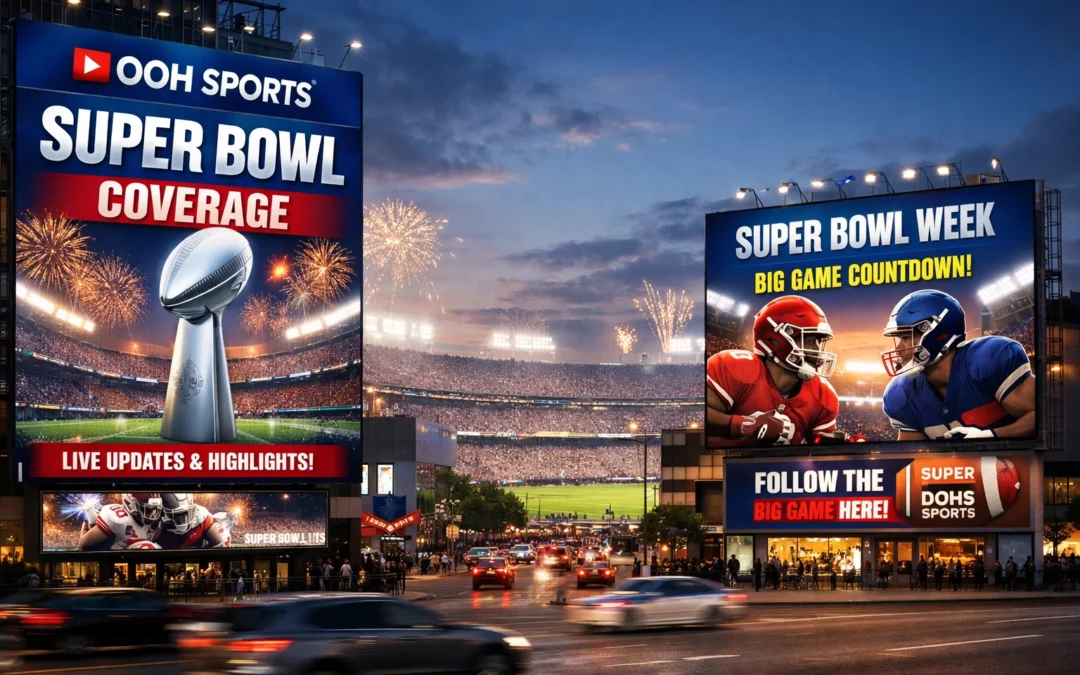
The Super Bowl has always been the ultimate stage for advertising. For decades, the focus was almost entirely on the thirty second television spot. However, the landscape shifted significantly by February 2026. While television remains a factor, the real conversation now centers on how brands dominate the physical environment. OOH Sports established a new benchmark for this during the recent Super Bowl coverage, leveraging 40 years of industry leadership to create a truly venue-wide experience.
From the floors of the stadium to the massive digital billboards overlooking the festivities, the strategy was clear. It was about being everywhere the fans were, ensuring that the brand message was not just seen, but felt. This approach, often referred to as environment domination, has transformed how major sporting events are marketed.

A Legacy of Four Decades in Sports Advertising
The success of the 2026 Super Bowl coverage was not an overnight achievement. It was the result of 40 years of leadership in the advertising space. Under the guidance of CEO Dan Kost, OOH Sports has consistently pushed the boundaries of what is possible in out-of-home media. This long history allowed the company to build the necessary infrastructure and relationships to execute a campaign of this scale.
Over four decades, the company evolved from traditional static signage to a sophisticated digital network. This experience provided a deep understanding of fan behavior. Advertisers today benefit from this historical perspective, knowing that the placement of a message is just as important as the message itself. The 2026 coverage showcased this expertise by integrating various media types into a single, cohesive narrative.
The Strategy of Environment Domination
Environment domination is a term that describes a comprehensive advertising strategy where a brand takes over a specific location. During the Super Bowl, OOH Sports executed this by using a multi-layered physical presence. This was not limited to a few screens. Instead, it included everything from concourse floor graphics to high-impact digital ribbon boards and jumbotrons.
This "surround sound" brand presence ensures that fans encounter the message at multiple touchpoints throughout their journey. Whether they are walking to their seats, waiting at a concession stand, or looking at the main scoreboard, the brand is there. This repetition reinforces the message without it becoming redundant. It creates a sense of ubiquity that a single television commercial simply cannot match.

From Floors to Billboards: A Venue-Wide Approach
The 2026 coverage demonstrated that every square inch of a venue is a potential advertising opportunity. One of the most talked-about elements was the use of floor graphics. These high-touch displays caught fans’ attention in areas that are often overlooked, such as entrances and concession lines.
Moving upward, the coverage included digital screens strategically placed throughout the concourses. These screens provided real-time updates and engaging content, keeping fans connected to the brand even when they were away from the field. Outside the stadium, the strategy extended to massive billboards and metropolitan displays, creating a seamless transition from the city streets to the stadium seats.
This comprehensive coverage is made possible by the Sporttron digital network. With access to over 780 venues nationwide, OOH Sports can coordinate campaigns across multiple facilities simultaneously. This eliminates the fragmentation that used to make large-scale OOH campaigns difficult to manage.
Capturing the Undivided Attention of Fans
One of the biggest challenges in modern advertising is the fragmented attention of the audience. People often use ad-blockers or look at their phones during television commercials. However, fans inside a sporting venue are a captive audience. They are in a high-energy environment and are predisposed to engage with the content around them.
The OOH Sports strategy capitalizes on this by placing ads in natural pause points. Concession platforms and digital displays in high-traffic areas engage fans when they are most likely to be looking for information or entertainment. This results in a level of engagement that is increasingly scarce in the digital world. For a deeper look at why this works, the article on why stadium perimeter ads capture hearts better than social media provides excellent context.
https://www.youtube.com/watch?v=l6J-0zileKE
The Role of Programmatic Technology in 2026
The use of programmatic digital out-of-home (DOOH) technology was a cornerstone of the 2026 Super Bowl strategy. Programmatic technology allows advertisers to buy and display ads in real-time, based on specific data and triggers. This means that a campaign can be adjusted on the fly to respond to what is happening during the game.
For example, if a specific player makes a big play, a brand can trigger an ad featuring that player across the entire network within seconds. This level of agility was previously impossible with traditional OOH advertising. The adoption of programmatic DOOH has been a game-changer for sports marketers, as discussed in the spotlight on StackAdapt DSP.

Measurable Results and ROI
The shift toward digital and programmatic OOH is driven by the ability to measure results. In the past, OOH was often seen as a brand awareness tool with limited attribution. Today, sophisticated data collection allows brands to see exactly how their campaigns are performing.
During the 2026 Super Bowl period, brands using the OOH Sports network saw significant lifts in key metrics. Based on previous campaign data, such as the White Claw programmatic campaign which saw a 74 percent lift in purchase consideration, the Super Bowl results followed a similar trajectory of high impact. Other brands, like Mike's Hard Iced Tea, have seen a 119 percent lift in positive brand image using similar strategies.
These numbers prove that venue-wide coverage is not just about visibility. It is about driving actual business results. By reaching fans in a high-intent environment, brands can influence purchase decisions more effectively than through traditional channels.
Expanding the Reach Across America
While the Super Bowl is a single event, the infrastructure used to cover it is part of a much larger network. OOH Sports recently expanded to 25,000 digital screens across America. This expansion means that the same level of environment domination seen at the Super Bowl can be replicated at thousands of other venues and events.
This scale is crucial for brands that want to maintain a consistent presence throughout the entire sports season. From the regular season to the playoffs, the ability to reach fans across various sports and locations provides an unparalleled level of market penetration. It allows for a national campaign with local relevance.

Why the Industry is Shifting Toward DOOH
The conversation around OOH Sports’ Super Bowl coverage reflects a broader industry trend. Experts predict that DOOH sports advertising will hit 50 billion dollars by 2030. This growth is fueled by the realization that traditional stadium sponsorships are evolving. Static signs are being replaced by dynamic, interactive, and data-driven displays.
Advertisers are moving away from simple logo placement and toward integrated storytelling. The 2026 Super Bowl was a prime example of how to use technology to enhance the fan experience rather than interrupt it. When advertising adds value to the event, whether through information or entertainment, it is much better received by the audience.
Conclusion: The Future of Sports Marketing
The 2026 Super Bowl coverage by OOH Sports showcased the power of combining 40 years of experience with cutting-edge technology. By focusing on venue-wide coverage and environment domination, the campaign reached fans in a way that was impactful, measurable, and highly engaging.
As the industry continues to move toward more programmatic and AI-powered solutions, the lessons learned from this year's Super Bowl will serve as a guide for future campaigns. For brands looking to make a lasting impression, the message is clear: the field is just the beginning. To truly win, you have to dominate the entire environment.
For more information on how to leverage these strategies for your brand, visit the OOH Sports homepage or explore our sitemap for more resources.