
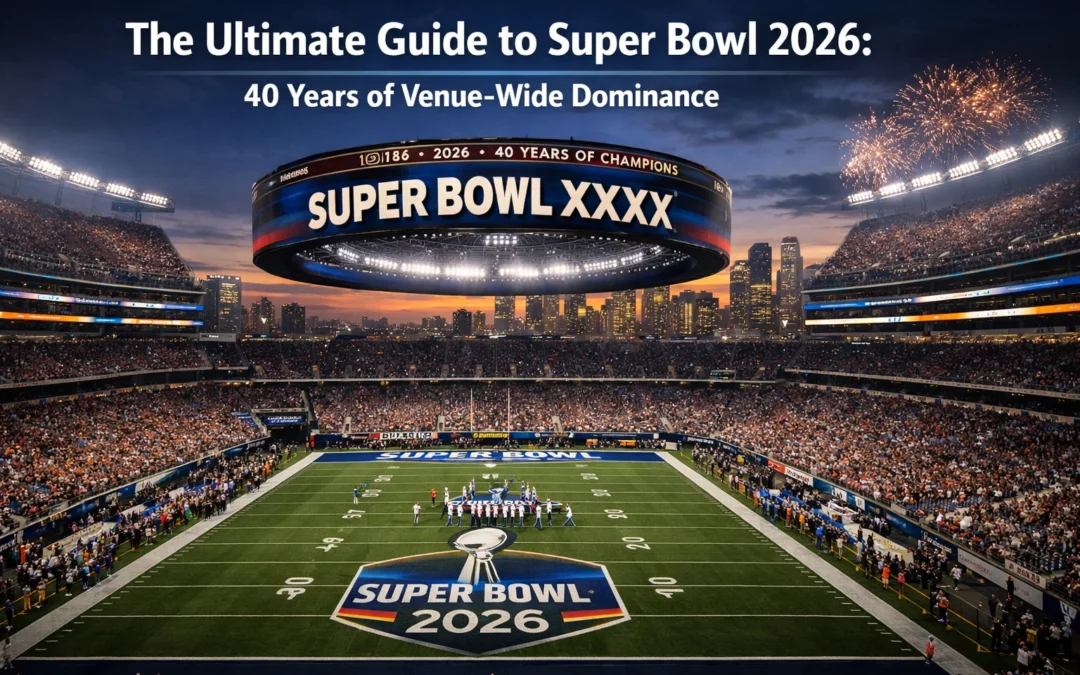
The roar of the crowd at Levi's Stadium in Santa Clara on February 8, 2026, marked more than just the end of an intense battle between the New England Patriots and the Seattle Seahawks. It represented a milestone in the world of sports marketing. As Super Bowl LX concluded, the industry looked back at a legacy that has spanned four decades. OOH Sports has been at the center of this evolution, transforming how brands interact with fans within the stadium walls. This guide explores the strategies used during the 2026 event and the 40 year journey of advertising dominance that led to this moment.
The 2026 Super Bowl Context
Super Bowl LX was held at the high tech Levi's Stadium, a venue known for its LEED Gold certification and sustainable design. With a capacity of 68,500, the stadium provided a massive canvas for advertisers. The game featured a halftime performance by Bad Bunny, drawing a global audience that extended far beyond the physical seats in California.
For advertisers, the 2026 game was not just a one day event. It was the culmination of months of programmatic planning. The focus shifted from simple television spots to a "venue-wide" approach. This strategy ensures that from the moment a fan steps onto the floor of the concourse to the moment they look at the massive high definition video boards, the brand message remains consistent and unavoidable.

40 Years of Advertising Leadership
The history of Super Bowl advertising has transitioned from static billboards to a fully integrated digital ecosystem. In the mid 1980s, stadium advertising was limited to fixed signage and printed banners. These traditional methods offered high visibility but lacked the flexibility of modern technology.
Over the last 40 years, the industry saw a shift toward dynamic content. By 2026, OOH Sports had expanded its network to include over 25,000 digital screens across America. This expansion allowed for real time updates and hyper local targeting that was impossible decades ago. You can read more about how this network expansion impacts modern marketing in this detailed look at digital screen growth.
Strategy: Dominating Every Square Inch
The concept of venue-wide dominance involves a multi layered approach to Out-of-Home (OOH) advertising. It is no longer enough to have a single ad on a scoreboard. In 2026, the strategy involves "floor to ceiling" coverage.
Floor Graphics and Wayfinding
The floor is often an overlooked asset. During Super Bowl LX, floor graphics served dual purposes. They acted as navigational tools for fans finding their seats while simultaneously showcasing brand logos. These graphics are durable and designed to handle the high foot traffic of nearly 70,000 people.
Digital Perimeters and Sportrons
Stadium perimeter ads are critical for capturing the attention of both the live crowd and the television audience. These ads capture hearts and wallets better than traditional social media because they are part of the live experience. Data shows that fan engagement is significantly higher when ads are integrated into the physical environment. For more on this, explore the importance of fan engagement.

Programmatic Integration
The 2026 campaign utilized programmatic Digital Out-of-Home (DOOH) technology. This allowed brands to trigger specific ads based on game events. If a touchdown was scored, the entire stadium's digital inventory could switch to a celebratory creative for a specific sponsor in milliseconds.
The following video showcases the power of visual storytelling in these high pressure environments:
https://www.youtube.com/watch?v=l6J-0zileKE
Objective and Execution
The primary objective for major brands during the 2026 Super Bowl was to achieve maximum "share of voice" within the venue. The execution involved several key technology partners and logistics.
- Audience Segmentation: Brands used mobile device IDs to understand who was in the stadium. This allowed for retargeting after the game.
- Creative Deployment: High definition video content was optimized for the unique aspect ratios of Sportrons and ribbon boards.
- Synchronized Messaging: By coordinating the concourse screens with the main stadium boards, brands created an immersive loop of content.
Quantifiable Results: Case Studies in Success
The success of venue-wide dominance is measured through brand lift studies and purchase consideration metrics. Looking at historical data provides a clear picture of why this strategy works.
White Claw Case Study
In a programmatic DOOH campaign, White Claw saw a 74 percent lift in purchase consideration during a product launch. By using real time data to place ads where the target audience was most active, the brand achieved a massive return on investment. The full details of this White Claw study highlight the power of precise targeting.
AB InBev and Mike's Hard Iced Tea
Another example of effective OOH execution involves AB InBev. Their campaign for Mike’s Hard Iced Tea resulted in a 119 percent lift in positive brand image. This was achieved through a programmatic DOOH strategy that prioritized high traffic sports environments. The AB InBev results prove that visibility in a stadium environment translates directly to brand sentiment.

Technology and Logistics
Executing a venue-wide campaign at an event as large as the Super Bowl requires precise logistics. Levi's Stadium features thousands of Wi-Fi access points and state of the art digital infrastructure. OOH Sports utilized these systems to ensure that there was no latency in ad delivery.
The logistics involved:
- Pre-event Testing: Ensuring all digital assets were compatible with the venue's hardware weeks before kickoff.
- Dynamic Creative Optimization (DCO): Adjusting the creative content based on the weather, the score, or the time of day.
- Foot Traffic Analysis: Using sensors to determine which areas of the concourse had the highest dwell time.
Why Stadium Ads Outperform Social Media
While social media offers reach, it often lacks the undivided attention of a stadium crowd. At Super Bowl LX, fans were focused on the live action. Stadium ads become part of the memory of the event. A fan might scroll past a social media post, but they cannot ignore a 200 foot wide digital board during a crucial play.
The "proximity effect" also plays a role. When a fan sees an ad for a beverage while standing ten feet away from a concession stand, the path to purchase is immediate. This is the core of why venue-wide dominance is the ultimate goal for sports advertisers.

Final Thoughts on the 2026 Super Bowl
The 40 year journey from simple signs to the digital spectacle of 2026 shows that the physical venue remains the most valuable real estate in advertising. OOH Sports continues to lead this field by combining massive scale with technical precision.
As we look toward future seasons, the lessons learned at Levi's Stadium will serve as the blueprint for brand engagement. The combination of programmatic flexibility and the sheer impact of physical presence ensures that OOH remains the dominant force in sports marketing.
For those interested in exploring how to implement these strategies for future events, the OOH Sports contact page is the best place to start. You can also browse our blog for more insights into the world of sports advertising or view our sitemap for a full list of resources.
Whether it is through floor graphics, digital billboards, or integrated programmatic campaigns, the goal remains the same. To dominate the venue and leave a lasting impression on the audience. The 2026 Super Bowl was a perfect example of that mission accomplished.