
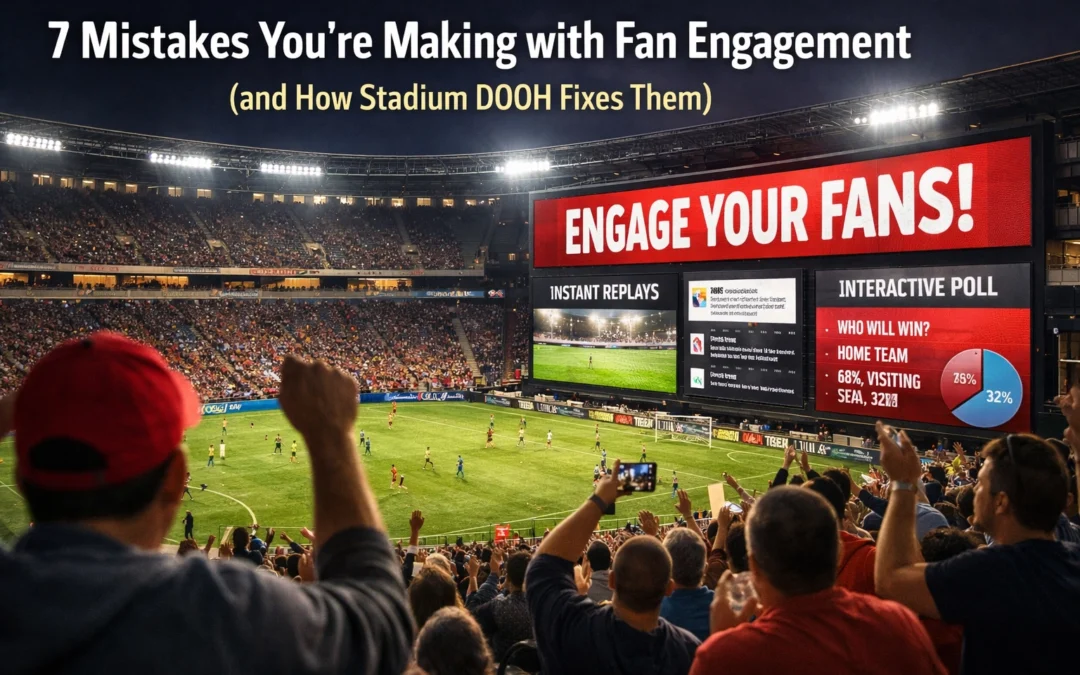
Fan engagement is no longer about just putting a game on a field and hoping people watch. In a world where every spectator has a high definition screen in their pocket, the battle for attention is fierce. Creative directors and CMOs face a constant challenge: how do you keep a crowd of thousands focused on the brand experience when distractions are everywhere?
Traditional advertising methods often fall short in the high energy environment of a stadium. Many brands continue to make fundamental errors that lead to wasted spend and missed connections. Digital Out-of-Home (DOOH) technology, specifically through platforms like OOH Sports, offers a sophisticated solution to these common pitfalls.
1. Relying on Static Content in a Dynamic Environment
One of the most frequent mistakes in stadium branding is the use of static signage. In a fast paced sporting event, scores change, momentum shifts, and the mood of the crowd evolves every minute. A static banner remains the same regardless of what is happening on the turf.
Static signage becomes background noise quickly. Because it cannot react to the live environment, it loses its relevance within the first quarter. Stadium DOOH fixes this by allowing for real time updates. Whether it is a celebratory animation after a home run or a tactical message change during a timeout, digital displays ensure the creative is always in sync with the live action. This relevance is what captures eyes and maintains brand salience throughout the entire event.

2. Neglecting the Fan Journey and Wayfinding
Fan engagement starts the moment a spectator enters the gates, not just when they sit in their seats. Many brands focus exclusively on the big screen and forget the rest of the venue. A frustrated fan struggling to find their section, a restroom, or a concession stand is a fan who is not looking at advertisements.
Inadequate wayfinding is a major barrier to a positive experience. Modern stadium DOOH creates a connected environment where fans receive consistent, relevant information at every touchpoint. By integrating wayfinding information with brand messaging, companies can provide a service while building brand equity. When a brand helps a fan find the shortest line for a drink, that brand earns a level of gratitude that a traditional billboard cannot match.
3. Ignoring the "Dead Air" During Breaks
Game stoppages, halftime, and timeouts are often viewed as "dead air" where engagement drops. Research shows that during these breaks, fans immediately turn to their mobile devices. This is a critical moment where brands lose their audience to social media feeds.
Stadium perimeter advertising and Sportrons turn these gaps into high value engagement opportunities. Instead of letting the attention drift, DOOH displays can feature game highlights, behind the scenes content, and interactive media that pulls eyes back to the physical environment. By providing entertainment during breaks, brands maintain a continuous narrative that keeps the audience captive.

4. Failing to Leverage Programmatic Flexibility
Many CMOs still treat stadium advertising as a "buy and hold" long term commitment with no room for optimization. This lack of flexibility is a significant mistake in a data driven marketing landscape.
Programmatic DOOH allows for a level of precision that was previously impossible in physical spaces. Brands can now trigger ads based on specific conditions, such as weather, time of day, or even the current score. This methodology has been proven to drive massive results. For example, White Claw utilized a programmatic DOOH campaign that resulted in a 74% lift in purchase consideration. You can read more about that success in this detailed case study.
5. Treating Fans as Passive Observers
Traditional signage creates a passive experience. The brand speaks, and the fan is expected to listen. However, modern fans, especially younger demographics, want deeper digital interaction with their favorite teams and the brands that support them.
One in four fans expresses a desire for more digital interaction while at the stadium. Failing to provide this is a missed opportunity for data collection and brand affinity. Stadium DOOH fixes this by enabling social media walls, live polling, and QR code integrations that bridge the gap between the physical screen and the fan's mobile device. This interactive approach transforms a one way broadcast into a two way conversation. More on why this matters can be found in our exploration of why stadium perimeter ads capture hearts and wallets.

6. Disconnected Messaging Across the Venue
Consistency is key in branding, yet many stadium campaigns feel fragmented. The message a fan sees on a concourse screen might have a completely different look and feel than the one on the perimeter LED boards. This disconnection dilutes the brand impact and confuses the audience.
OOH Sports streamlines this process by creating a unified network. When messaging is synchronized across the entryways, concourses, and the field perimeter, it creates an immersive brand world. This level of saturation ensures that the brand remains top of mind regardless of where the fan is in the stadium. In fact, AB InBev saw a 119% lift in positive brand image by utilizing a coordinated programmatic DOOH strategy.
7. Missing the Opportunity for Targeted Impulse Purchases
The stadium is a unique retail environment where the "mood to buy" is exceptionally high. 85% of event audiences report changing their purchasing decisions after a satisfying experience. A major mistake brands make is failing to influence these decisions at the point of sale.
Digital displays near concession stands and team stores can be updated instantly to promote specific items based on real time stock or even the temperature. If it is a hot day, promoting cold beverages via DOOH can drive immediate foot traffic. This tactical use of digital signage turns branding into a direct sales tool. For instance, Sea-Doo saw a 144% increase in purchase consideration through a well executed DOOH campaign, proving that the right message at the right time moves the needle. You can see the full breakdown of that Sea-Doo campaign here.

The Strategic Shift to Stadium DOOH
The transition from traditional, static stadium advertising to a dynamic DOOH model is not just a technological upgrade, it is a strategic necessity. For Creative Directors, it offers a larger, more vibrant canvas to tell a brand story. For CMOs, it provides the data, flexibility, and ROI metrics required in a modern marketing budget.
OOH Sports provides the infrastructure to avoid these seven common mistakes. By utilizing a network that spans thousands of screens, brands can ensure their message is not only seen but felt. The power of the stadium environment is the collective energy of the crowd. When a brand successfully taps into 그 energy through smart, digital communication, the results go far beyond simple impressions.
The goal is to move from being a logo on a wall to being a part of the event itself. By addressing wayfinding, filling the gaps in action, and using programmatic triggers, brands can create a seamless and memorable experience for every fan in the stands.
For those looking to elevate their stadium presence and tap into the power of real time fan engagement, the path forward is clear. It is time to move past the limitations of the past and embrace the dynamic potential of OOH Sports.
To learn more about how to integrate these strategies into an upcoming campaign, visit the OOH Sports contact page to start a conversation with the team.