
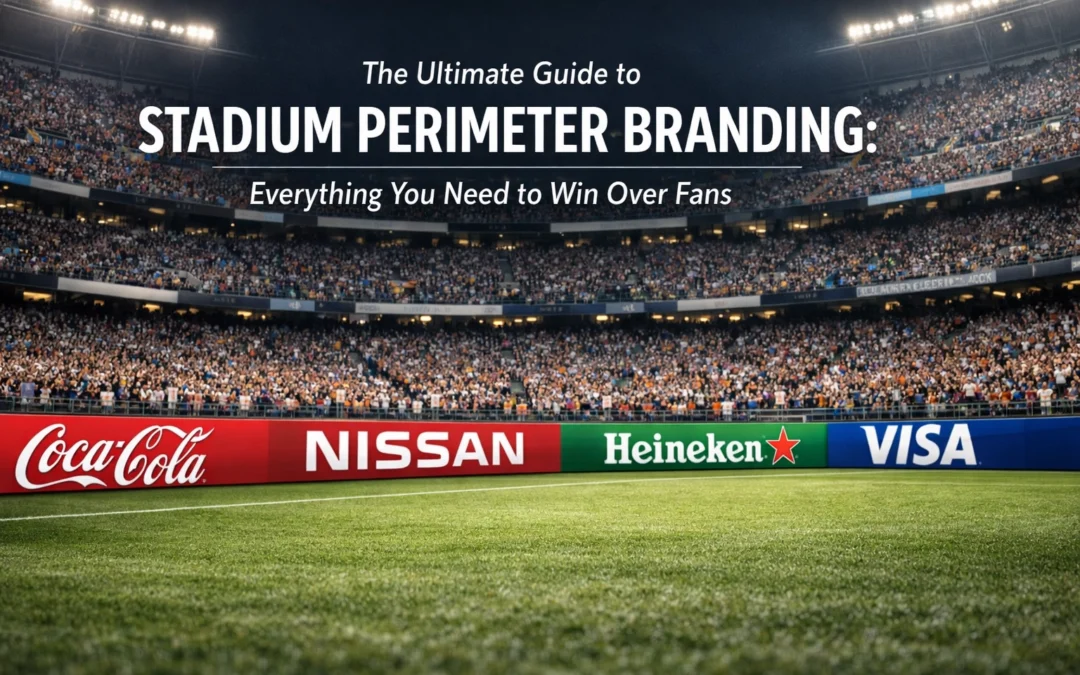
Stadium perimeter branding represents the inner circle of sports marketing. It is the visual border that frames the action, sitting at the intersection of live fan experience and global broadcast reach. For brand managers and creative directors, this space offers a unique opportunity to capture attention when emotional engagement is at its peak.
This guide explores the mechanics of perimeter advertising, the strategic choices that drive brand lift, and the technical requirements for executing a successful campaign within a sports environment.
The Strategic Value of Perimeter Advertising
Perimeter branding is not merely a background element. It is a high frequency touchpoint that serves two distinct audiences simultaneously. The first audience consists of the thousands of fans inside the venue. The second, often much larger audience, consists of viewers watching via live stream or television broadcast.
Because cameras naturally follow the ball or the athletes, perimeter boards receive consistent "hero" placement. This placement ensures that the brand remains in the line of sight for the duration of the event. Unlike traditional commercials that viewers might skip, perimeter branding is integrated into the live content. This creates high brand recall and positions the sponsor as an essential part of the sporting narrative.
Objective and Strategy
The primary objective of a perimeter campaign is typically to build brand equity and drive purchase consideration through repeated exposure. Success requires a strategy that balances visibility with clarity.
Strategic layering involves using different types of signage to fulfill different goals. While a main LED board might focus on brand awareness, secondary signage near exits or concourses can focus on direct calls to action. For brands looking to stay ahead of the curve, reviewing the ultimate guide to sports DOOH trends can provide additional insights into how technology is shifting the landscape.

Types of Stadium Perimeter Signage
The physical hardware used in perimeter branding has evolved significantly. Choosing the right medium depends on the venue, the sport, and the campaign budget.
- Digital LED Systems: Modern venues favor LED systems due to their brightness and versatility. These screens allow for dynamic content, real-time score updates, and synchronized "takeovers" where every screen in the stadium displays the same brand message.
- Static Boards: Fixed panels are common in smaller venues or as secondary placements. They provide a constant presence but lack the flexibility of digital displays.
- Rotating Boards (Prism): These mechanical boards flip between three different sponsors. While less common than LED, they are still used in many international soccer leagues.
- Dasher Boards: In hockey rinks, dasher boards provide a 360-degree perimeter. These are subject to heavy physical impact, requiring durable materials that can withstand pucks and player contact.
- Fence Mesh and Wind Screens: These are often used at the perimeter of the stadium grounds or practice fields. They serve the dual purpose of privacy and branding.
Design Principles for Maximum Impact
Designing for a stadium environment is different from designing for print or mobile. The scale is massive, the viewing distance is long, and the environment is visually crowded.
Scale and Legibility
Graphics must be legible from the furthest seat in the stadium. This requires large, bold typography and high-contrast color palettes. A common mistake is including too much text. In the fast-paced environment of a game, fans and cameras only have seconds to register a message. Short, punchy slogans or just a logo and a URL are often more effective than detailed descriptions.
Color Accuracy
Colors can appear differently depending on the lighting and the material of the sign. Digital LED screens emit light, while vinyl banners reflect it. It is critical to calibrate colors so that brand identity remains consistent across all platforms. This ensures that the blue in a logo on a screen matches the blue on the entrance banners.
Motion and Hierarchy
On digital boards, motion can attract the eye, but it must be used carefully. Excessive or fast-moving animation can become a distraction rather than an attraction. Subtle movement or "shimmer" effects often work better to draw the eye without overwhelming the viewer.

Rotation Strategies and Exposure Models
How a brand shares space with other sponsors is a key tactical decision. There are several models for how perimeter ads are displayed:
- Full Rotation: A single sponsor takes over the entire perimeter for a set period. This creates a powerful, uncluttered visual that is impossible to miss.
- Split Rotation (4:4 or 2:2): The perimeter is divided into sections, with different sponsors occupying different zones. This allows for lower entry costs while still maintaining a significant presence.
- Multisession: Up to 14 sponsors may be featured simultaneously in smaller sections. This is common in high-traffic areas where total contact figures are more important than individual dominance.
Technology and Integration
The integration of programmatic Digital Out-of-Home (pDOOH) has changed how perimeter ads are bought and sold. OOH Sports has been at the forefront of this shift. As the OOH Sports network expands to 25,000 digital screens, the ability to target specific demographics in real-time becomes more accessible.
Technology also allows for "virtual" perimeter branding. In some broadcasts, the physical boards in the stadium are digitally overlaid with different ads for viewers in different regions. This allows a global brand to show a specific message to fans in New York while showing a different message to fans in London, all during the same game.
Measuring Success and Results
Quantifying the impact of stadium branding is essential for CMOs and creative directors. Measurement usually focuses on two areas: broadcast exposure and brand lift.
Broadcast Metrics
Sophisticated software can now track every second a brand appears on screen during a game. This data is used to calculate an "Equivalent Advertising Value" (EAV), comparing the cost of the sponsorship to the cost of buying an equivalent amount of traditional commercial airtime.
Brand Lift and Consumer Behavior
Data driven studies show that stadium OOH campaigns drive significant increases in purchase consideration. For example, a programmatic DOOH campaign for White Claw saw a 74% lift in purchase consideration for their vodka launch. Similarly, AB InBev’s Mike’s Hard Iced Tea campaign resulted in a 119% lift in positive brand image. These results highlight the effectiveness of combining high visibility sports environments with data-driven targeting. More details on these outcomes can be found in the White Claw case study.

Enhancing the Fan Journey
Perimeter branding should be seen as one part of a larger fan journey. The journey begins at the parking lot, moves through the gates, into the concourse, and finally to the seating bowl.
- Wayfinding Integration: Smart brands integrate their messaging with directional signage. This makes the brand helpful to the fan experience.
- Retail Alignment: Placing perimeter messages near stadium retail shops can drive immediate sales for merchandise or food and beverage partners.
- Interactive Moments: QR codes or social media prompts on perimeter boards can bridge the gap between the physical stadium and the fan's mobile device, allowing for data collection and direct engagement.
Durability and Logistics
Executing a perimeter branding campaign requires careful logistical planning. For physical signage, material choice is vital. Vinyl and self-adhesives must be high-tack to stick to rough stadium surfaces but removable enough to be swapped out for different events. Mesh banners are preferred for exterior fences because they allow wind to pass through, preventing the "sail effect" that can damage structures.
For digital campaigns, the focus shifts to file formats and delivery systems. Ensuring that creative assets are optimized for the specific aspect ratios of a stadium’s LED ribbons is a technical requirement that cannot be overlooked.
Conclusion
Stadium perimeter branding remains one of the most effective ways to reach a captive, passionate audience. By focusing on simple, high-impact design and leveraging modern digital technologies, brands can ensure they stay top of mind for fans both in the stands and at home.
Strategic placements, combined with the power of the OOH Sports network, allow brands to turn a standard game into a significant marketing victory. Whether it is through a massive LED takeover or a carefully placed dasher board, the perimeter is where the brand meets the game.
For more information on how to implement these strategies, visit the OOH Sports marketing page or explore the case studies to see how other major brands have successfully navigated the stadium environment.