
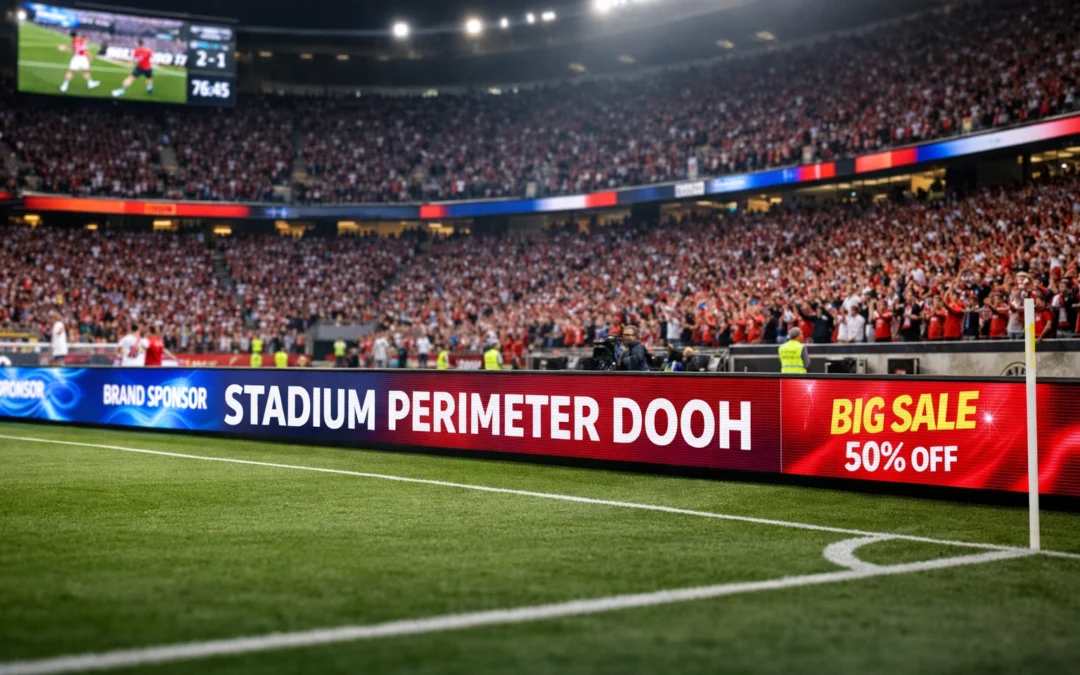
Stadium perimeter advertising has undergone a significant transformation. Once limited to static boards that required manual installation and offered zero flexibility, the medium has evolved into a powerhouse of Digital Out-of-Home (DOOH) technology. For Creative Directors and Chief Marketing Officers (CMOs) looking to capture the attention of a highly engaged audience, understanding the nuances of stadium perimeter DOOH is essential.
Modern sports marketing relies on more than just visibility. It requires a strategic blend of timing, technology, and emotional resonance. As the industry moves toward a future where sports advertising is projected to reach $50 billion by 2030, the role of perimeter DOOH becomes even more central to the brand mix.
Here are ten critical factors regarding stadium perimeter DOOH and its impact on fan engagement.
1. The Strategy of Non-Intrusive Integration
One of the primary benefits of stadium perimeter DOOH is its ability to integrate into the viewing experience without disrupting the fan. Unlike traditional television commercials that force a break in the action, perimeter boards exist within the natural eye line of the spectator.
This non-intrusive placement creates a positive brand association. When a brand appears as part of the entertainment rather than an interruption, the audience perceives it as a facilitator of the experience. This strategy ensures that the marketing message is consumed alongside the primary content, leading to higher acceptance rates among fans who are typically resistant to traditional advertising formats.
2. Capitalizing on High-Stakes Emotional Moments
The placement of advertising during peak emotional moments is a proven tactic for increasing memory retention. In a stadium environment, certain locations carry more weight than others. Boards positioned behind the goals or at center-pitch locations are frequently captured during goal celebrations, penalty kicks, or game-winning plays.
These moments are not only witnessed live but are also replayed across highlight reels, news broadcasts, and social media platforms. By aligning a brand with these high-intensity moments, marketers can strengthen the psychological association between their products and the positive feelings associated with victory. Research indicates that memory associations are significantly stronger when formed during periods of high emotional arousal.

3. Visual Simplicity and Brand Recall
In the fast-paced environment of a live sporting event, complex messaging often fails. The most effective perimeter DOOH campaigns prioritize visual simplicity. Clear brand names, recognizable logos, and high-contrast color schemes perform better than text-heavy creative.
The use of dynamic LED displays allows for subtle animations that catch the eye more effectively than static images. These animations must be balanced. While movement increases recall rates, excessive motion can become a distraction. The goal is to create a visual "shimmer" that draws the eye toward the brand without pulling the viewer away from the game. Digital boards offer the brightness and clarity needed to ensure the message remains visible under stadium floodlights or direct sunlight.
4. Real-Time Programmatic Capabilities
The shift from traditional static boards to programmatic DOOH has revolutionized how campaigns are executed. Programmatic technology allows for the delivery of messages in real-time, based on the progression of the game. For example, a betting brand can update odds instantly on perimeter boards to reflect the current score, or a beverage brand can trigger a specific creative when a timeout is called.
This level of agility is a major advantage for modern marketing departments. Launching real-time sports betting DOOH campaigns can now be done in under 24 hours, providing a level of responsiveness that was previously impossible. This technology ensures that the content remains relevant to the immediate state of the fan.

5. Interactive Fan Experiences
Perimeter DOOH is no longer a one-way communication channel. Interactive elements are becoming increasingly common as stadiums upgrade their hardware. Digital boards can now display live polls, social media feeds, or QR codes that invite fans to participate in games or access exclusive discounts via their mobile devices.
These interactive features serve two purposes. First, they enhance the fan's presence at the event by making them an active participant in the stadium atmosphere. Second, they provide valuable data collection opportunities. When a fan interacts with a board, the sponsor can gather information about audience behavior and preferences, enabling more effective retargeting efforts in the future.
6. Broadcast and Social Media Amplification
The reach of a stadium perimeter board extends far beyond the physical seats of the venue. Because these boards are positioned to be in the camera's view during live broadcasts, they achieve massive secondary reach. A single match can be broadcast to millions of viewers globally, turning a local placement into an international campaign.
Furthermore, social media serves as a significant amplifier. When fans record video of a goal or a major play on their smartphones, the perimeter advertising is captured in the background. These clips are then shared across platforms like Instagram, TikTok, and X (formerly Twitter). This organic sharing transforms standard ad placements into self-perpetuating marketing assets, often generating millions of impressions without additional media spend.
7. Personalized and Behavioral Targeting
Advancements in digital technology allow for geographic and time-based targeting. In some broadcast environments, virtual replacement technology can even overlay different brand messages on the same perimeter boards for different viewing regions. This means a fan watching in London might see a different ad than a fan watching the same match in New York.
Even without virtual overlay, advertisers can use data to adjust messaging based on game progression. If a match is nearing the end and the home team is winning, the tone of the messaging can shift to celebratory or promotional for post-game activities. This level of personalization increases both engagement and conversion rates by meeting the audience where they are emotionally.
8. Measurable ROI and Impact Data
CMOs are under constant pressure to justify marketing spend with hard data. Stadium perimeter DOOH provides a wealth of measurable outcomes. Through the use of mobile device IDs and brand lift studies, advertisers can track how exposure to stadium ads influences consumer behavior.
For instance, White Claw's programmatic DOOH campaign resulted in a 74% lift in purchase consideration. Similarly, Mike's Hard Iced Tea saw a 119% lift in positive brand image. These metrics allow brands to compare the effectiveness of DOOH against other channels, often proving that the high-impact nature of sports environments delivers a superior Return on Investment (ROI).

9. Omnichannel Synergies
Perimeter DOOH works best when it is part of a broader omnichannel strategy. By integrating stadium advertising with mobile, social, and digital display campaigns, brands can create a continuous narrative for the consumer. A fan might see a brand on the perimeter board during a game, receive a retargeted ad on their mobile device later that evening, and see a related post on social media the following day.
Platforms like the StackAdapt DSP help facilitate this integration. By using a centralized platform to manage DOOH alongside other digital channels, marketers can ensure brand consistency and frequency, which are key drivers of brand preference.
10. Long-Term Brand Authority
Finally, stadium perimeter DOOH provides a level of prestige and authority that few other mediums can match. Being associated with major sporting leagues and world-class venues places a brand in the same category as the elite. This "halo effect" is particularly valuable for newer brands looking to establish credibility quickly or for established brands looking to maintain their dominant market position.
The use of Sportrons and other high-end LED technologies ensures that the brand is presented in the best possible light, with high resolution and vibrant colors. In an era where consumer trust is a valuable commodity, appearing in the trusted and high-energy environment of a stadium can significantly boost a brand's reputation.

Summary of Strategic Advantages
To summarize the strategic choices available to advertisers, consider the following mechanics:
- Logistics: Programmatic platforms allow for rapid deployment and creative changes without physical site visits.
- Targeting: Use geographic and time-of-day triggers to maximize relevance.
- Creative: Prioritize high-contrast, simple visuals that leverage the brightness of LED technology.
- Measurement: Utilize device ID exposure and brand lift surveys to quantify the impact on purchase intent.
When comparing programmatic DOOH vs traditional stadium ads, the digital approach consistently delivers better flexibility and measurable results. By understanding these ten facets of stadium perimeter DOOH, creative directors and CMOs can build campaigns that do more than just show a logo: they can build campaigns that truly engage fans.
For more information on how to implement these strategies, visit the OOH Sports blog or explore our case studies to see these principles in action.