
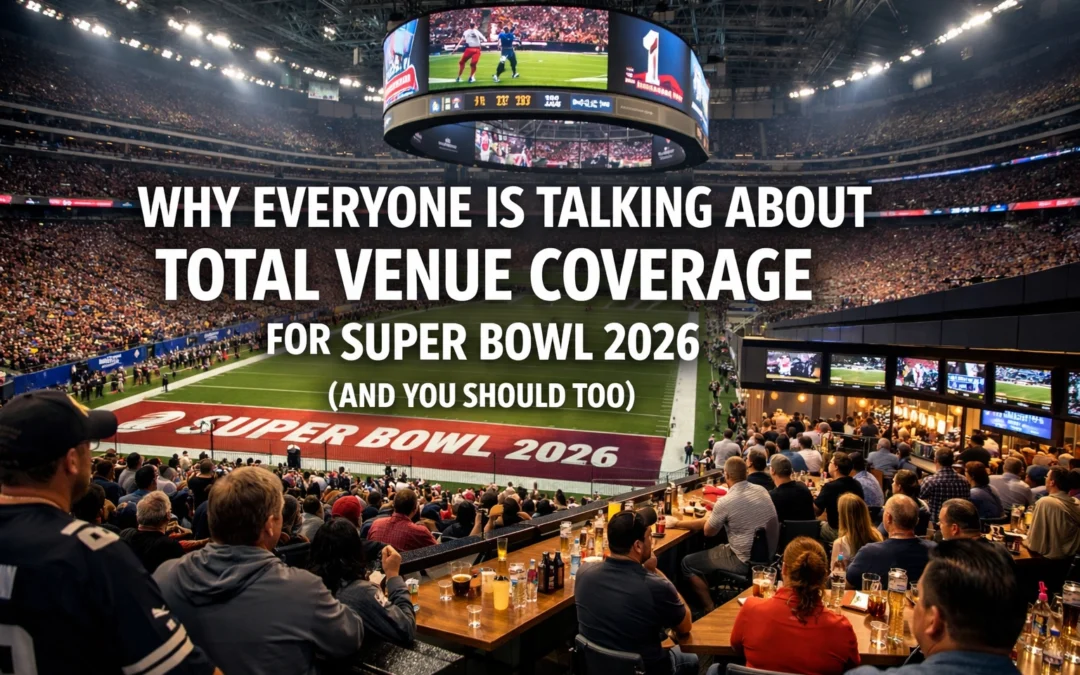
The landscape of sports advertising has reached a pivotal moment in 2026. As the dust settles from Super Bowl LX, the industry is analyzing the shift toward what experts call Total Venue Coverage. This strategy ensures that a brand presence is felt at every possible touchpoint within a sports environment, from the parking lot entrance to the physical floor graphics and the massive 4K video displays. OOH Sports has led this charge by leveraging 40 years of experience to transform how fans interact with advertisements during the most-watched sporting events on the planet.

The Evolution of the Big Game Environment
The 2026 championship game at Levi’s Stadium represented more than just a football game. It served as a showcase for a $200 million venue renovation designed specifically to handle the demands of modern digital out-of-home (DOOH) advertising. While the stadium typically holds 68,500 people, the capacity for this specific event was strategically adjusted to 65,000 to accommodate an unprecedented media footprint. Despite these adjustments, the actual attendance surged to 70,823, creating a high-density environment perfect for immersive brand messaging.
Total Venue Coverage is the practice of synchronizing every digital and physical asset within a stadium. This includes the massive 4K video boards, which now measure 48 feet tall by 200 feet wide, and the smaller, more intimate screens located in concourses and luxury suites. By integrating these assets, brands can create a narrative that follows a fan throughout their entire journey.
Forty Years of Advertising Leadership
Success in the high-stakes world of Super Bowl advertising does not happen by accident. It requires decades of institutional knowledge and a deep understanding of fan behavior. OOH Sports has spent 40 years refining the logistics of sports marketing. This history allows for a sophisticated approach to venue-wide coverage that goes beyond simple billboard placement.
In the early days, stadium advertising was limited to static signage and basic perimeter boards. Today, the approach is entirely digital and programmatic. This evolution has allowed OOH Sports to stay at the forefront of the industry, managing complex campaigns that require real-time updates and precision targeting. The focus has shifted from mere visibility to total dominance of the visual environment.

Strategy: From Floors to Billboards
The core of the 2026 strategy involved a "floor-to-ceiling" approach. This meant that a fan could not look in any direction without encountering a cohesive brand message.
- Floor Graphics and Ground-Level Assets: Utilizing high-traffic areas near concessions and entrances to place durable, eye-catching graphics.
- Concourse Digital Displays: Engaging fans while they move between the seating bowl and the amenities.
- Stadium Perimeter Targeting: Reaching the thousands of fans who gather outside the gates but do not have a ticket to the game.
- Massive 4K Video Boards: Capturing the attention of the entire stadium during breaks in play with high-definition creative content.
This comprehensive integration ensures that there are no "dead zones" in the advertising strategy. When a brand achieves Total Venue Coverage, the impact is cumulative. A fan sees a message on a billboard while parking, encounters it again on a floor graphic at the gate, and sees the full video execution on the 4K boards during the second quarter.
Technology and Infrastructure Upgrades
The technology behind Super Bowl 2026 was a major talking point for industry professionals. The installation of the largest 4K video boards in the NFL provided a canvas that was previously unimaginable. These boards allow for hyper-realistic creative that can be seen clearly from every seat in the house.
Furthermore, the shift toward programmatic DOOH has allowed brands to buy space with the same ease as digital web ads. According to recent industry reports, DOOH sports advertising is projected to hit $50 billion by 2030. This growth is driven by the ability to swap creative in real-time based on game events, such as a touchdown or a lead change.
https://www.youtube.com/watch?v=l6J-0zileKE
Programmatic DOOH and Real-Time ROI
The move away from traditional static sponsorships is accelerating. Media planners are increasingly shifting budgets toward digital assets that offer better measurement and flexibility. In fact, 67% of media planners are shifting their budgets toward sports DOOH by 2026.
The results of this shift are measurable and significant. For example, campaigns using programmatic DOOH have seen a 74% lift in purchase consideration for new product launches. Similar results were seen with Mike’s Hard Iced Tea, which experienced a 119% lift in positive brand image through a targeted DOOH campaign. These numbers prove that the high-tech infrastructure of modern stadiums is not just for show; it is a powerful engine for return on investment.

The Importance of Venue-Wide Synchronization
One of the biggest mistakes brands make is treating different ad units as isolated islands. Total Venue Coverage requires all assets to work in harmony. During the 2026 championship, the most successful brands used synchronized "takeovers." At specific moments, every screen in the stadium would display the same content, creating a massive, unavoidable brand moment.
This level of synchronization is only possible through platforms like the StackAdapt DSP, which allows for omnichannel management of stadium screens. By coordinating the message across 25,000 digital screens, advertisers can create an atmosphere that feels like a unified brand experience rather than a collection of random ads.
Challenges and Execution in 2026
Executing a Total Venue Coverage strategy is not without its challenges. The reduction in seat capacity to accommodate media meant that every remaining square foot of the stadium had to work harder. Logistics teams had to manage the installation of physical assets like floor graphics while ensuring that digital feeds remained stable under the massive bandwidth requirements of 4K video.
Additionally, the venue is preparing to host eight matches for the 2026 FIFA World Cup. This dual-hosting duty means the advertising infrastructure must be flexible enough to pivot between American football and international soccer. The investment in these upgrades ensures that the venue remains a premier destination for advertisers for years to come.

Why Traditional Sponsorships are Evolving
There is a growing debate in the marketing world: are traditional stadium sponsorships dead? While the traditional name-on-the-wall approach still has value, it is no longer enough to move the needle for major brands. The audience at the 2026 Super Bowl expected high-tech engagement.
Static signs do not offer data, and they cannot change in response to the game. In contrast, digital out-of-home assets allow for audience measurement, foot traffic attribution, and even brand lift studies. Brands that relied on Total Venue Coverage at the Super Bowl were able to track how many fans saw their ads and later visited a retail location or made a purchase online.
Logistics and Perimeter Targeting
A key component of Total Venue Coverage is reaching the "un-ticketed" fan. For every person inside the stadium, there are thousands more in the surrounding area celebrating at fan fests and tailgate parties. OOH Sports utilized stadium perimeter targeting to capture this secondary audience.
Mobile billboards, digital street furniture, and large-format screens in the surrounding entertainment districts ensured that the brand presence extended far beyond the stadium walls. This expanded the reach of the campaign from the 70,000 people inside the stadium to hundreds of thousands in the immediate vicinity.
Measuring the Impact of 2026 Campaigns
As the industry analyzes the data from February 2026, the success of Total Venue Coverage is clear. Campaigns that integrated both physical and digital assets saw higher levels of brand recall than those that used single-channel approaches. By utilizing AI-powered analytics, OOH Sports has been able to fix common measurement mistakes and provide advertisers with a clear picture of their performance.
The use of 4K video boards, floor graphics, and programmatic DOOH has set a new standard for sports marketing. As we look forward to the rest of 2026 and the upcoming World Cup matches, it is clear that Total Venue Coverage is no longer an optional luxury. It is the new baseline for brands that want to win on the biggest stages in sports.

Final Thoughts on the Future of Stadium OOH
The 2026 Super Bowl proved that the right combination of history, technology, and strategy can create an unforgettable brand experience. With 40 years of leadership in the space, OOH Sports continues to push the boundaries of what is possible in a stadium environment. The transition to a "floor-to-ceiling" model has changed the way fans interact with brands, making the advertisement as much a part of the event as the halftime show.
For brands looking to capture their share of the growing sports advertising market, the message is simple. Do not just show up to the game. Own the entire venue. From the billboards outside to the very floors fans walk on, Total Venue Coverage is the key to making a lasting impact in 2026 and beyond.